Have you tried with just a single pulse?
> On Oct 28, 2018, at 20:49, Dr. David Kirkby <[email protected]>
> wrote:
>
> I'm trying to do something which would seem conceptually easy, but I'm
> getting results I can't understand. I wish to measure the delay (in
> seconds) of a bit of length of coaxial cable.
>
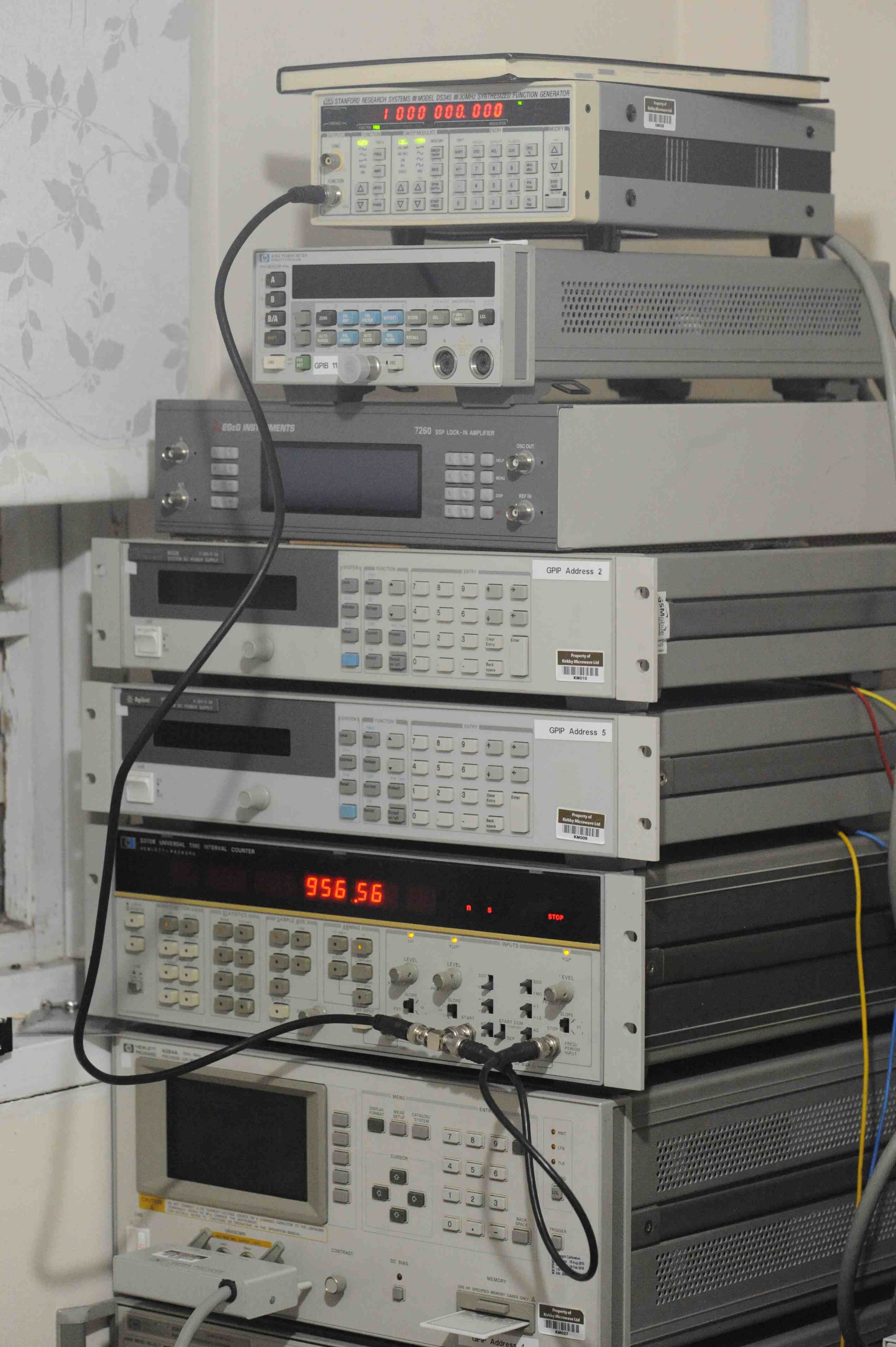
> I'm feeding a sine wave from a Stanford Research DS345 30 MHz function
> generator via a coax to the START input of the counter, then with a BNC
> T-piece, of 480 mm of 50 ohm cable to the STOP input of the counter. Here's
> a photo of the complete setup.
>
> https://www.kirkbymicrowave.co.uk/Experiments/Delay-of-coax/Path-is-signal-generator-to-start-then-stop.jpg
>
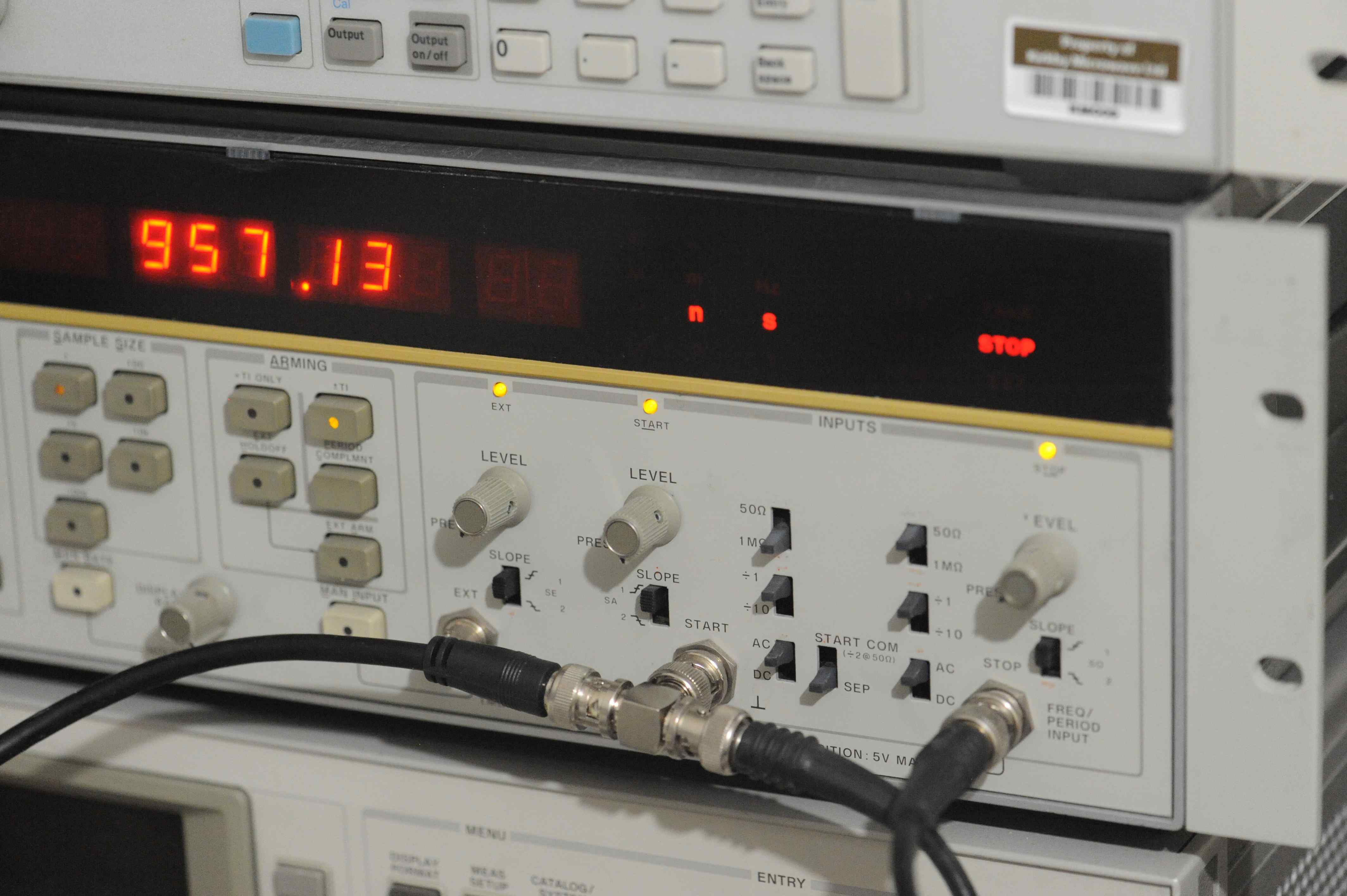
> I've set the 5370B's START impedance to be 1 M ohm, and the STOP to be 50
> ohms, so the function generator should see a 50 ohm load, as 1 M ohm in
> parallel with 50 ohms is virtually 50 ohms.
>
> The switch position on the counter are as shown here
>
> https://www.kirkbymicrowave.co.uk/Experiments/Delay-of-coax/switch-postitions.jpg
>
> So the main settings are
>
> * TI mode.
> * +/- TI
> * START. 1 M ohm, positive slope, level to preset position (0 V)
> * STOP 50 ohm, positive slope, level to preset position (0 V)
>
> With the cable 480 mm in length, the velocity factor of the cable being
> approximately 0.7, I would have expected an electrical length of around 686
> mm, and so a delay of
>
> time =  distance / velocity = 0.686 / 3e8
> = 2.29 ns.
>
> I would not be surprised by small changes in delay with frequency, which is
> what I wanted to investigate. But I'm getting the following readings, for
> different frequencies of the function generator
>
> 1 kHz - unstable readings, around 100~300 us.
> 10 kHz  -> -21.3 us
> 50 kHz -> -4.27 us
> 100 kHz -> -1.90 us
> 250 kHz -> - 528 ns
> 500 kHz -> 1.837 us
> 1 MHz -> 956 ns
> 2 MHz -> 490 ns
> 3 MHz -> -2.6 ns
> 4 MHz -> -0.33 ns
> 5 MHz -> 0.90 ns
> 6 MHz -> 1.50 ns
> 7 MHz -> 1.93 ns
> 8 MHz -> 2.15 ns
> 9 MHz -> 2.38 ns
> 10 MHz -> 2.52 ns
> 11 MHz -> 2.60 ns
> 20 MHz -> 2.85 ns
> 30 MHz -> 2.80 ns
>
> The numbers look believable  with a frequency input of 10 MHz or more. I
> did not do the complete set again, but using a cable of 1.53 m in length,
> where I would expect the delay to be around 7.29 ns, the results were
>
> 1 MHz  -> -26.51 ns
> 5 MHz -> 9.70 ns
> 10 MHz -> 9.70 ns
> 15 MHz -> -57.81 ns
> 20 MHz -> -41.64 ns
> 30 MHz -> 7.13 ns
>
> Note, the function generator and counter do not share a common frequency
> standard for this test. I have not tried it with them locked to the same 10
> MHz reference, but I somewhat doubt that is the cause of these issues.
>
> I must be missing something, but I'm not sure what it is.
>
> --
> Dr David Kirkby Ph.D C.Eng MIET
> Kirkby Microwave Ltd
> Registered office: Stokes Hall Lodge, Burnham Rd, Althorne, CHELMSFORD,
> Essex, CM3 6DT, United Kingdom.
> Registered in England and Wales as company number 08914892
> https://www.kirkbymicrowave.co.uk/
> Tel 01621-680100 / +44 1621-680100
> _______________________________________________
> time-nuts mailing list -- [email protected]
> To unsubscribe, go to
> http://lists.febo.com/mailman/listinfo/time-nuts_lists.febo.com
> and follow the instructions there.

_______________________________________________
time-nuts mailing list -- [email protected]
To unsubscribe, go to
http://lists.febo.com/mailman/listinfo/time-nuts_lists.febo.com
and follow the instructions there.