Hi, Guus

I did some test regarding the points you mentioned below, and yes, you’re
right, but some of points may need further adjusted:
1. The destination of IPv4 wouldn’t be changed, Yes I agree, that’s the goal
and final destination for the communication. But during the path, it may be
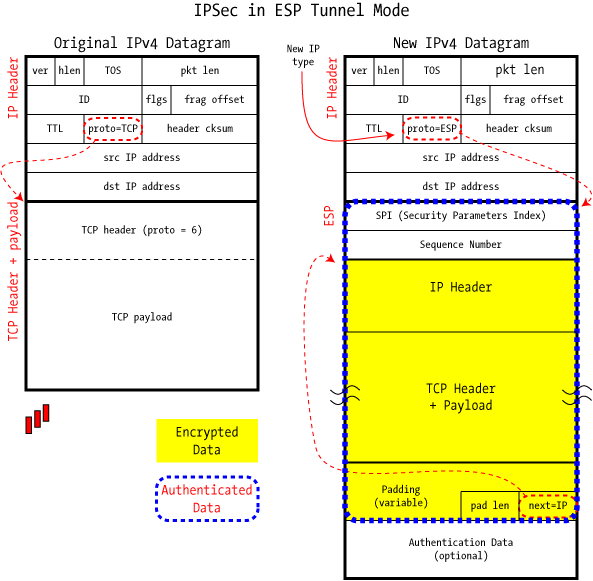
encapsulated into another packet(tunnel mode), where the outside IP header is
the physical address, but the inner destination remain unchanged, and I think
Tinc encapsulates into UDP packet, where the outside S/D IP is the physical
adapter IP address, but the whole original packet was encapsulated into the UDP
content part. Conceptually, it’s the same as IPSec site-to-site VPN:
http://www.unixwiz.net/images/IPSec-ESP-Tunnel-Mode.gif
<http://www.unixwiz.net/images/IPSec-ESP-Tunnel-Mode.gif>

2. Regarding the “via 10.0.0.3”, you’re right, it’s only for Ethernet ARP
resolution for the next hop. And after my test, my understanding is as below
for the routing part of Tinc:
        a. When tinc get up, the tun0 assigned an IP address by tinc-up, let’s
say 10.0.0.100/24, this will add an direct attached route into host’s route
table which appears as “10.0.0.0 255.255.255.0 tun0”, which is not deletable;
this route will enable traffic head to 10.0.0.0/24 will throw into the tun0
interface
        b. Also, if there’s any other traffic need to convey by tinc VPN, you
just add another route, for example: “ip route 8.8.8.8/32 dev tun0”, and
actually we don’t need to specify the via, since we only need throw the traffic
into tun0 interface.
        c. No matter for above a or b, when the traffic send to tun0, from the
tunnel’s perspective, the source IP will be 10.0.0.100(since routed through
this interface), and the destination IP will be the one I pinged, which is
8.8.8.8
        d. After above c, then the tinc need to figure out how to encapsulate
the original packet (S/10.0.0.100 > D/8.8.8.8) into the tunnel and send to the
other Tinc node. Then I guess Tinc will check “ADD_SUBNET” messages it received
from the ConnectTo node(learn the whole network), and try to encapsulate the
original packet into UDP packets, send to the node where its subnet of 8.8.8.8
is preferred(weight setting on Subnet)
        e. If Tinc configured by default, then the local host will try to send
UDP packet directly to the preferred host which advertise 8.8.8.8
        f. If IndirectData = yes configured everywhere, then the local host
will always encapsulate the UDP packet to the ConnectTo/aly_hk (No matter
8.8.8.8 is advertised or not), if aly_hk doesn’t advertise 8.8.8.8, it will
check it’s Tinc daemon, to see who advertised 8.8.8.8, and then encapsulate UDP
to him as the next step to relay

Interestingly, earlier I check the below post for my setup, but now I found,
the configuration can be simplified into, because tinc-up will make the
172.16.1.0/24 to $INTERFACE, and for those two default routes, the via is not
required as well:

#!/bin/sh
VPN_GATEWAY=172.16.1.1
ORIGINAL_GATEWAY=`ip route show | grep ^default | cut -d ' ' -f 2-5`

ip route add $REMOTEADDRESS $ORIGINAL_GATEWAY
ip route add $VPN_GATEWAY dev $INTERFACE
ip route add 0.0.0.0/1 via $VPN_GATEWAY dev $INTERFACE
ip route add 128.0.0.0/1 via $VPN_GATEWAY dev $INTERFACE

https://www.tinc-vpn.org/examples/redirect-gateway/
<https://www.tinc-vpn.org/examples/redirect-gateway/>


> On 3 May 2017, at 12:36 AM, Guus Sliepen <[email protected]> wrote:
>
> On Tue, May 02, 2017 at 09:53:15PM +0800, Bright Zhao wrote:
>
>> When tinc daemon get up on A(together with some manual scripts for
>> destination to 8.8.8.8), the route table looks like below:
>> 10.0.0.0/24 dev tun0
>> 10.0.0.3 dev tun0
>> 8.8.8.8 via 10.0.0.3 dev tun0
>
> IPv4 packets have only two addresses in their header: the source and the
> destination address. If you want to send a packet to 8.8.8.8, the
> destination address of the packet will always be 8.8.8.8, regardless of
> how it is forwarded via the network.
>
> Imagine that your local node would replace the destination address with
> 10.0.0.3, then the information about the final destination (8.8.8.8)
> would be lost.
>
> The "via 10.0.0.3" only has an effect on Ethernet networks. Ethernet
> doesn't know about IPv4 or IPv6, it only knows about MAC addresses. What
> "via 10.0.0.3" does is that when it has to send a packet to 8.8.8.8, it
> sets the IPv4 header's destination address to 8.8.8.8, but it sets the
> Ethernet header's destination address to the MAC address of the host
> which has the address 10.0.0.3. It figured out the last part by doing
> ARP resolution.
>
> It's perhaps a bit confusing that there is no error message when you try
> to add such a route, even though the "via 10.0.0.3" part doesn't do
> anything. It's just ignored for non-Ethernet networks. Also, on some
> (older) BSD platforms, you could not add a route to a "dev tun0", you
> could only identify interfaces by their IP address. So there the
> equivalent of "via" would have an effect, but also not the one you
> intended.
>
> --
> Met vriendelijke groet / with kind regards,
>     Guus Sliepen <[email protected]>
> _______________________________________________
> tinc mailing list
> [email protected]
> https://www.tinc-vpn.org/cgi-bin/mailman/listinfo/tinc
_______________________________________________
tinc mailing list
[email protected]
https://www.tinc-vpn.org/cgi-bin/mailman/listinfo/tinc