Mike Palij wrote:
> On Sat, 17 Jan 2009 11:05:37 -0500, Christopher D. Green wrote:
>
>> [Franklin] is one of the many
>> Philadelphian "auslanders" described in a fascinating (if somewhat
>> dated) book I'm now reading: /Puritan Boston and Quaker Philadelphia/
>> (E. Digby Baltzell, 1979)....
> I'll have to take a look at the book.  This sounds somewhat strange
> to me given that New York City (New Amsterdam) was basically a
> "company town" (i.e., founded for doing business) and would become
> the first capital of the U.S.
>
Up to 1760, New York was smaller than Boston. It only permanently passed
Philly in 1790:
http://academic.brooklyn.cuny.edu/history/burrows/demog.htm
It was only with the completion of the Erie Canal (1825) that New York
became a uniquely important port.
Before that, the best was to get stuff beyond the Adirondacks was
through New Orleans and up the Mississippi.
Why would you want to get stuff over the Adirondacks? Well, that was the
REAL point of the Revolution, to drive (bad) French Catholics and
Indians out of the Ohio River valley and make way for (good) English
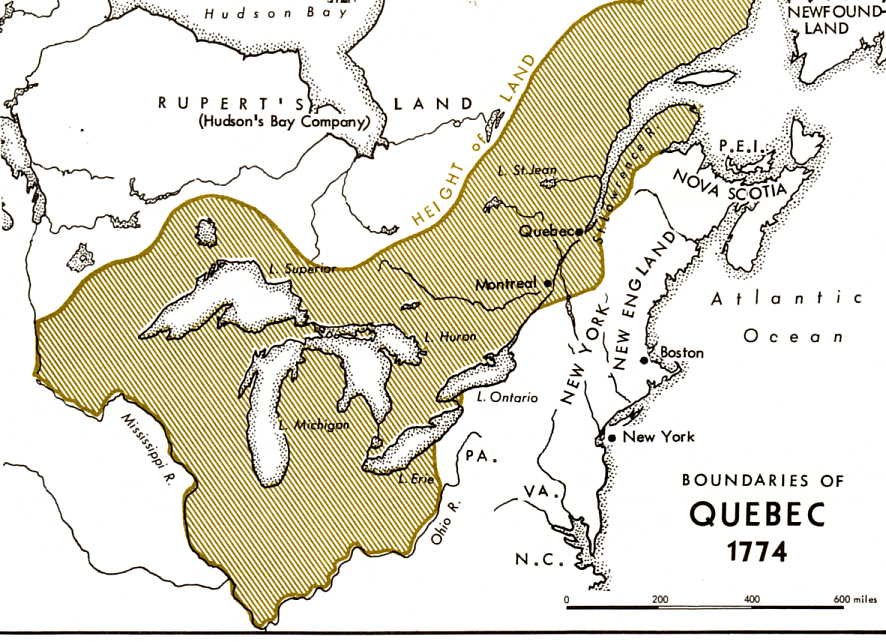
Protestants. But the Crown had already granted the Ohio River valley to
Quebec in the Quebec Act of 1774 (because the French Quebecers already
had well-established trade routes there, coming in from the north, which
was not blocked by mountains).
http://www.uppercanadahistory.ca/fn/fn3p1c.jpg
http://www.encyclopedia.com/topic/1774_Quebec_Act.aspx

 The Quebec Act was, of course, one of the "intolerable Acts" mentioned
in the "Declaration of War Upon the Infidels," oops, sorry the
"Declaration of Independence." Forget about stamps, tea, taxes,
representation, liberty, and all that rot. That was all just Fox-like
spin. It was about land, race, and religion.
Canadian version of the American Revolution endeth here. ;-)

As for NYC being the US capital, I think wikipedia sums up the situation
rather well: "Upon gaining independence, the Congress of the
Confederation was formed, and convened in Philadelphia until June 1783,
when a mob of angry soldiers converged upon Independence Hall, demanding
payment for their service during the American Revolutionary War.
Congress requested that John Dickinson, the governor of Pennsylvania,
call up the militia to defend Congress from attacks by the protesters.
In what became known as the Pennsylvania Mutiny of 1783, Dickinson
sympathized with the protesters and refused to remove them from
Philadelphia. As a result, Congress was forced to flee to Princeton, New
Jersey on June 21, 1783,^ and met in Annapolis and Trenton, before
ending up in New York City. The United States Congress was established
upon ratification of the United States Constitution in 1789. New York
City remained home to Congress until 1790,^ when the Residence Act was
passed to pave way for a permanent capital."
http://en.wikipedia.org/wiki/U.S._Capitol


> Make it a sundae.  With vanilla ice cream, hot fudge sauce, low-fat
> whipped cream, and a cherry on top.
>
>

"Peaceful, tolerant" Philly is playing dry, hard, cracked Arizona on TV
today in the "Bird Bowl."
Probably more like pizza and beer. :-)

Best,
Chris
--

Christopher D. Green
Department of Psychology
York University
Toronto, ON M3J 1P3
Canada


416-736-2100 ex. 66164
[email protected]
http://www.yorku.ca/christo/

==========================


---
To make changes to your subscription contact:

Bill Southerly ([email protected])