I believe the question was what happened to the curve if you went out to 30
km and a height of 5 km.  To compare with the curve of 2.8 km and a height
of 500m.  At 2.8 km there is a notch forming, already at -2.5 dB.  But the
notch is NOT at the ground.
If one pursues this tack,  assuming all prior statements of equations, and
definitions of boundaries are wholly appropriate and factual, then nothing
new will ever happen.  All things are discovered, nothing new will be
invented, and all problems are due to insufficient acquaintance with the
books.

Does it really matter what so and so defined to be the extent of far field?
 What end did that suit?  If you trust the math to be correct at a
particular distance and height, where does it become incorrect and should
not be used?  WHY should it not be used?  If the math skews off reality and
cannot be used at 30 km, WHY can it not be used?  What is the physical
nature of the disconnect?  Why doesn't the equation follow reality?  Does
the equation need adjustment to include 30 km distance?

Perhaps one cannot properly state INCLUSIVE pattern without specifying
distance of measurement

73, Guy.

On Wed, Oct 10, 2012 at 10:34 AM, Richard Fry <[email protected]> wrote:

> According to antenna engineering textbooks (Kraus, Balanis. Johnson &
> Jasik etc), the free space, far-field radiation pattern is not a function
> of the distance from the radiator, as it is in the near field.  The
> near-field/far-field boundary conventionally is defined as equal to
> 2L^2/lambda, where L = the greatest physical dimension of the radiator.  So
> for a 1/4-wave monopole on 160 meters, that boundary would be located about
> 20.25 meters from the radiator.
>
> Unfortunately NEC software did not follow this convention, which may lead
> to some confusion.
>
> For example, the surface wave fields calculated by NEC are defined by NEC
> as "near field" even when the calculation was made in the far field
> according to the equation above.
>
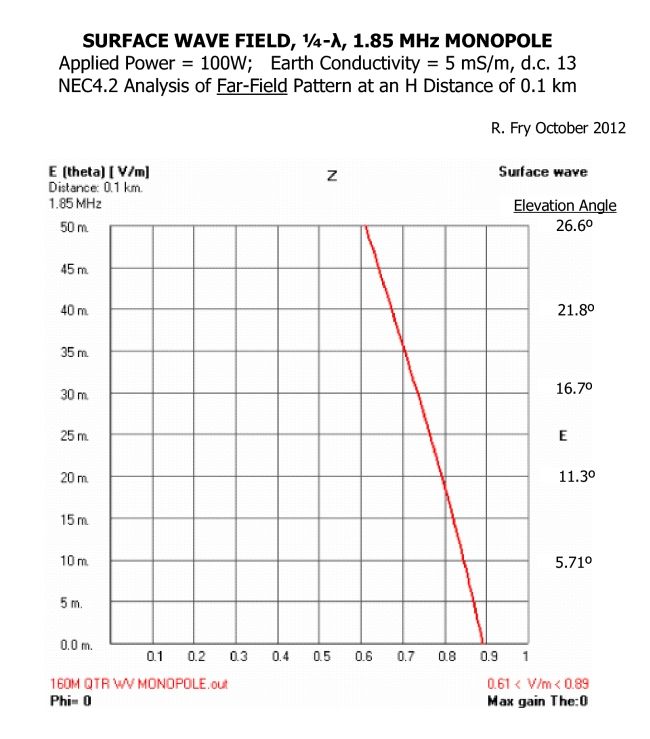
> The link below leads to a NEC surface-wave analysis of a 160m monopole at
> an H distance of 0.1 km, or about 5X greater than the near-field boundary.
>
> It will be seen that:
>
> 1) The greatest field is radiated in the horizontal plane.
>
> 2) The field radiated toward low elevation angles is greater than the
> field at elevations at/around the "takeoff angle" described in a NEC or
> textbook far-field pattern over real earth.
>
> Of interest also is that the maximum field (0.89 V/m) shown in this
> analysis for earth = 5 mS/m, dc 13 is 89.9% of the field that would be
> generated over a perfect ground plane (0.99 V/m).
>
> This analysis further develops those in the Topband thread "Skywaves from
> Monopole Surface Waves."
>
> http://i62.photobucket.com/**albums/h85/rfry-100/160m_**
> Monopole_ElPat_at_1km.jpg<http://i62.photobucket.com/albums/h85/rfry-100/160m_Monopole_ElPat_at_1km.jpg>
> ______________________________**_________________
> Remember the PreStew coming on October 20th.  http://www.kkn.net/stew for
> more info.
>
_______________________________________________
Remember the PreStew coming on October 20th.  http://www.kkn.net/stew for more
info.