Perhaps a better definition of far field is the point of increasing
distance where the shape of a pattern calculated by a  near field process
quits changing at angles and azimuths of concern.
Let's test this idea using the NEC4 near field table generator.  We will
not change processes, using the near field table generator exclusively.  We
find that the ultimate shape, particularly the notch,  is not even close to
being formed at 3 km.  With increasing distance, the shape very gradually
morphs into the familiar deep notch at 0.2 degrees, finally equaling the
far field plot value out around 50 km.

We will run NEC4 near field calculations on a 1/4 wave radiator with 120
buried 0.4 wavelength radials at 1.825 MHz, soil char of (5, .13).  Even at
30 (thirty) km the depth of the notch near ground is still increasing.  The
notch relative to pattern max (highest reading at that distance and any
elevation)  is -23.71 dB.  At 31 km this figure is -24.04 dB.

At 3 km, seemingly considered far field by listening to posts here, this
"notch", really a gentle bow at this point, is a mere -3.46 dB, only a hint
of the depth of the ultimate notch.  At 10 km the notch is much deeper at
-12.13 dB, but still far away from the ultimate value.  Remember this is
the NEAR field process generating these figures.

At 50 km out the minimum at 100m height is -28.69 dB  below the max value
at 17 km height, with the pattern of values up to elevation 50 km looking
very much like the familiar FAR field process pattern plot which
coincidentally has a value of -28.93 dB below max at 0.2 degrees elevation.

So it will make no sense to say that near field generated values should be
added to far field values at very low angles because far field doesn't
compute them.  Near field doesn't either.

If given enough room to work, the NEAR field generation will show the same
notch.  The problem all along has been 3 km is nowhere near far enough away
to complete whatever accounts for the notching.

OR perhaps the NEC4 near field process has a really serious unpublished
flaw or weakness?  Or ???  Maybe the equations in the books were done for
ground wave and standing-man-with-meter, and are in fact approximations
themselves, and only really apply to sky wave in special circumstances
which hams mostly don't care about?  Or maybe the equations are right and
no one tried them out 50 km, and just assumed that 3 km is far enough?

Measurements of actual reality?  Done at distances and altitude to confirm
at least the progressive deepening of the notch?

Sitting-man-with-meter-in helicopter would have to remove to a distance of
50 km and descend from an altitude of 17 km to confirm the presence of the
notch at that ratio to maximum which matches the far field plot notch
depth.  Practically he would have to come in quite a bit so the altitude
with predicted max signal was within the normal achievable altitude of the
helicopter.   Not sure there is anything around that hovers at a particular
GPS point up at flight level 56

Far field is the point of increasing distance where the shape of a pattern
calculated by a  near field process quits changing at elevations and
azimuths of concern.

73, Guy.


On Thu, Oct 11, 2012 at 8:11 AM, Tom W8JI <[email protected]> wrote:

>  According to antenna engineering textbooks (Kraus, Balanis. Johnson &
>> Jasik etc), the free space, far-field radiation pattern is not a function
>> of the distance from the radiator, as it is in the near field.  The
>> near-field/far-field boundary conventionally is defined as equal to
>> 2L^2/lambda, where L = the greatest physical dimension of the radiator. So
>> for a 1/4-wave monopole on 160 meters, that boundary would be located about
>> 20.25 meters from the radiator.
>>
>
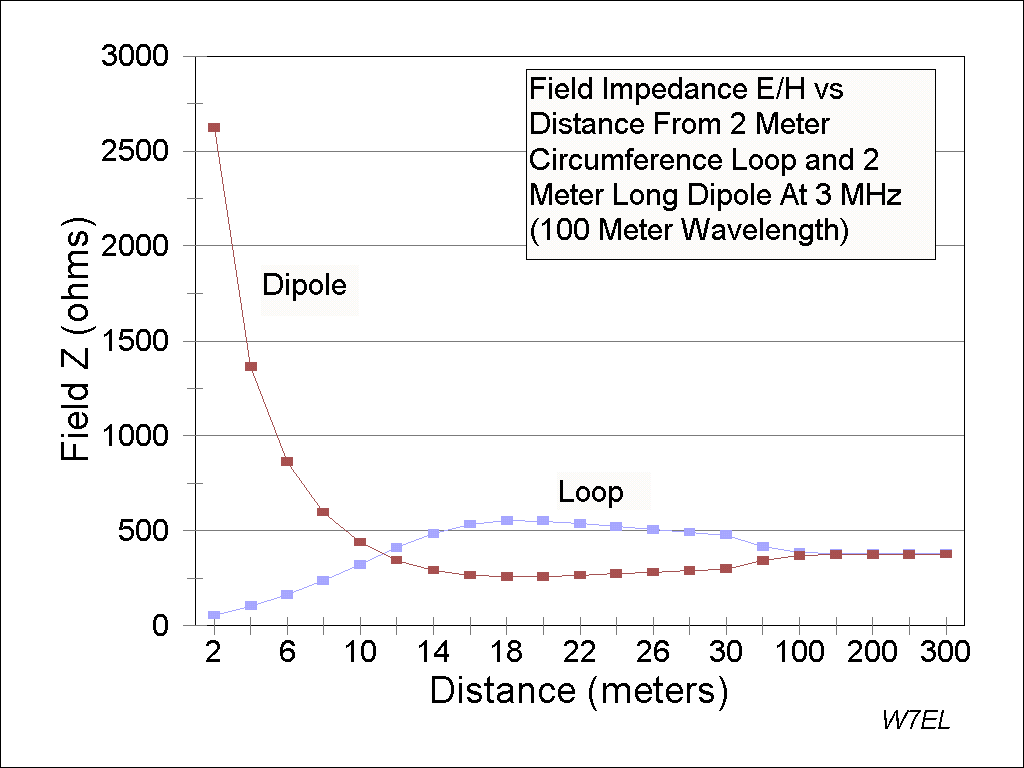
> The boundary is around 1 wavelength minimum even for a very small antenna,
> like a "magnetic" loop. As a matter of fact a small magnetic loop is
> electric field response dominant at a distance of about 1/8th wave from the
> antenna outward to about 1 wavelength.
>
> http://www.w8ji.com/images/**emfield.gif<http://www.w8ji.com/images/emfield.gif>
>
> Page 341 of Jordon and Balmain ( as with other EM radiator texts) define
> farfield boundary as a distance "large with respect to a wavelength and
> also large with respect to the largest dimension of the source". A
> wavelength is safe for a small antenna, but not a large system. My 4 square
> on 160 still behaves slightly like nearfield at a distance of two
> wavelengths, but my 200 foot omni vertical is settled down about 1
> wavelength away.
>
> 73 Tom
>
>
>
>
>
> ______________________________**_________________
> Remember the PreStew coming on October 20th.  http://www.kkn.net/stew for
> more info.
>
_______________________________________________
Remember the PreStew coming on October 20th.  http://www.kkn.net/stew for more
info.