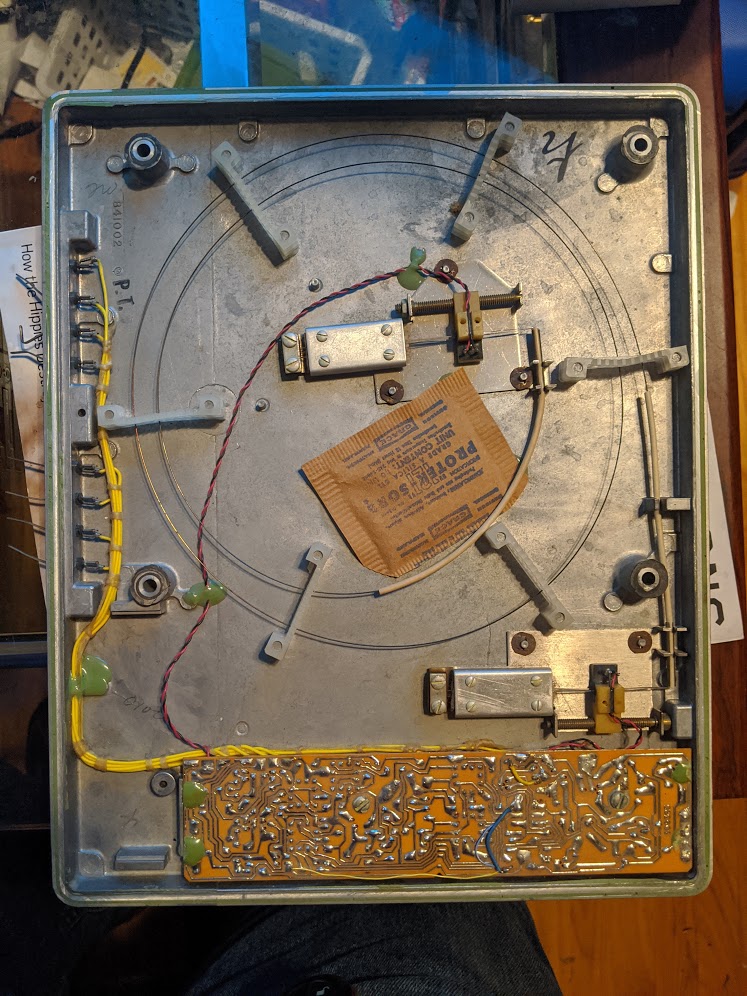
From context I figured it was sending mechanical sound impulses along the wire.
I think it would be a fun demonstration to do a storage like that but in free
space, with a speaker and a microphone at a TriEmbed meeting.

Tadd --- Sent from Planet X

> On Aug 10, 2020, at 1:00 PM, Gregg Tracton via TriEmbed
> <[email protected]> wrote:
>
>
>
> how does this delay circuit work?
> is it just using the fact that signals flow down lines at 1’ per nanosecond,
> so a 50’ length delays for 50 ns?
>
> -g
>
>> On Mon, Aug 10, 2020 at 9:40 AM Rodney Radford via TriEmbed
>> <[email protected]> wrote:
>> This is the first time I have seen another one - thanx for the photo and the
>> back story. If you find the patent number, I would be interested in seeing
>> it.
>>
>> After watching someone interface an Arduino to core memory at the virtual
>> computer festival, I wondered how difficult it would be to interface an
>> Arduino to this delay line. Mine has 12v stamped on the board, so that gives
>> me some hint as to voltages, and the electronics on the board is simple, so
>> should be possible to sketch out a schematic of the read and write circuits.
>>
>>
>>> On Mon, Aug 10, 2020 at 3:10 AM Robert Mackie <[email protected]> wrote:
>>> Rodney,
>>>
>>> Oddly enough, I see the photos attached.
>>>
>>> re:  a mechanical delay line
>>>
>>> My dad worked for IBM way back in the day, as an electrical engineer.
>>>
>>> He left me copies of a few of the patents on which he was listed as an
>>> inventor. One of them is exactly such a device, used at the edge of
>>> telephone switching networks (I think - edge of some network anyway) to
>>> hold state. Much cheaper than core memory for the time, and could hold 2048
>>> bits, with a latency of something like 50ms. Somewhere I have the paperwork
>>> for the patent application. Now I'm curious if it was a refinement or the
>>> first of its type. Never thought about it before.
>>>
>>> But this is one where he had kept a physical example, one they had to cut
>>> open during testing. I knew exactly where it was so I just snapped a photo
>>> with my phone:
>>>
>>> http://mackies.org/mechanical_delay_line_dynamic_memory_ibm.jpg
>>>
>>> Figured it would be interesting to see and compare.
>>>
>>> Rob.
>>>
>>>> On Sun, Aug 9, 2020 at 6:14 PM Rodney Radford via TriEmbed
>>>> <[email protected]> wrote:
>>>> Nevermind, the photos 440k were deemed too large to be sent by the
>>>> TriEmbed server.
>>>>
>>>> Sorry you will not be able to see them.
>>>>
>>>>
>>>>> On Sun, Aug 9, 2020 at 5:38 PM Rodney Radford <[email protected]>
>>>>> wrote:
>>>>> I forgot to include the photos...
>>>>>
>>>>>
>>>>>> On Sun, Aug 9, 2020 at 5:37 PM Rodney Radford <[email protected]>
>>>>>> wrote:
>>>>>> One of the passions I have put time in the last few months are
>>>>>> collecting and learning about old vintage computers.
>>>>>>
>>>>>> I currently have:
>>>>>> * IMSAI S-100 system
>>>>>> * Sol-20 S-100 system
>>>>>> * TRS-80 Model 1 and 4p
>>>>>> * Two Apple IIe systems
>>>>>> * Kaypro 10 luggable system
>>>>>> * TI 99/4
>>>>>>
>>>>>> I used to have a much larger collection including
>>>>>> * Burroughs L5000 (google about that beast)
>>>>>> * TRS-80 Model 2, 3 and 4
>>>>>> * Zerox CP/M system (I think I still have it, but can't find it)
>>>>>> * Pet Commodore 2001 (loaned to a 'friend' - never got it back)
>>>>>> * several Apollo systems
>>>>>>
>>>>>> While I wish I could have kept all the old systems, it just was not
>>>>>> possible due to storage space constraints.
>>>>>>
>>>>>> Back in highschool, a teacher gave me her old 4-function Singer (yes,
>>>>>> the sewing machine) calculator. I, of course, took it apart... ;-)
>>>>>>
>>>>>> I did keep two parts from the calculator - the keyboard (mechanica
>>>>>> marvel) and the storage device (a mechanical delay line).
>>>>>>
>>>>>> When I first looked inside, I saw the aluminum box with the words read
>>>>>> amp and write amp on it, and I *knew* I had found core memory. Then I
>>>>>> opened it and was completely surprised with what I found. It is a
>>>>>> magnetostrictive delay line memory device - memory was stored by
>>>>>> twisting the wire at one end, and the twist would propogate through the
>>>>>> long coil and out at the other end. By varying the direction of the
>>>>>> twist, data could be stored temporarily, and it was then sent back in
>>>>>> again for storage again.
>>>>>>
>>>>>> The other item I kept from the calculator was the keyboard. On each
>>>>>> keypress, the key was decoded with gears and levers that move magnets
>>>>>> over reed relays - as that was more economical than a simple electronic
>>>>>> keyboard decoder.
>>>>>>
>>>>>> Here is a link to information about the calculator (and some info on the
>>>>>> delay line):
>>>>>>
>>>>>> https://www.oldcalculatormuseum.com/friden1160.html
>>>>>>
>>>>>> Photos included of the delay line and keyboard. If we were meeting in
>>>>>> person Monday, I would have brought them out for show and tell.
>>>>>> I also really enjoyed the virtual vintage computer festival I mentioned
>>>>>> earlier. Some really good talks on that, and my first of four books I
>>>>>> ordered arrived today - the ENIAC Technical Reference manual, as written
>>>>>> by one of the first female programmers on it.
>>>>>>
>>>>>> PS: If you have any old systems that need a home let me know. I really
>>>>>> should have grabbed the TRS-80 Model 100 that I brought last year that
>>>>>> was given to the club, but I let someone else take it (any idea who
>>>>>> grabbed it?)
>>>>>>
>>>>>> Anyway, back to current time where I need to finish up an IoT device for
>>>>>> work... ;-)
>>>>>>
>>>> _______________________________________________
>>>> Triangle, NC Embedded Computing mailing list
>>>>
>>>> To post message: [email protected]
>>>> List info: http://mail.triembed.org/mailman/listinfo/triembed_triembed.org
>>>> TriEmbed web site: http://TriEmbed.org
>>>> To unsubscribe, click link and send a blank message:
>>>> mailto:[email protected]?subject=unsubscribe
>>>>
>> _______________________________________________
>> Triangle, NC Embedded Computing mailing list
>>
>> To post message: [email protected]
>> List info: http://mail.triembed.org/mailman/listinfo/triembed_triembed.org
>> TriEmbed web site: http://TriEmbed.org
>> To unsubscribe, click link and send a blank message:
>> mailto:[email protected]?subject=unsubscribe
>>
> --
> Gregg Tracton: tired, retired & inappropriately unattired (PJ's)
> _______________________________________________
> Triangle, NC Embedded Computing mailing list
>
> To post message: [email protected]
> List info: http://mail.triembed.org/mailman/listinfo/triembed_triembed.org
> TriEmbed web site: http://TriEmbed.org
> To unsubscribe, click link and send a blank message:
> mailto:[email protected]?subject=unsubscribe
>
_______________________________________________
Triangle, NC Embedded Computing mailing list

To post message: [email protected]
List info: http://mail.triembed.org/mailman/listinfo/triembed_triembed.org
TriEmbed web site: http://TriEmbed.org
To unsubscribe, click link and send a blank message:
mailto:[email protected]?subject=unsubscribe