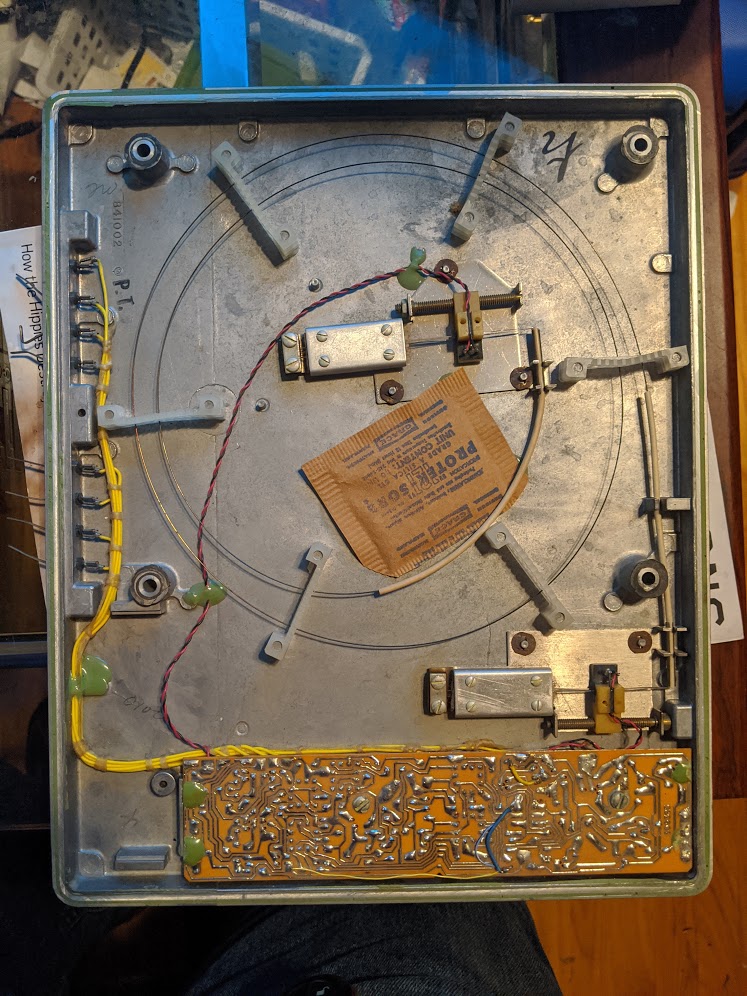
this is fascinating, in that the original designs used mercury and sound!
although I'm not sure what a "twist torque pulse" is...
> Ragen's solution to this problem was to leverage technology used in early
computers (from the late 1940's through early '50's) to store the content
of the working registers of the calculator. Before the advent of
ferrite-core magnetic memory devices, one particular means of storage for
electronic computers used long narrow tubes filled with Mercury with a
transducer at each end. The bits of data took the form of sonic
disturbances created by the transducer at one end of the tube. These
disturbances propogated through the mercury at a fixed rate. The bits were
sent through the mercury a bit at a time in serial fashion, and were
constantly re-circulated through the tube like a big shift-register. When
bits were needed, they were siphoned off by a transducer which converted
the acoustical pulses to pulses of electrical energy, which were amplified
and sent into the arithmetic unit bit at a time, where the appropriate
operations were performed and the results pushed back into the bitstream
circulating through the Mercury.
> The 130 uses a similar method, but rather than using exotic (and
poisonous) materials like Mercury, a carefully-selected type of wire made
of an alloy of Nickel, Iron, and Chromium (with a trade name of Ni-Span C )
is used that holds the bits as tiny twists (torque variations) in the wire
that move along it from one end to the other. The phenomenon is much like
the wave that travels down a length of rope when you quickly whip one end
of the rope. A transducer at one end of the wire places a twisting torque
pulse on the wire which travels through the wire and is registered at the
other end by a similar transducer. By continuously circulating these torque
pulses through the wire, the wire becomes the storage medium for the bits,
and far less circuitry is required to maintain all of the bits that the
machine needs to operate. In the Friden 130, the delay line takes the form
of a number of circular spirals, arranged in two layers, that, if unwound,
would be about *approximately 47 feet in length*. A torque pulse entering
at one end of the wire will come out the other end in *approximately 5
milliseconds* (specified as 4.95 milliseconds +/- 0.1 millisecond), or
stated otherwise, it takes about about 5/1000ths of a second for a pulse to
make its way from one end of the delay wire to the other. The wire is
carefully suspended by six supports with silicone rubber pads to support
the wire while minimizing the dampening of the torque pulses. The wire was
arranged in two spiral layers so that both the transmitter and receiver
transducers can be located outside the spirals. The delay line,
transducers, and support structure are contained inside a metal enclosure
that takes up most of the bottom part of the chassis of the calculator. The
engineering of the delay line was very complex, and for those that are
interested in this technology, the engineering process was thoroughly
documented in an internal Friden Engineering Report
<https://www.oldcalculatormuseum.com/d-f130dleng.html> published in June of
1964.

On Mon, Aug 10, 2020 at 1:50 PM Rodney Radford <[email protected]> wrote:

> Robert is correct - it works by twisting the wire, and has a period of
> about 3-4 milliseconds.
>
> There is a good description of it here and an engineering drawing of the
> actuating device:
>
> https://www.oldcalculatormuseum.com/friden130.html
>
> On Mon, Aug 10, 2020 at 1:09 PM Robert Mackie <[email protected]> wrote:
>
>> I don't think it works at nanosecond speeds. More like milliseconds
>>
>> The wire is physically twisted by an actuator, and the physical twist
>> moves down the wire at a predictable rate, like a bend in a jump rope when
>> you jerk one handle.
>>
>> At the other end is a sensor that reads the twist and reapplies it to the
>> actuator. (Refreshing the values on the medium constantly as the arrive at
>> the end of the physical wire) This holds memory in the dynamic physical
>> state of the medium.  A read action waits for the right segment of time
>> (address) to happen and reads out the twist state. A write action waits for
>> the correct address to arrive and then does NOT repeat the input but
>> actuates according to the value to be written.
>>
>> The unit I showed had an 8 bit register with 8 externalized wires. Send
>> write, send address, send value. Wait for indication of successful write.
>>
>> Send read, send address, wait for indication of successful read,
>> acknowledge, take 8 bits off interface. Or something very close to that.
>>
>> Rob
>>
>> On Mon, Aug 10, 2020, 1:00 PM Gregg Tracton <[email protected]> wrote:
>>
>>>
>>> how does this delay circuit work?
>>> is it just using the fact that signals flow down lines at 1’ per
>>> nanosecond, so a 50’ length delays for 50 ns?
>>>
>>> -g
>>>
>>> On Mon, Aug 10, 2020 at 9:40 AM Rodney Radford via TriEmbed <
>>> [email protected]> wrote:
>>>
>>>> This is the first time I have seen another one - thanx for the photo
>>>> and the back story. If you find the patent number, I would be interested in
>>>> seeing it.
>>>>
>>>> After watching someone interface an Arduino to core memory at the
>>>> virtual computer festival, I wondered how difficult it would be to
>>>> interface an Arduino to this delay line. Mine has 12v stamped on the board,
>>>> so that gives me some hint as to voltages, and the electronics on the board
>>>> is simple, so should be possible to sketch out a schematic of the read and
>>>> write circuits.
>>>>
>>>>
>>>> On Mon, Aug 10, 2020 at 3:10 AM Robert Mackie <[email protected]> wrote:
>>>>
>>>>> Rodney,
>>>>>
>>>>> Oddly enough, I see the photos attached.
>>>>>
>>>>> re:  a mechanical delay line
>>>>>
>>>>> My dad worked for IBM way back in the day, as an electrical engineer.
>>>>>
>>>>> He left me copies of a few of the patents on which he was listed as an
>>>>> inventor. One of them is exactly such a device, used at the edge of
>>>>> telephone switching networks (I think - edge of some network anyway) to
>>>>> hold state. Much cheaper than core memory for the time, and could hold
>>>>> 2048
>>>>> bits, with a latency of something like 50ms. Somewhere I have the
>>>>> paperwork
>>>>> for the patent application. Now I'm curious if it was a refinement or the
>>>>> first of its type. Never thought about it before.
>>>>>
>>>>> But this is one where he had kept a physical example, one they had to
>>>>> cut open during testing. I knew exactly where it was so I just snapped a
>>>>> photo with my phone:
>>>>>
>>>>> http://mackies.org/mechanical_delay_line_dynamic_memory_ibm.jpg
>>>>>
>>>>> Figured it would be interesting to see and compare.
>>>>>
>>>>> Rob.
>>>>>
>>>>> On Sun, Aug 9, 2020 at 6:14 PM Rodney Radford via TriEmbed <
>>>>> [email protected]> wrote:
>>>>>
>>>>>> Nevermind, the photos 440k were deemed too large to be sent by the
>>>>>> TriEmbed server.
>>>>>>
>>>>>> Sorry you will not be able to see them.
>>>>>>
>>>>>>
>>>>>> On Sun, Aug 9, 2020 at 5:38 PM Rodney Radford <[email protected]>
>>>>>> wrote:
>>>>>>
>>>>>>> I forgot to include the photos...
>>>>>>>
>>>>>>>
>>>>>>> On Sun, Aug 9, 2020 at 5:37 PM Rodney Radford <[email protected]>
>>>>>>> wrote:
>>>>>>>
>>>>>>>> One of the passions I have put time in the last few months are
>>>>>>>> collecting and learning about old vintage computers.
>>>>>>>>
>>>>>>>> I currently have:
>>>>>>>> * IMSAI S-100 system
>>>>>>>> * Sol-20 S-100 system
>>>>>>>> * TRS-80 Model 1 and 4p
>>>>>>>> * Two Apple IIe systems
>>>>>>>> * Kaypro 10 luggable system
>>>>>>>> * TI 99/4
>>>>>>>>
>>>>>>>> I used to have a much larger collection including
>>>>>>>> * Burroughs L5000 (google about that beast)
>>>>>>>> * TRS-80 Model 2, 3 and 4
>>>>>>>> * Zerox CP/M system (I think I still have it, but can't find it)
>>>>>>>> * Pet Commodore 2001 (loaned to a 'friend' - never got it back)
>>>>>>>> * several Apollo systems
>>>>>>>>
>>>>>>>> While I wish I could have kept all the old systems, it just was not
>>>>>>>> possible due to storage space constraints.
>>>>>>>>
>>>>>>>> Back in highschool, a teacher gave me her old 4-function Singer
>>>>>>>> (yes, the sewing machine) calculator. I, of course, took it apart...
>>>>>>>> ;-)
>>>>>>>>
>>>>>>>> I did keep two parts from the calculator - the keyboard (mechanica
>>>>>>>> marvel) and the storage device (a mechanical delay line).
>>>>>>>>
>>>>>>>> When I first looked inside, I saw the aluminum box with the words
>>>>>>>> read amp and write amp on it, and I *knew* I had found core
>>>>>>>> memory. Then I opened it and was completely surprised with what I
>>>>>>>> found. It is a magnetostrictive delay line memory device - memory was
>>>>>>>> stored by twisting the wire at one end, and the twist would propogate
>>>>>>>> through the long coil and out at the other end. By varying the
>>>>>>>> direction of
>>>>>>>> the twist, data could be stored temporarily, and it was then sent back
>>>>>>>> in
>>>>>>>> again for storage again.
>>>>>>>>
>>>>>>>> The other item I kept from the calculator was the keyboard. On each
>>>>>>>> keypress, the key was decoded with gears and levers that move magnets
>>>>>>>> over
>>>>>>>> reed relays - as that was more economical than a simple electronic
>>>>>>>> keyboard
>>>>>>>> decoder.
>>>>>>>>
>>>>>>>>
>>>>>>>> Here is a link to information about the calculator (and some info
>>>>>>>> on the delay line):
>>>>>>>>
>>>>>>>>
>>>>>>>> https://www.oldcalculatormuseum.com/friden1160.html
>>>>>>>> <https://www.oldcalculatormuseum.com/friden1160.html?fbclid=IwAR1jtFCm3O_oRCn_hLop43h5fNOtefDedwSv1hVtzH7vUv_TSvCC4qqGjEs>
>>>>>>>>
>>>>>>>>
>>>>>>>> Photos included of the delay line and keyboard. If we were meeting
>>>>>>>> in person Monday, I would have brought them out for show and tell.
>>>>>>>>
>>>>>>>> I also really enjoyed the virtual vintage computer festival I
>>>>>>>> mentioned earlier. Some really good talks on that, and my first of four
>>>>>>>> books I ordered arrived today - the ENIAC Technical Reference manual,
>>>>>>>> as
>>>>>>>> written by one of the first female programmers on it.
>>>>>>>>
>>>>>>>>
>>>>>>>> PS: If you have any old systems that need a home let me know. I
>>>>>>>> really should have grabbed the TRS-80 Model 100 that I brought last
>>>>>>>> year
>>>>>>>> that was given to the club, but I let someone else take it (any idea
>>>>>>>> who
>>>>>>>> grabbed it?)
>>>>>>>>
>>>>>>>>
>>>>>>>> Anyway, back to current time where I need to finish up an IoT
>>>>>>>> device for work... ;-)
>>>>>>>>
>>>>>>>>
>>>>>>>> _______________________________________________
>>>>>> Triangle, NC Embedded Computing mailing list
>>>>>>
>>>>>> To post message: [email protected]
>>>>>> List info:
>>>>>> http://mail.triembed.org/mailman/listinfo/triembed_triembed.org
>>>>>> TriEmbed web site: http://TriEmbed.org
>>>>>> To unsubscribe, click link and send a blank message: mailto:
>>>>>> [email protected]?subject=unsubscribe
>>>>>>
>>>>>> _______________________________________________
>>>> Triangle, NC Embedded Computing mailing list
>>>>
>>>> To post message: [email protected]
>>>> List info:
>>>> http://mail.triembed.org/mailman/listinfo/triembed_triembed.org
>>>> TriEmbed web site: http://TriEmbed.org
>>>> To unsubscribe, click link and send a blank message: mailto:
>>>> [email protected]?subject=unsubscribe
>>>>
>>>> --
>>> Gregg Tracton: tired, retired & inappropriately unattired (PJ's)
>>>
>>

--
Gregg Tracton: tired, retired & inappropriately unattired (PJ's)
_______________________________________________
Triangle, NC Embedded Computing mailing list

To post message: [email protected]
List info: http://mail.triembed.org/mailman/listinfo/triembed_triembed.org
TriEmbed web site: http://TriEmbed.org
To unsubscribe, click link and send a blank message:
mailto:[email protected]?subject=unsubscribe