Michael Everson wrote at 8:27 PM on Friday, December 26, 2003:

>No student of writing systems classes the "Gaelic
>script" as something different from "Latin script". The same cannot
>be said of Phoenician, Samaritan, and Hebrew, for instance.
It depends, of course, on what you mean by "something different".

If you have glyph variation in mind then there are, naturally,
differences; if you mean they are different writing systems then no, they
are not; and contra your assertion, I know of NO student of ancient
writing systems who would claim that these are different writing systems
(in the Unicode sense of the phrase, which I presume we are talking about
here). Can you cite one?

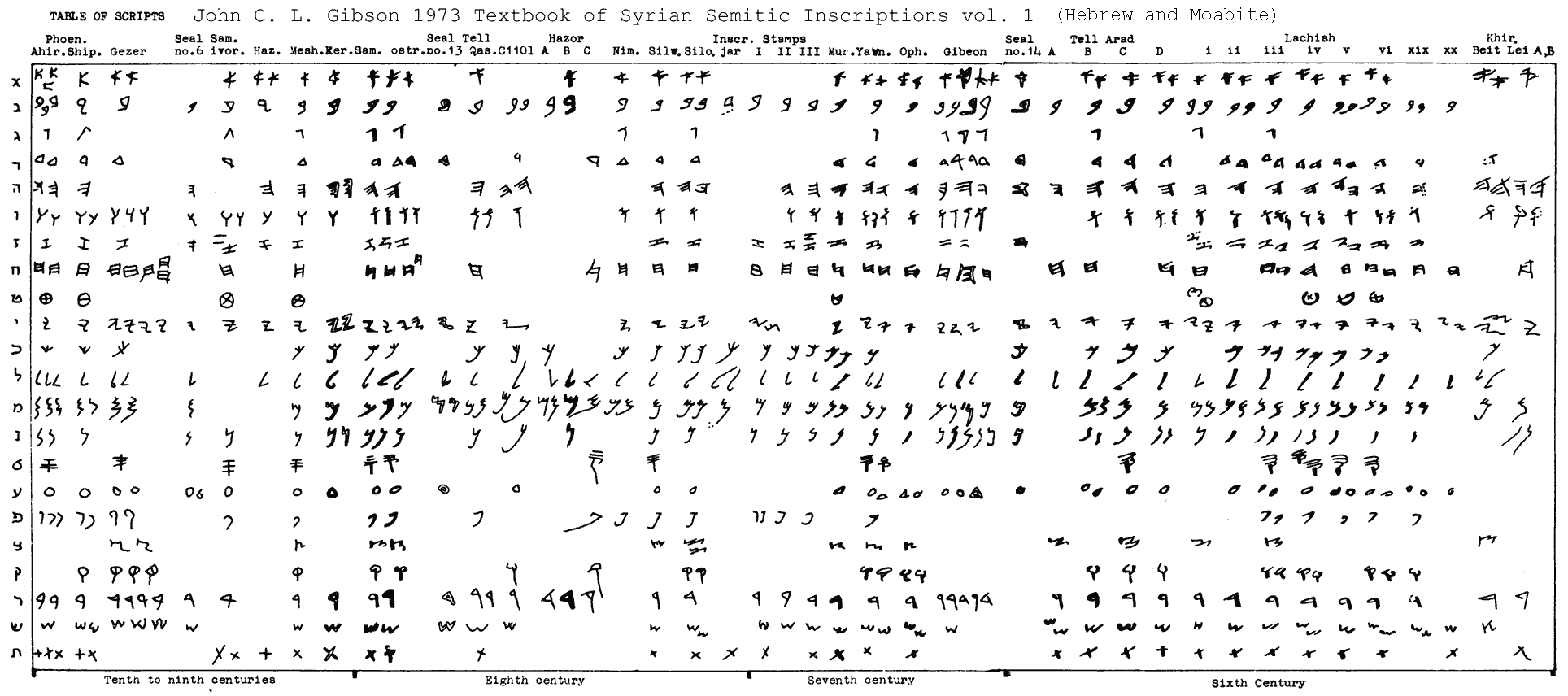
To get a feel for the kinds of variations that occurred over many
centuries in the ancient Northwest Semitic script take a look at these
paleographic charts, which include glyphs for Phoenician, Moabite, Old
Hebrew, Samaritan, and Old Aramaic:

<http://www.jhu.edu/ice/ancientnorthwestsemitic/gesenius.gif>
<http://www.jhu.edu/ice/ancientnorthwestsemitic/gibson1.gif>
<http://www.jhu.edu/ice/ancientnorthwestsemitic/gibson2.gif>

These are exactly the same kinds and extents of variations one encounters
in various Greek inscriptions and manuscripts over the centuries, the
script variants of which are not, of course, encoded separately. And so I
think there must be a compelling reason to do so for Northwest Semitic,
one which I have not heard yet.

Don't get me wrong, I do think there may be good reasons to separately
encode some of the script "nodes", as you call them, (Samaritan comes to
mind, because of its long and separate transmission tradition associated
with its religion) but we should be very clear that the reasons are NOT
based on the fact that they are separate writing systems. I see, for
example, no justification for calling Phoenician, Punic, Moabite,
Ammonite, Old Hebrew, and Old Aramaic different writing systems.
(Samaritan, I would have to do more research on with this issue in mind,
but from what I know now about it, it is not a separate writing system.)


Respectfully,

Dean A. Snyder
Scholarly Technology Specialist
Library Digital Programs, Sheridan Libraries
Garrett Room, MSE Library, 3400 N. Charles St.
Johns Hopkins University
Baltimore, Maryland, USA 21218

office: 410 516-6850 fax: 410-516-6229
Manager, Digital Hammurabi Project: www.jhu.edu/digitalhammurabi