"Dean Snyder" <[EMAIL PROTECTED]> wrote:

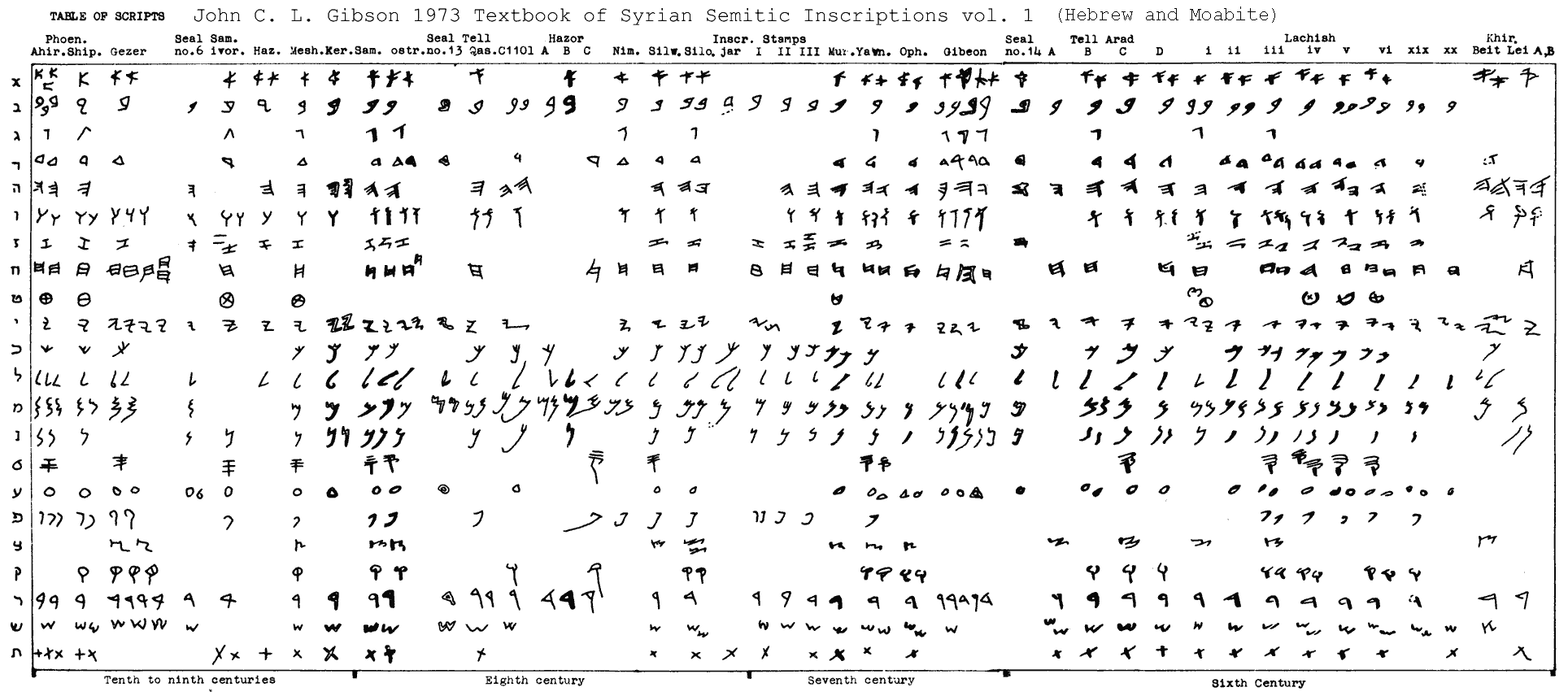
> To get a feel for the kinds of variations that occurred over many
> centuries in the ancient Northwest Semitic script take a look at these
> paleographic charts, which include glyphs for Phoenician, Moabite, Old
> Hebrew, Samaritan, and Old Aramaic:
> <http://www.jhu.edu/ice/ancientnorthwestsemitic/gesenius.gif>
> <http://www.jhu.edu/ice/ancientnorthwestsemitic/gibson1.gif>
> <http://www.jhu.edu/ice/ancientnorthwestsemitic/gibson2.gif>

> These are exactly the same kinds and extents of variations one encounters
> in various Greek inscriptions and manuscripts over the centuries, the
> script variants of which are not, of course, encoded separately. And so I
> think there must be a compelling reason to do so for Northwest Semitic,
> one which I have not heard yet.

> Don't get me wrong, I do think there may be good reasons to separately
> encode some of the script "nodes", as you call them, (Samaritan comes to
> mind, because of its long and separate transmission tradition associated
> with its religion) but we should be very clear that the reasons are NOT
> based on the fact that they are separate writing systems. I see, for
> example, no justification for calling Phoenician, Punic, Moabite,
> Ammonite, Old Hebrew, and Old Aramaic different writing systems.
> (Samaritan, I would have to do more research on with this issue in mind,
> but from what I know now about it, it is not a separate writing system.)

But there is the same kind of variation between Indic scripts which have been
encoded separately - or at least between the different scripts used to write
the contemporary North Indian languages or between the various scripts used to
write the contemporary Dravidian languages. The compelling reasons for encoding
them as separate scripts probably include: ISCII encodes them as separate (even
if only by means of a control sequence) ; there is often a need to use these
different scripts in one and the same document (Indian currency notes and
railway station signs for a start); each of these scripts is used to write
different languages and in normal use they are not interchangeable. There is
also a strong resistance to any one linguistic group gaining cultural hegemony
over another in India and since particular scripts are associated with
particular languages it is popular to emphasise their distinctiveness more than
their similarity.

OTOH  in their sphere Han Chinese at least  seem keen to stress cultural unity
as much as possible - hence they see the 'Phags-pa script as a Chinese
invention - though others would say it was invented by a Tibetan for Mongolian
and is ultimately based on an Indic script.

Since Pali is written in several scripts none of which is predominant I've had
several Pali scholars and those involved in digitising Pali texts ask "Why
can't there be a single encoding for Indic scripts which can be used to encode
Pali texts which could then be displayed in Devanagri, Sinhalese, Burmese,
Thai, Lao or Khmer script?"

Personally I think although many  scholars may regard Phoenician, Moabite, Old
Hebrew, Samaritan, and Old Aramaic:as  one "writing system" - for contemporary
political reasons some descendents of the users of those scripts might take
offence if these old scripts were lumped together under the name "Hebrew" (old
or new), and no one wants that to happen.

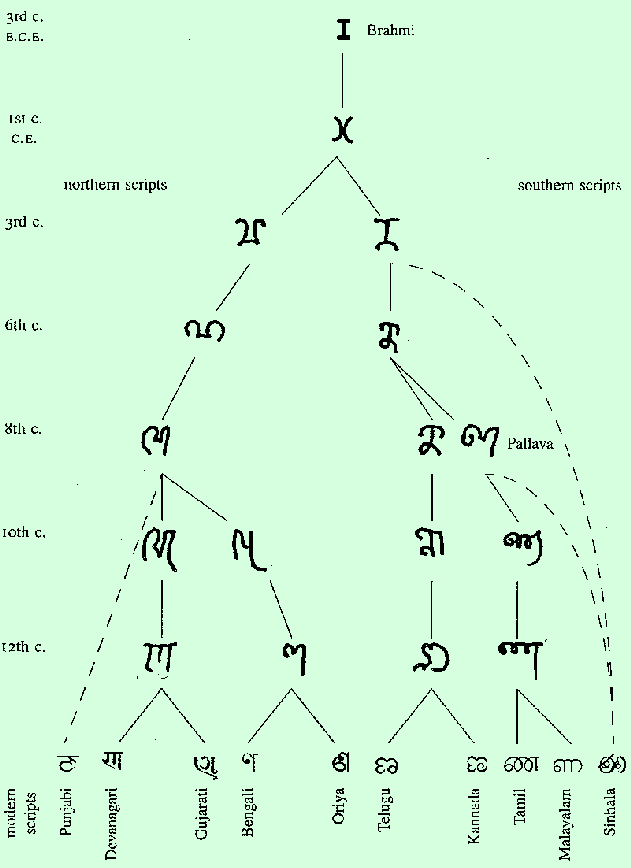
It is interesting to compare your charts of  variations in "ancient Northwest
Semitic"
with charts showing variations in Indic scripts e.g.
http://www215.pair.com/sacoins/images/scripts/master_script.gif
http://www.ukindia.com/zalph.htm
http://www.geocities.com/Athens/Academy/9594/brahmi.html
http://www.cs.colostate.edu/~malaiya/images/brah11.gif
http://www.medvarsity.com/vmu1.2/dmr/dmrdata/currenttopics/coins/Andhra%20script.htm


- Chris