On 9 Dec 2015, at 23:32, Martin J. Dürst wrote:
On 2015/12/10 09:30, Mark E. Shoulson wrote:
I remember when we went through all this the first time around,
encoding
ẞ in the first place. People were saying "But the Duden says
no!!!" And
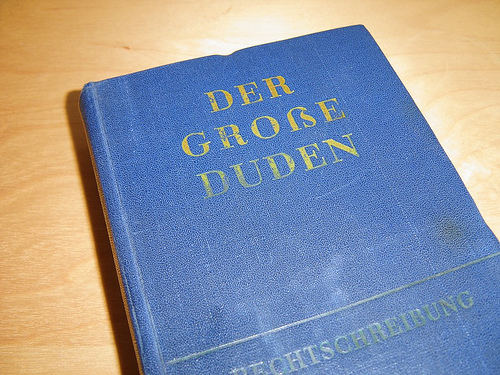
someone then pointed out, "Please close your Duden and cast your gaze
upon ITS FRONT COVER, where you will find written in inch-high
capitals
plain as day, "DER GROẞE DUDEN"
(http://www.typografie.info/temp/GrosseDuden.jpg)  So in terms of
prescription vs description, the Duden pretty much torpedoes itself.
This is an interesting example of a phenomenon that turns up in many
other contexts, too. A similar example is the use of accents on
upper-case letters in French in France where 'officially', upper-case
letters are written without accents.
while in Québec, upper-case letters are written _with_ accents. l10n…

Marc.
When working on internationalization, it's always good to keep eyes
open and not just only follow the rules.
However, the example is also somewhat misleading. The book in the
picture is clearly quite old. The Duden that was cited is new. I
checked with "Der Grosse Duden" on Amazon, but all the books I found
had the officially correct spelling. On the other hand, I remember
that when the upper-case sharp s came up for discussion in Unicode,
source material showed that it was somewhat popular quite some time
ago (possibly close in age with the old Duden picture). So we would
have to go back and check the book in the picture to see what it says
about ß to be able to claim that Duden was (at some point in time)
inconsistent with itself.
Regards, Martin.