Hey Marc,
thank you for your insights regarding RS3D. Actually, I like the look
and image quality of what comes out at the end of the modeling and
rendering process with RS3D. It's really high quality in every way. But
on the other hand I think, a tool should support the artist. I am always
forced in RS3D to think very technically and like a mathematician. I
was an RS3D evangelist in the past and told everyone how great this
software is. I always hoped that it gets more easier to cope with it. In
my opinion, it was the other way round. The way how you have to do so
many things is often too much too complicated for me. So, as my
interests in rendering went more and more in the direction of landscape
modeling and rendering (a pain in RS3D) i dropped it and touched it
never again. It's here on my computer (V4.5) but last time i have
started it was 1.5 or so years ago for a rendering I did for a friend.
That was it. I maybe start again with raytracing in the future, but
certainly not with RS3D.
Ciao,
Markus

Marc Michael schrieb:
Hello Markus,

on Dienstag, 25. September 2007, 11:17:20, you wrote:
Hi,
yeah, but he writes what lets me drop down RS3D. I didn't touch it for
years now and don't miss it. Sad but true.
I see it the other way around. What he said let me stay with RS3D.
RS3D is a professional tool. But yes, it lacks of some feature the
often used tools in a production environment provide. Look for example
at the quality of the editor view of Caligary Truespace.

But it’s the architecture and the special features of RS3D I like.
RS3D is more like LEGO, where you have small blocks, and when you know
this small blocks and know the architecture, it’s often easier to
build something different than the mainstream. For example, it’s said
that RS3D have a good hair system. But when you look at RS3D, there’s
no word like hair or something in the program! All is based on the
small features of raytraced NURBS and the interpolator and VSL.

I like the minimalistic aproach also in programming languages. I like
APL, TCL, or my favored Smalltalk.

In my opinion RS3D is a tool for the artist who wants to go beyond,
but has also the time to learn the basics and the things which going on
behind the scene.

But IMO this helps also in a more production environment. For example,
for some weeks I need to recreate a scene in a 3D program. The
original file wasn’t available. So I simply grabbed a faked image as a
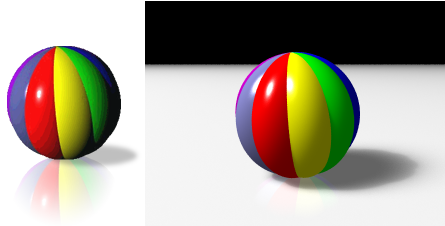
boilerplate and recreated it in RS3D. On the left, you see the
boilerplate, on the right the output of my scene:

http://realsoft3d.turboland.de/tmp/DolphinBeachBall-BoilerPlateVSmyBeachBall.png

In my RS3D project I have a material for the colours of the ball. In
the GUI, there are simply 10 colour fields. So I can simply change
each colour by simply clicking on the desired field and choose the
colour in a colour selector. Or look at the faded reflexion. This
doesn’t really appear in such way in reality. But in RS3D, I simply
set it up by create a dependency between the distance of the mirror to
the object. Very easy and fast solution I think.

So, in small, individual projects RS3D is a tool to think about. When
you know what’s going on behind the scene, RS3D is a fast and
flexible tool, IMHO.

Best wishes,
Yogi Marc Michael
--
Markus
...................................................................
visit my Renderosity Gallery at
http://www.renderosity.com/mod/gallery/browse.php?username=RealUser
...................................................................