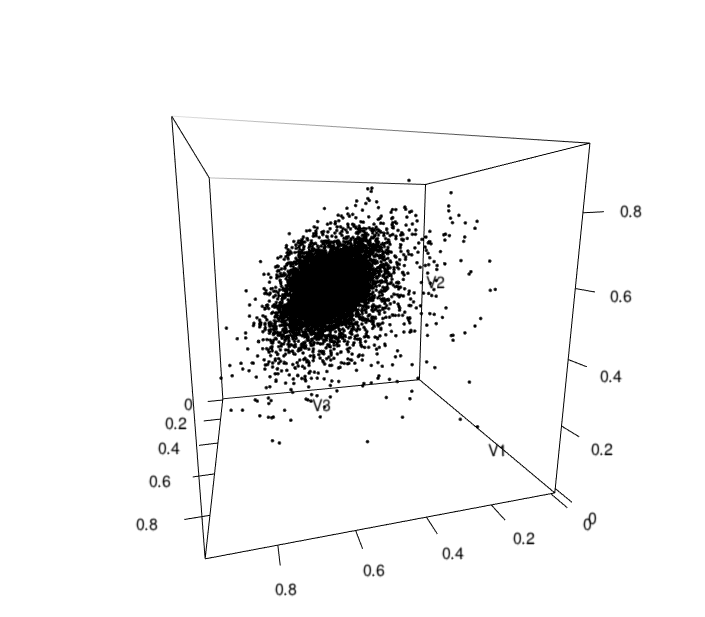
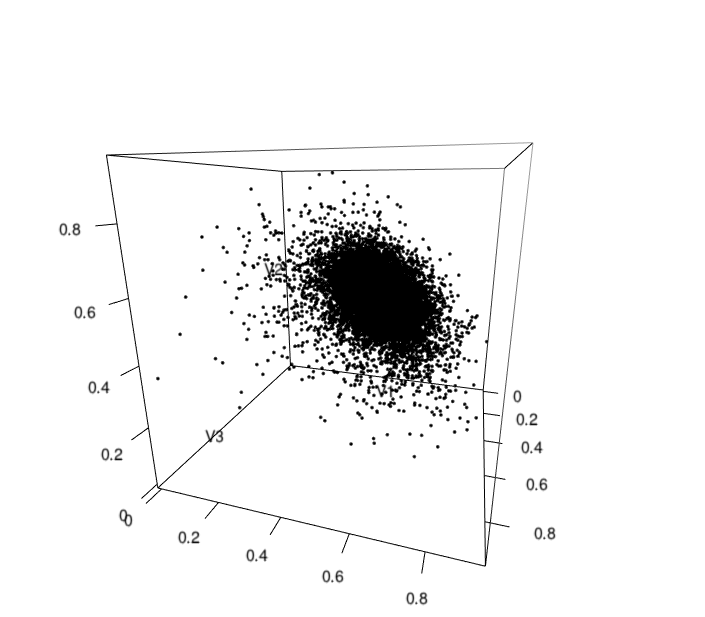
Awesome! Thanks for your help! :D

I had gotten your code to work but really wasn't sure what I was
looking for. I tried projecting it in 3D and plotting it with RGL.
I have a couple of questions:
- how did you pick 1000 as the dimension of the vectors?
- what is spoking behavior? is it that there seem to be some lines
going through the origin that points tend to be on?
- when you say you built a multinomial model, how did you see strong
signals? I'm not sure how you used it actually. :)

On Fri, Dec 28, 2012 at 4:53 AM, Ted Dunning <[email protected]> wrote:
> I have fixed the vectorizer in knn.  Available from [0] as
> org.apache.mahout.knn.Vectorize20NewsGroups
>
> Typical invocation would have these command line options:
>
>    lic subject false 1000 ../20news-bydate-train
>
> These are:
>
> - term weighting code.  lic = log(tf) * IDF with cosine normalization
>
> - which header fields to include (comma separated)
>
> - should quoted text be included?
>
> - number of dimensions to project to
>
> - top-level directory of documents (one doc per file).
>
> The outputs go to two files:
>
>    output - contains a sequence file where the newsgroup is the key and the
> value is the document vector.
>
>    output.csv - contains CSV data with newsgroup name, document id and
> vector coordinates
>
> Happily, the vectorized forms here can be read into R directly using the CSV
> format.  For visualization of these kinds of things, I think that R's plot
> function is very nice.    For instance, [1] has a few plots of 10 of the
> 1000 dimensions against each other.  Color is according to news group, term
> weighting code is lic (log(tf) * IDF, cosine normalized.  We see lots of
> axis alignment, also see some color discrimination (green seems to stand
> out) and we see various kinds of spoking behavior.  These are the sorts of
> things I would expect.   The axis alignment is good because it indicates
> that L_1 learning should help here.  The color coding is arbitrary and not
> what we really care about at this level of examination.
>
> I also built a small multinomial model on the first 15 components and saw
> gratifyingly strong signals on a few of the coordinates.  That isn't the
> same as testing on held out data or building a full-scale model, but it is a
> good sign.
>
> [0]
> https://github.com/tdunning/knn
>
> [1]
> https://dl.dropbox.com/u/36863361/plot20.png
> https://dl.dropbox.com/u/36863361/plot30.png
> https://dl.dropbox.com/u/36863361/plot40.png
> https://dl.dropbox.com/u/36863361/plot50.png
> https://dl.dropbox.com/u/36863361/plot60.png
> https://dl.dropbox.com/u/36863361/plot70.png
> https://dl.dropbox.com/u/36863361/plot80.png
>
>
> On Thu, Dec 27, 2012 at 11:53 AM, Dan Filimon <[email protected]>
> wrote:
>>
>> Hi!
>>
>> I'm finally getting back to work on Streaming KMeans! :)
>> The last thing I did was experiment with different ways of vectorizing
>> the 20 newsgroups data set and I wanted to project them in 3D and
>> check out  what I get.
>>
>> The result is pretty odd, but I get it regardless of the method I use
>> to generate vectors.
>> It looks like someone splashed a 2D normal distribution on a sphere.
>>
>> Here's an image from Ted's algorithm [2] and one from mine [3] using
>> log term-frequency scoring.
>> Ted's uses vectors of size 9000 with hashing (using
>> StaticWordValueEncoder) while mine uses vectors of size ~90000 with a
>> manual approach.
>>
>> I think the vectorization actually went okay for both algorithms, but
>> maybe the projection is off?
>>
>> The shape is odd. What am I doing wrong? :/
>>
>> [1] https://gist.github.com/4391252
>> [2] http://swarm.cs.pub.ro/~dfilimon/skm-mahout/ted-projected.png
>> [3] http://swarm.cs.pub.ro/~dfilimon/skm-mahout/log-projected.png
>
>