.....or if you are more fussy, 104348/33215=3.14159265392142104470871594159265.....
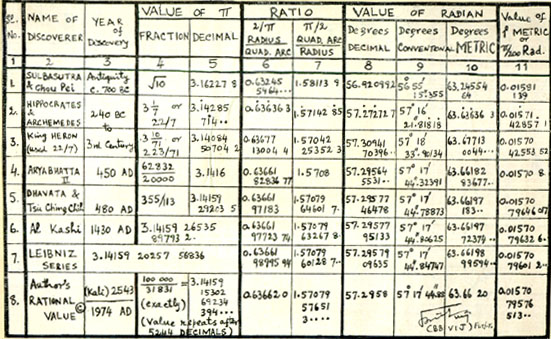
This is yet another approximation for the value of Pi. The question I raised is NOT for being 'fussy' BUT for arriving at the value on 'number line'. I have processed several values that I knew (in mid seventies) to arrive at my value: 100000/31831 (exactly) that fixes Pi as the *ratio a/b* and also the value for angle radian=57*.2958. My argument stands at:
If a circle has 2 Pi radians; either Pi or radian MUST be defined or else the *circle=2 pi radians* need some constant to be introduced to fix either Pi or the radian. I placed my results at:
http://www.the-light.com/cal/bbv_pi-radian.jpg
http://www.the-light.com/cal/bbv_pi-worked.doc
My results were published during 1974, although the working had been done much earlier.
Value of Pi (p) - News Report; The Times of India, New Delhi; 1974 October 25
Vedic Numeral Code; Value for Pi (p) Indian Standards Institution Bulletin, New Delhi; V 27 N 10; 1974 October; pp 381.
Regards,
Brij Bhushan Vij <[EMAIL PROTECTED]>
20040623H1225(decimal) PM(IST)
Aa Nau Bhadra Kritvo Yantu Vishwatah -Rg Veda.
*****The New Calendar Rhyme*****
Thirty days in July, September:
April, June, November, December;
All the rest have thirty-one; accepting February alone:
Which hath but twenty-nine, to be (in) fine;
Till leap year gives the whole week READY:
Is it not time to MODIFY or change to make it perennial, Oh Daddy!
And make the calendar work with Leap Week Rule!
*****     *****     *****     *****
From: "m. f. moon" <[EMAIL PROTECTED]>
Reply-To: [EMAIL PROTECTED]
To: "U.S. Metric Association" <[EMAIL PROTECTED]>
Subject: [USMA:30117] Re: Liebnitz and Pi.
Date: Mon, 14 Jun 2004 14:39:37 -0700
"Stephen Davis" <[EMAIL PROTECTED]> wrote:
I am not sure I follow all this discussion on rational fractions approximately
pi. I have
always liked 355/113 or if you are more fussy, 104348/33215.
Marion Moon
I was aware of the 22/7 approximation of Pi (or 3 1/7 if you prefer) but I've
never heard of
this one.
I believe this gentlemen is trying to suggest that this equation is more or
less totally
accurate rather than a approximation.  I believe the latter, myself.
As I mentioned before, mathematicians have used programs with millions of
numbers in
order to solve the mystery of Pi but without succe
Therefore, I fail to see how this version he mentions can be spot-on rather
than a close
approximation.
----- Original Message -----
From: <[EMAIL PROTECTED]>
To: "U.S. Metric Association" <[EMAIL PROTECTED]>
Cc: <[EMAIL PROTECTED]>
Sent: Monday, June 14, 2004 8:47 PM
Subject: [USMA:30115] Re: Liebnitz and Pi.
> Hello Stephen!
>
> The "fractionalization" of pi is not at all part of a scheme by
anti-metric folks.
Fractions were used as rough APPROXIMATIONS of pi, (i.e. 3 1/7) in the past.
With respect
to the fractional series provided at the bottom of your message, that is a
good series for
approximating pi (given that a sufficient number of fractions).
> As someone who knows the history of the development of this
magnificent number, I
can tell you that there is NO reason for me to believe that BWMA,
metric-sucks,
freedom2mearure-like people are behind this "fractinaliztion 'attempt'" of pi.
>
> Hope this helps!
>
> METRIC ROCKS!
>
> -----Thanks!-----
>
> Cole Kingsbury
> USMA member - Age 19
> [EMAIL PROTECTED]
>
> -------------------
>
>
>
> > Can anyone on this mailing list confirm something for me? I had been
arguing
> > the benefits of decimals and metric over fractions and imperial
measurements
> > with someone on another website and Pi was mentioned.
> >
> > I realised that mathematicians over the years have tries to solve Pi by
feeding
> > millions of decimal numbers into computers but to no avail.
> >
> > Then he mentioned Liebnitz who, apparently, according to him, had solved
Pi
> > using fractions in the 1670's.
> >
> > What I would like to know is, is this actual fact or just another
misleading
> > piece of propaganda put about by the anti-metric brigade?
> >
> > The equation he mentioned is below:
> >
> > he riddle had of course been solved by Leibnitz in the 1670s with a
continuous
> > series of fractions:
> >
> >
> > Pi = 4 * (1 - 1/3 + 1/5 - 1/7 + 1/9 - 1/11 + 1/13 - 1/15 + 1/17 - 1/19
etc...)
> > or expressed in C to 2^24 this code is amazingly accurate.
> >
> >
> > int x = 0;for (int i = 1; i < 16777216; i++) { x += 1/((4*i)-3); x
-=
> > 1/((4*i)-1); }int pi = 4 * $x;cout pi;
> >
>
_________________________________________________________________
Post Classifieds on MSN classifieds. http://go.msnserver.com/IN/44045.asp Buy and Sell on MSN Classifieds.