Posted by K.C. Johnson (guest-blogging):
The Group of 88
http://volokh.com/archives/archive_2007_09_16-2007_09_22.shtml#1190132783
   Professors like to think of themselves as aggressive defenders of due
   process. In theory, the academy exists for the pursuit of truth. And
   faculty members are, in an ideal world, more inclined to embrace the
   dispassionate evaluation of evidence than the passions of the mob.

   The behavior of activist members of the Duke arts and sciences faculty
   during the lacrosse case contradicted all of these myths about the
   academy. And most other professors at Duke elected to remain silent as
   their extremist colleagues rushed to judgment and refused to
   reconsider their actions.

   In March 2006, less than a week after Crystal Mangum�s rape allegation
   became public, Houston Baker, a professor of English and
   African-American Studies, penned an [1]open letter demanding the
   immediate expulsion from Duke of all 46 white players on the lacrosse
   team. (Several lacrosse players, in fact, hadn�t even attended the
   party.) Baker mocked the �tepid and pious legalism� that resulted in
   �male athletes, veritably given license to rape, maraud, deploy hate
   speech, and feel proud of themselves in the bargain.�

   Two days after Baker�s missive, the former dean of faculty, History
   professor William Chafe, published an op-ed in the campus newspaper,
   the Chronicle. Entitled �Sex and Race,� Chafe�s op-ed suggested that
   the whites who kidnapped, beat, and murdered Emmett Till provided the
   appropriate historical context through which to interpret the behavior
   of the lacrosse players. In an unintentional commentary on the
   article�s intellectual seriousness, Chafe (a historian of civil
   rights) misidentified the year for Till�s murder, one of the crucial
   events in the development of the civil rights movement.

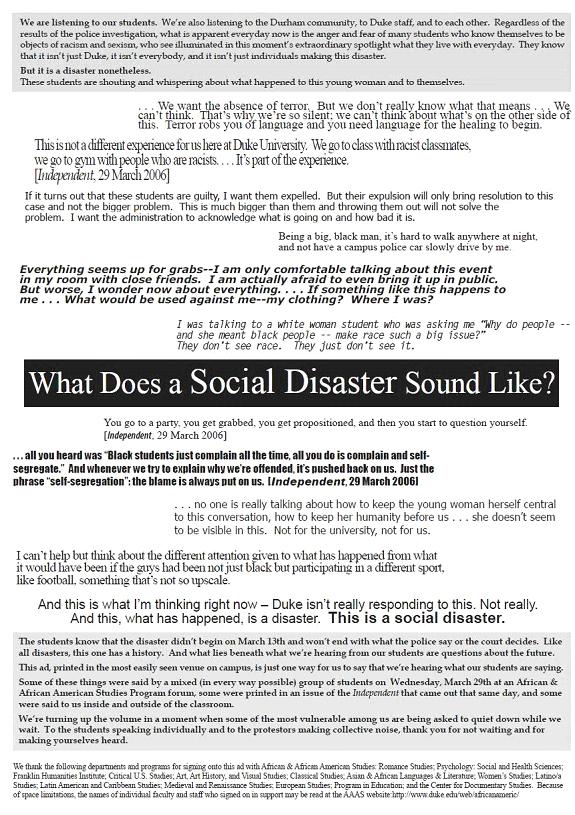
   Then, on the 6th of April, 88 members of the arts and sciences faculty
   took to �the most easily seen venue on campus,� the Chronicle, to
   publish a [2]full-page ad filled with guilt-presuming anonymous
   quotes, allegedly from Duke students. In their own voice, the
   professors asserted unequivocally that something �happened to this
   young woman� (Mangum). Following up on protests that had featured a
   �castrate� banner and the widespread distribution of a �wanted� poster
   with lacrosse players� photos, the signatories said, �To the
   protesters making collective noise, thank you for not waiting and for
   making yourselves heard.� And the ad, paid for by the African-American
   Studies Program, claimed the endorsement of five academic
   departments�even though none of the departments had actually voted on
   the issue.

   Months later, when asked about the propriety of the ad, statement
   author Wahneema Lubiano (a Literature professor and 1897 Ph.D. who has
   never published a scholarly monograph) unintentionally testified to
   the groupthink evident in many Duke departments: �In the moment when
   the ad came out, I did not hear from one colleague that there was
   something wrong with the ad.�

   The signatories, who came to be called the Group of 88, were of
   differing races, genders, departments, seniority, and interaction with
   the lacrosse players. But they had one thing in common.
   Disproportionately housed in the humanities and a few social sciences
   departments, an astonishing 84.1 percent of Group members describe
   their research interests as related to race, class, or gender (or all
   three). Some featured research agendas that came across more as
   parodies than serious scholarship. To take an extreme example: Kathy
   Rudy [3]published a scholarly article reminiscing how, when she
   arrived in Durham, she and fellow radical feminists oriented their
   activities around �the ideas that women were superior and that a new
   world could be built on that superiority.�

   For those whose intellectual approach presupposes an American society
   deeply oppressive on grounds of race, class, and gender, the lacrosse
   episode was too tempting not to exploit. As Group member Mark Anthony
   Neal explained two days after Nifong obtained his first indictments,
   the allegations proved that Duke needed to rework its curriculum in
   �an innovative and brave� fashion, so as to teach students to behave
   �in a progressive manner.�

   The most striking aspect of the faculty�s reaction, however, came not
   in the rush to judgment but in the professors� utter closed-mindedness
   as Mike Nifong�s case collapsed in late 2006. A post later today will
   discuss the issue.

References

   1.
http://www.dukenews.duke.edu/mmedia/features/lacrosse_incident/lange_baker.html
   2.
http://photos1.blogger.com/x/blogger/2862/372/1600/99636/Listening_Statement_b.jpg
   3. http://durhamwonderland.blogspot.com/2007/07/group-profile-kathy-rudy.html
_______________________________________________
Volokh mailing list
[email protected]
http://lists.powerblogs.com/cgi-bin/mailman/listinfo/volokh