On Wednesday 14 July 2004 18:44, leaking pen wrote:
> thanks for the help, but its been found by a friend.  its an
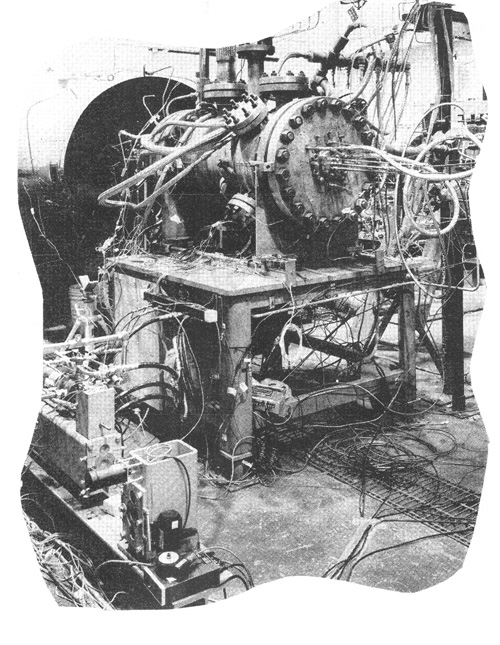
> experimental pulse detonation engine.  the picture is actually from
> the sep 03 pop sci.  which is why it looked familiar to me.    the
> hole is the thrust measurer.  thanks for the help though.
>
> On Thu, 15 Jul 2004 02:45:11 +0700, explorecraft
>
> <[EMAIL PROTECTED]> wrote:
> > Someone spent a lot of time putting that together.
> >
> > The big bolts imply high differential berween external
> > to internal pressure.
> >
> > The legs appear to have been set up on levelling blocks.
> >
> > Although the pressure containment may be a lower pressure,
> > since there are instruments laying around as if they are
> > monitored locally during operation, it is probably high
> > pressure as the 'dated appearance' of the photo
> > suggests an era when safety was less important.
> > The untidyness suggests either a long and meticulous
> > trial and error development, or a war-driven rush.
> >
> > The uneven bolt heads suggest private development
> > as opposed to government research uniformity.
> >
> > Can't really tell if the black circle behind the machine
> > is a disc or a hole in the wall behind. Guess=disc.
> > If it is a disc, it probably is rotated by hydraulics,
> > hoses evident, or perhaps the disc rotation drives a pump.
> > (chicken or egg?)
> > The block object on the lower left looks like a hydraulic pump,
> > but where do the hoses go?
> >
> > The grid-covered drain and the 20liter pail suggest fluids,
> > perhaps just contingency for hydraulic leaks.
> >
> > The mess of cabling appears to be for control and measurement.
> >
> > The top of the foto is clipped at a crucial point which
> > might be hiding a breather/filter or heat radiator.
> >
> > This has got all the trademark signs a stubborn inventor
> > who struggled and hacked and re-rigged an experiment
> > that just refused to work, alone and a bit disorganized
> > (pot kettle black situation) never getting to the
> > point of admitting 'ok, enough for now,
> > let's clean this mess up and start over
> > fresh using what we have learned.'
> >
> > Or maybe this is that magic moment when the flicker of
> > sucess began to twinkle. who knows?
> >
> > It looks so familiar it stinks, but...
> > In other words, clueless.
> > what is it?
> >
> > > -----Original Message-----
> > > From: leaking pen [mailto:[EMAIL PROTECTED]
> > > Sent: Thursday, 2004 July 15 01:15
> > > To: [EMAIL PROTECTED]
> > > Subject: help identifiying a machine.
> > >
> > >
> > > http://www.maydaymystery.org/mayday/offsite/letter06162004/page_huge.jp
> > >g http://www.maydaymystery.org/mayday/offsite/letter06162004/page.jpg
> > >
> > > second link is a bit smaller.  anyone know what this sucker is?
> > > thanks.
Dunno wot it is, but itz shooor a mess, aint it!  The leveling blocks on the
base of the pressure vessel appear to be vibration isolators like the mounts
on your automobile engine where it mounts to your car.  These can be quite
heavy.  The foto appears old; there are no indications of electronic or other
measuring equipment, not to mention computers.  There is a manifold on top
with many lines leading to it.  This manifold appears to originate in a wall
behind it.  It looks like a natural gas line with hose nipples like in school
chemistry labs.  The hoses appear to be attached to the nipples just like in
school labs as well.  The small lines appear that they may lead to the
pressure chamber.  The large black area is probably the open end of a long
large cylindrical tank.  Suppose the divice is a test bed for a rocket motor
and the tank is to contain the exhaust and lead it away from the stand.   A
little  more looking and one percieves a subtle venturi shape to it.

Standing Bear