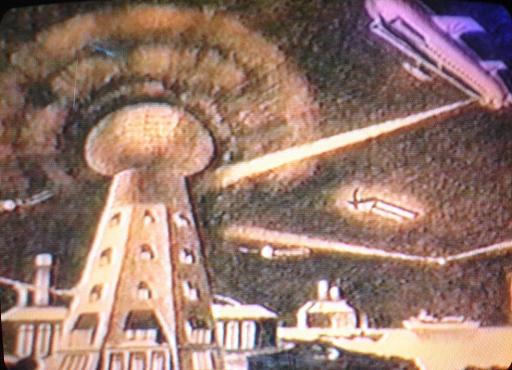
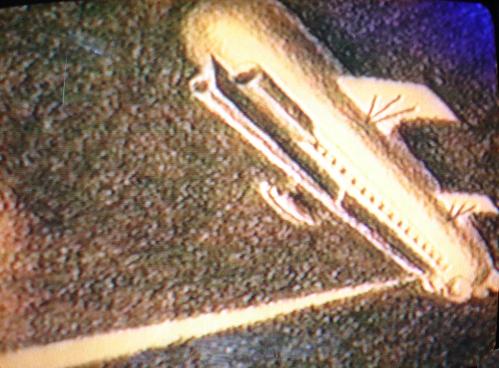
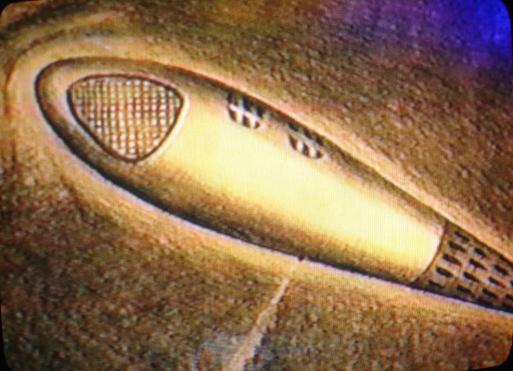
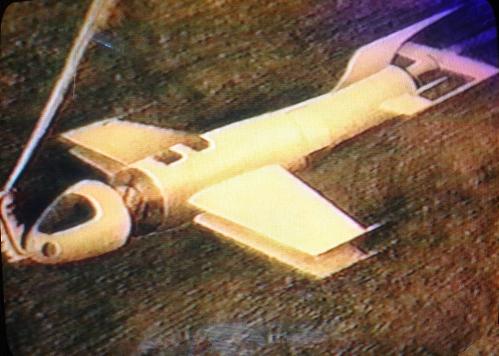
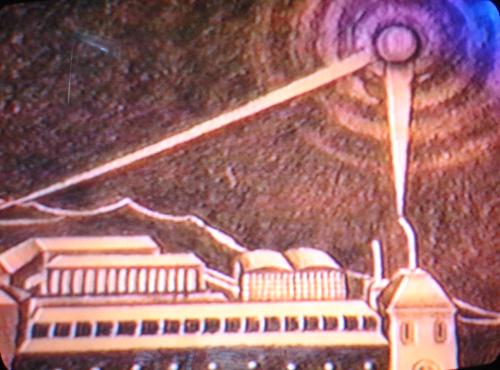
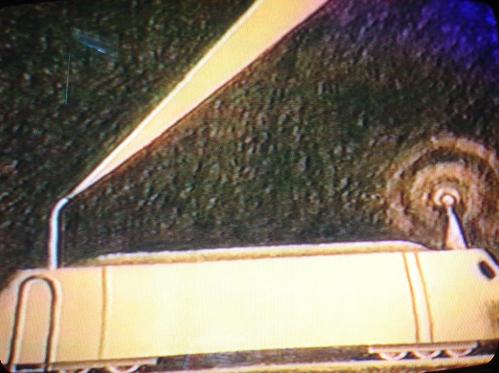
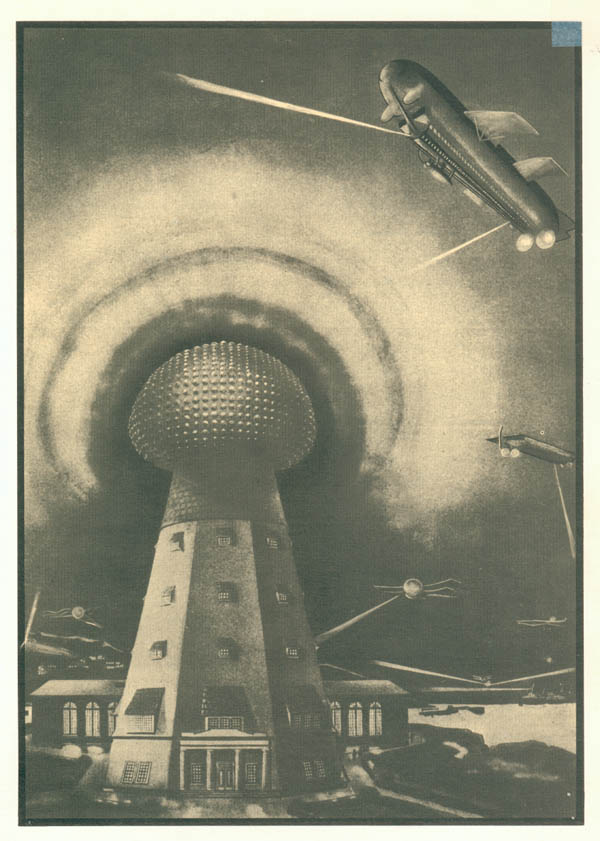
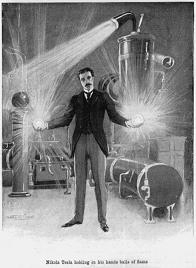
I uploaded some crude screenshots taken from the film "The Secret of
Nikola Tesla."   I'm very curious as to the original source of these
images.  Who was the artist?  On what were they based?  From what I
understand of Tesla technology, they seem very accurate (also quite
revealing.)
http://amasci.com/graphics/tstowr.jpg
http://amasci.com/graphics/tsflyr.jpg
http://amasci.com/graphics/tspjctl.jpg
http://amasci.com/graphics/tsplane.jpg
http://amasci.com/graphics/tscar.jpg
http://amasci.com/graphics/tsfactry.jpg
http://amasci.com/graphics/tstrain.jpg

These appear in the scene in the movie where Tesla visits JP Morgan and
tries to convince him to continue funding.  Tesla shows a portfolio of
large-format artwork which he pages through to show Morgan what he's
planning:

Note well the "searchlight beams" depicted as coming from the tips of
small high-voltage antennas in all the above artwork.  WEIRD!  Don't these
beams appear to be identical to the same "searchlights" depicted in other
Tesla artwork such as:

  Wardenclyff tower in operation
  http://www.teslasociety.com/pictures/wardenc3.jpg
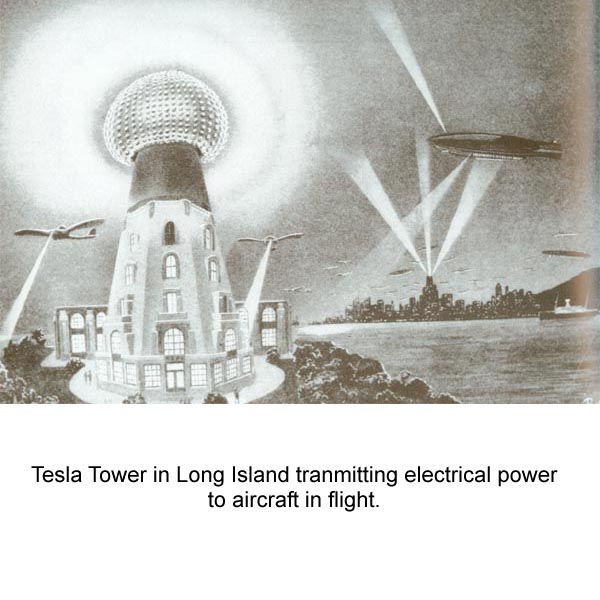
  http://www.teslasociety.com/pictures/lightstower.jpg

(And which artist created these two?  How accurate are the details, i.e.
how much guidance did the artist receive from Tesla?)

I'm tempted to conclude that *none* of these beams are supposed to be
searchlights ...and that all of them are detailed and accurate depictions
of Tesla's planned devices.  For years I've been looking right at the key
to Tesla's devices, and not noticing it.  I thought they were decoration:
searchlights added by some silly artist.

If I'm guessing correctly, they are AC ion beams: they are long narrow
corona discharges; "virtual conductors" created in the air using Tesla
bulbs emitting high-power x-rays.  (Those little antennas in the pictures
of cars and planes would have to have vacuum-bulbs in the tips of the
antennas.)  In addition, the glowing beams are being used as power lines,
or as huge VLF antennas.  There could be considerable AC amperage in those
glowing pathways.  The high current would make them glow all the more.

Remember that if we use high voltage and low current, we can make even a
fairly large resistor behave like a good conductor, and we can transfer
very large wattage at low loss.  That was one of Tesla's main inventions:
thin power lines with transformers on either end!

Why use these beams?  Here's one example.  If the Wardenclyffe tower was
operational, and if a large city needed more wireless power than was
available via many separate resonant loop antennas  ...it could project a
vertical "conductor ray" upwards as an Ionospheric tap.  Gain some extra
height: build the ray-projector on top of a tall building.   This would be
combined with a large ground rod, and would be just like a "power line,"
but would connect to the ionosphere layer which was driven by Tesla's main
tower built elsewhere.

Another example: if an aircraft needed extra wattage, it could extend a
"conductor ray" downwards to make contact with the Earth (while the metal
skin and wings of the flyer would act as a capacitive antenna.)  If it
needed still more power, it could launch another ray upwards...  and
that's exactly what we see happening in this artwork:

 http://www.teslasociety.com/pictures/lightstower.jpg

The skyscrapers send up beams!  The airplanes send beams downward, and one
large flyer sends beams both up and down.

It all makes perfect sense if we assume that the beams are conductors.

Something else makes sense too.  In this image a factory is being run by
wireless power:
http://amasci.com/graphics/tsfactry.jpg
One building has one of those little beam-emitting antennas.  But in this
case there is another beam coming in from... beyond the mountains.  The
"virtual conductors" connect together, and at the region where they join,
apparently Tesla employs a floating terminal (perhaps a metallized
balloon?)   This does make sense as follows: a factory requires too much
wattage for simple wireless power, so instead a long conductive beam is
sent through the air from a distant power station.  (In that case, is it
still "wireless" power?)

And here's something that's a bit too much to be just cooincidence.  Below
is a separate image from a magazine article, also apparently with a "Tesla
Bulb" sitting atop a coil and producing a fan-shape glowing beam.

http://amasci.com/graphics/tesbeam.jpg

If that bulb emits x-rays, then not only is the air conductive, but there
should also be a direct conductive path between the Tesla coil's main HV
terminal and the glowing beam.  After all, the thin glass envelope is
conductive to AC (acting as capacitor dielectric.)  The vacuum is
conductive, since it's filled with an electron cloud.  And the internal
electrode is connected to the TC.  So... rather than making a 10ft
lightning bolt, the x-ray bulb pre-ionizes the air and allows the Tesla
coil to spew out a fan-shaped glowing beam, a long narrow corona
discharge.

This perhaps solves another mystery too.  Tesla was said to have lit his
NYC laboratory without using fluorescent tubes.  Instead, supposedly he
had a way to make the air itself light up.  If Tesla was producing a wide
fan of powerful x-rays, and if this was connected to a big Tesla coil,
then this would create a large-volume corona discharge.  Turn the air into
a fluorescent tube!   (Pretty cool, eh?  We'll just ignore the bit about
irradiating our gonads.)

What were these AC x-ray tubes like?  There's an online article where
Tesla gives details.


((((((((((((((((((((((( (  (    (o)    )  ) )))))))))))))))))))))))
William J. Beaty              http://staff.washington.edu/wbeaty/
Research Engineer             UW Chem Dept,  Bagley Hall RM74
[EMAIL PROTECTED]     Box 351700, Seattle, WA 98195-1700
ph:206-543-6195 fax:206-685-8665