On Dec 15, 2011, at 10:08 AM, Alan J Fletcher wrote:
At 10:45 AM 12/15/2011, Horace Heffner wrote:
Just to be clear, no one is talking about heating the outside box
metal envelope. My focus is entirely the inside box, the 30 cm x
30 cm x 30 cm inside box, the insides of which no one has seen.
It is easy to place a thermal mass inside this volume that can
store and release sufficient energy to meet the requirement of
producing some boiling water for 4 hours, especially if phase
changing salts are used. Also, small ceramic kilns are commonly
available that reach over 1200°C. Graph 6S shows a maximum
internal temperature of about 1000°C being reached at time 270
minutes, 11 minutes before converting power to the "frequency
generator".
30 cm x 30 cm x 30 cm
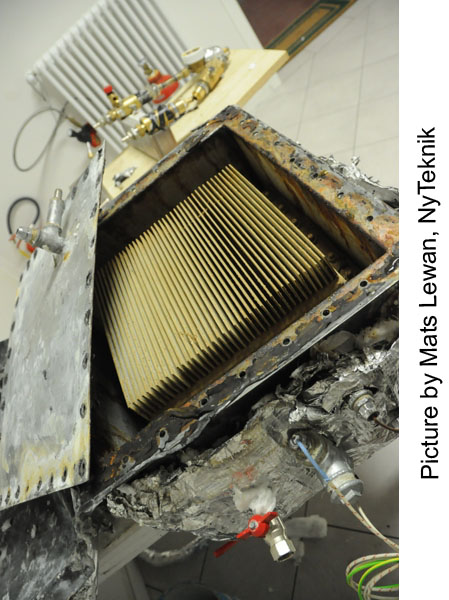
That's much bigger than is shown in Lewan's photo.
http://lenr.qumbu.com/111010_pics/lewan_DSC_0089_600_a.jpg
I'd say that it's 30 cm x 30 cm x 15 cm at MOST, and more likely
closer to Rossi's 30 cm x 30 cm x 10 cm.
Based on what data?
Note that the bolted flange is not at the bottom of the outer box, it
is in the middle. All but the upper right most conduit enter the
inner box *below* the inner box flanges. The inner box flanges are
located at about the middle depth of the outer box, as can be seen by
the front views of the box that show the entry point level for the
conduits.
The Lewan report says: "The E-cat model used in this test was
enclosed in a casing measuring about 50 x 60 x 35 centimeters."
My best estimate so far, based on pixel counts, for the width of the
outer box, including flanges, is 49.2 mm. This closely matches the
estimate given by Lewan (taken from a Rossi staff member) of 50 cm
width. The left and right outer box flanges are about 4.3 cm, thus
giving the interior width of the outer box as 40.6 cm. In my paper I
estimated 39.4 cm interior width. There is rough agreement. It thus
looks like the 50 cm width is right. I obtain 56.9 cm overall
length, including the flanges, so there is some disagreement there,
but this is a very rough estimate pending a better photo analysis. I
think the depth of 35 cm is likely very close to correct.
I estimated the distance between the top of the inner box and the
outer box to be about 3.5 cm. See "VOLUME CALCULATIONS" section, p.
5&6, and Photos 1 and 2. I estimated the depth of the cooling fins to
be 3.3 cm. This leaves a potential useful height of the inner box as
35 - 3.5 - 3.3 = 28.2 cm. My best current estimate for the useful
inner box size is 30.1 cm x 30.1 cm x 27 cm, using 1 mm for its outer
wall thickness, and assuming the bottom of the box is elevated from
the bottom of the outer box by a cm for cooling or insulation
purposes. That is 24.4 liters.
One of the reasons I ordered a new computer is so I can better model
the device via photographic analysis, etc. I yet have a long
learning curve though. These estimates can be greatly improved. If
the inner flange is at the midpoint elevation of the inner box, it is
at an elevation of 27 cm/2 + 1 cm = 14.5 cm from the bottom of the
outer box, and thus 20.5 cm from the top of the outer box. The inner
box flanges should be located about 41% of the way up the side of the
outer box. This would be just below the right most port (with the
black wire) shown in Photo. 1. It looks like the inner box flanges
might be located slightly below this, but this only indicates the
inner box flanges are no located at the middle elevation of the inner
box.
I need to add phase-change salts (and possibly even ceramic bricks)
to my fakes paper. Can you give me / point me to a likely candidate?
A good model will undoubtedly include layers of materials. I am far
from completing an analysis. I have also done nothing at all
regarding phase change materials. Phase change material have
advantages primarily in low temperature regimes. Due to a volume
restriction, a high temperature regime is likely required, or a
chemical reaction of some kind in addition to thermal storage.
As for phase change salts, I discuss the properties of NaF, NaCL and
NaNO3, potential residential thermal storage salts, here:
http://www.mtaonline.net/~hheffner/HotCold.pdf

Glauber salt is discussed here:

http://www.jatit.org/volumes/research-papers/Vol4No6/6Vol4No6.pdf
"Glauber salt (Na2SO4. H2O) which contains 44% Na2SO4 and 56%H2O has
been studied in 1952 [6,2], and it has melting temperature of 32.4ºC,
latent heat of 254Kj/Kg." Its main advantage is its low melting point.
Note that if phase change storage is used then the heat flux will
taper off quickly once the cooling phase change is complete.
Here are some values that may be of interest:

http://www.mtaonline.net/~hheffner/ThermalStorage.pdf


Best regards,

Horace Heffner
http://www.mtaonline.net/~hheffner/