Interesting, can you point me to any sources that discuss those issues?

On 15 June 2012 21:11, Axil Axil <[email protected]> wrote:
> Details, details, details…
>
> There are some fundamental political as well as technical problems with
> the LFTR that take some of the luster off your high opinion of this
> technology.
>
> One of the most insidious is the desire of the LFTR advocacy crowd to
> require the use of 19.75% enriched U235 to perpetually provide the
> supplemental neutrons needed to keep the thorium fuel cycle critical. Even
> worst is the desire to use plutonium as the source of supplemental
> neutrons. You can build bombs with reactor grade Plutonium as demonstrated
> by some bomb tests in India and the USA.
>
> Then there is the need for U233 denaturing with U238 at a rate of 88%.
> This produces lots of plutonium which is always a proliferation risk.
>
> The only way to get a PURE thorium fuel cycle is to use hot fusion is some
> way in a hybrid to eliminate the need for uranium235 and plutonium. But the
> LFTR advocates say that fusion is not viable.
>
> So currently a LFTR with a PURE thorium fuel cycle is a fantasy.
>
>
> Cheers:  Axil
> On Fri, Jun 15, 2012 at 1:43 PM, Robert Lynn <
> [email protected]> wrote:
>
>>
>>> 1/  The power source is too diffuse, and the sun doesn't shine at night
>>>> meaning you need a huge plant to produce significant power.
>>>>
>>>
>>> This is 110 MW on 1,600 acres. That is excellent power density. Better
>>> than uranium fission or coal, when you take into account the land needed
>>> for the mines and railroads to transport the fuel.
>>>
>>
>> 100MW/year is about 70kg of thorium in a LFTR (about 250 times less than
>> a conventional non-breeding uranium reactor requires), at average 6ppm
>> there is about 70kg of thorium in the accessible column of earth under
>> every square meter of the earth's crust.  Thorium deposits are of course
>> far more concentrated, so you can see the mined land and infrastructure
>> needed to produce 70kg of thorium per year are relatively tiny and the
>> thorium itself is benign enough to delivered by a postman.  LTFR waste
>> decays below natural uranium radioactivity in 300 years.
>>
>>
>>> 2/  You have to build mirrors heavy to survive weather/environment.
>>>>  Hail, snow, rain, salt, wind, dust and UV all mean that the construction
>>>> needs to be reasonably heavy if you want it to survive decades even if the
>>>> bad weather is infrequent.
>>>>
>>>
>>> That has not been a problem with existing installations. The LUZ
>>> installations have lasted for 30 years in a harsh environment.
>>>
>>
>> The point is that existing CSP is heavy but the environment means that it
>> can't be made much lighter to reduce costs.  Each m² contains 10's of kg of
>> expensive low iron and borosilicate glass, metals, plastics, paints,
>> concrete, mirror controls, copper wiring, bearings, stainless steel heat
>> piping, silver coatings etc and yet only delivers about 100W averaged over
>> the year.  All that material content and its processing is a large part of
>> the reason that CSP is currently optimistically $4000/kW nameplate
>> capacity, but at $0.05/kWh delivers only about $100 worth of electricity
>> per year.
>>
>>
>>
>>>
>>>
>>>> 3/  The plants are a relatively long distance from consumers and
>>>> existing grid infrastructure - expensive grid connections.
>>>>
>>>
>>> That is a problem with some wind installations, but not a problem with
>>> solar PV or CSP. The PV installations are being built right on the grounds
>>> of gas turbine generators, giving the overall installation about 10% more
>>> peak power. The Crescent Dunes installation is right next to a major high
>>> voltage line so it will not cost any more than a conventional generator to
>>> hook up. That's why they put it there.
>>>
>>> Solar is more flexible than wind.
>>>
>>> Most solar power in Japan is a couple of meters away from the people who
>>> will use it, right on the roof. In southern Japan -- which resembles the
>>> U.S. southwest only with lots more rain -- solar roofs are everywhere these
>>> days. They do not generate much power on rainy days, but people do not need
>>> much power on rainy days.
>>>
>>>
>>>> 4/  There will be alternative extremely cheap sources of intense heat
>>>> energy available for foreseeable future (fossil fuels + nuclear, probably
>>>> LENR, maybe hot fusion).
>>>>
>>>
>>> Nuclear is not cheap! Not after Fukushima. Fossil fuels are only cheap
>>> because the power companies do  not pay for the 20,000 they murder every
>>> year, and they will not pay for the cost of global warming. Add in those
>>> costs and coal or natural gas would cost FAR more than CSP.
>>>
>>
>> That is ridiculous, every industry has a death toll and of course the
>> fossil fuel industry pays for those lives, in insurance levies, higher
>> salaries for dangerous jobs etc.  But there are different standards in the
>> West to the developing world where most of those deaths occur as life is
>> not valued so highly.  Coal is 15 deaths per TWh in USA, but almost 300 in
>> China.  Gas is just 4 per TWh worldwide (1 TWh is worth about $200 million
>> at retail level).
>>
>> Nuclear is in global terms still extremely safe even after Fukushima and
>> Chernobyl, and will be very cheap once perfected, but we are not there yet.
>>  The global nuclear plant development hiatus of the last 30 years hurt, and
>> antiquated plants like fukushima have to go, but new build nuclear is
>> <$2000/kW in China (targeting $1000/kW) and much much safer, with tiny fuel
>> and operations costs.  However it is still only a stop-gap until breeder
>> reactors are developed to reduce waste and Thorium in particular offers
>> huge gains in safety, waste minimisation and fuel efficiency that will all
>> lead to big cost savings.  If you are willing to assume favourable learning
>> curves for CSP then you should be willing to do the same for nuclear.
>>
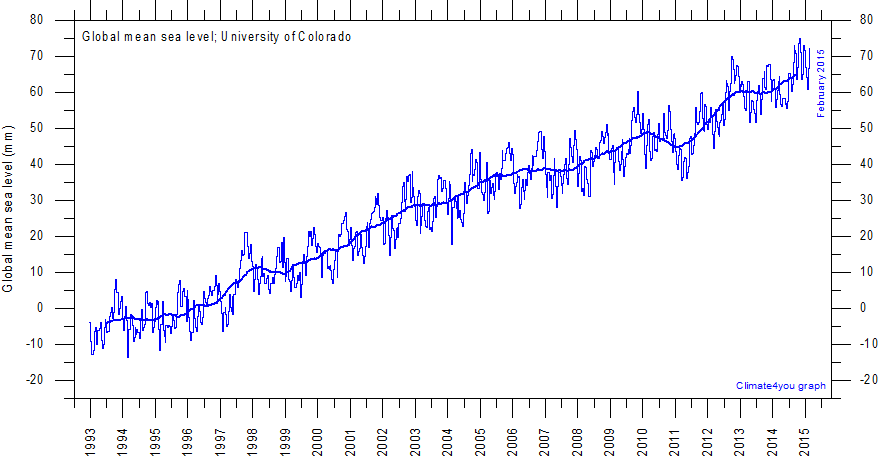
>> Without wanting to open another can of worms, not a whole lot of warming
>> apparent in last 15 years, and falling rate of sea level rise since 2006.
>>  While the earth warmed in the 20th century and it seems most likely CO2
>> had some positive effect, the IPCC's assumed high positive H20 feedbacks
>> were ill-founded and are now being steadily revised downwards.  Even their
>> "best-case" model predictions from 10 years ago have now been shown to be
>> excessively pessimistic.  Seems very likely that CO2 driven thermaggedon
>> isn't as bad as was advertised.
>>
>> http://www.woodfortrees.org/plot/rss/from:1997/to:2013/plot/rss/from:1997/to:2013/trend
>>
>> http://climate4you.com/images/UnivColorado%20MeanSeaLevelSince1992%20With1yrRunningAverage.gif
>> Given current temperature and seal level trends I'm content to have the
>> earth climate change as we it may without political intervention for
>> another few decades as we transition to nuclear or LENR for sound economic
>> reasons without seeing the need for a gun to be held to our heads.
>>
>>
>>> Given massive availability of shale gas produced electricity at
>>>> $0.04-0.06/kWh (currently <$0.04/kWh in USA due to extremely low gas price)
>>>> . . .
>>>>
>>>
>>> That price does not include the cost of the land that is destroyed by
>>> fraking. Add that in and we are paying a fortune and destroying our living
>>> space, our wildlife and our future.
>>>
>>
>>> If you burn the furniture in your house in winter to keep warm, you can
>>> live cheaply for a month. Then what do you do? After we destroy large parts
>>> of New York, Pennsylvania and West Virginia, where will we live? What will
>>> we eat?
>>>
>>
>> How about doing the frakking in uninhabited regions instead?  US is not
>> short of alternative gas resources.  Sounds like either there is a problem
>> with your democracy not functioning very well, or the land is not actually
>> being destroyed or rendered uninhabitable as you claim so people are not
>> voting against it.  How exactly is land destroyed by frakking anyway?
>>
>>
>>>
>>>
>>>> and the best CSP running along at $0.2-0.3/kWh, there is just no
>>>> foreseeable technology path that can bring the CSP cost down by a factor of
>>>> 4 to compete with gas and (eventually) nuclear.
>>>>
>>>
>>> That's absurd. What is so expensive about making mirrors? Do you think
>>> they cost far more than gas turbines? And what do you think coal
>>> electricity would cost if 20,000 families every years successfully sued
>>> them for murdering their fathers and mothers? As I said here before, if the
>>> airlines killed 20,000 people in one year, the entire aviation industry
>>> would be closed down, and we would soon have high speed trains instead. The
>>> only reason that does not happen with coal fired electricity is because the
>>> victims are poor people living downwind of the generators. They do not vote
>>> and they cannot afford to file suits, so you can kill them off with
>>> impunity. No one but his family gives a damn when a poor person dies at age
>>> 60 instead of 70 or 80.
>>>
>>
>> Yes, CSP mirrors are demonstrably far more expensive than gas turbines.
>>  $300/kW for the glass alone ($30/m², need about 10m² for 1kW 24 hours per
>> day), without all the other fabrication, installation, thermal plant, land,
>> etc.  The CSP mirror industry has already had the opportunity to travel far
>> down the learning curve, being not much different from mass producing
>> window glass (though the materials are a little different, particularly
>> low-iron and expensive borosilicateglass) but are not reducing cost
>> significantly.
>>
>> I'm all for getting rid of coal for power, it should at most be a
>> feedstock for metals and chemicals.  Coal is rapidly being supplanted by
>> gas anyway, that more than halves CO2 for the same power output.  It also
>> produces far fewer noxious emissions (though why would you put up with
>> dirty coal stacks when tech exists to clean them up - poor democracy or are
>> we talking developing world again?)
>>
>>
>