Very nice work!
Alan, as I understand, you apply natural convection and no forced
(controlled) cooling. Right?
Op woensdag 26 juni 2013 schreef Alan Fletcher ([email protected]) het volgende:

> (I posted some of these in the Penon topic -- I have to redo all the
> pictures for the web version).
>
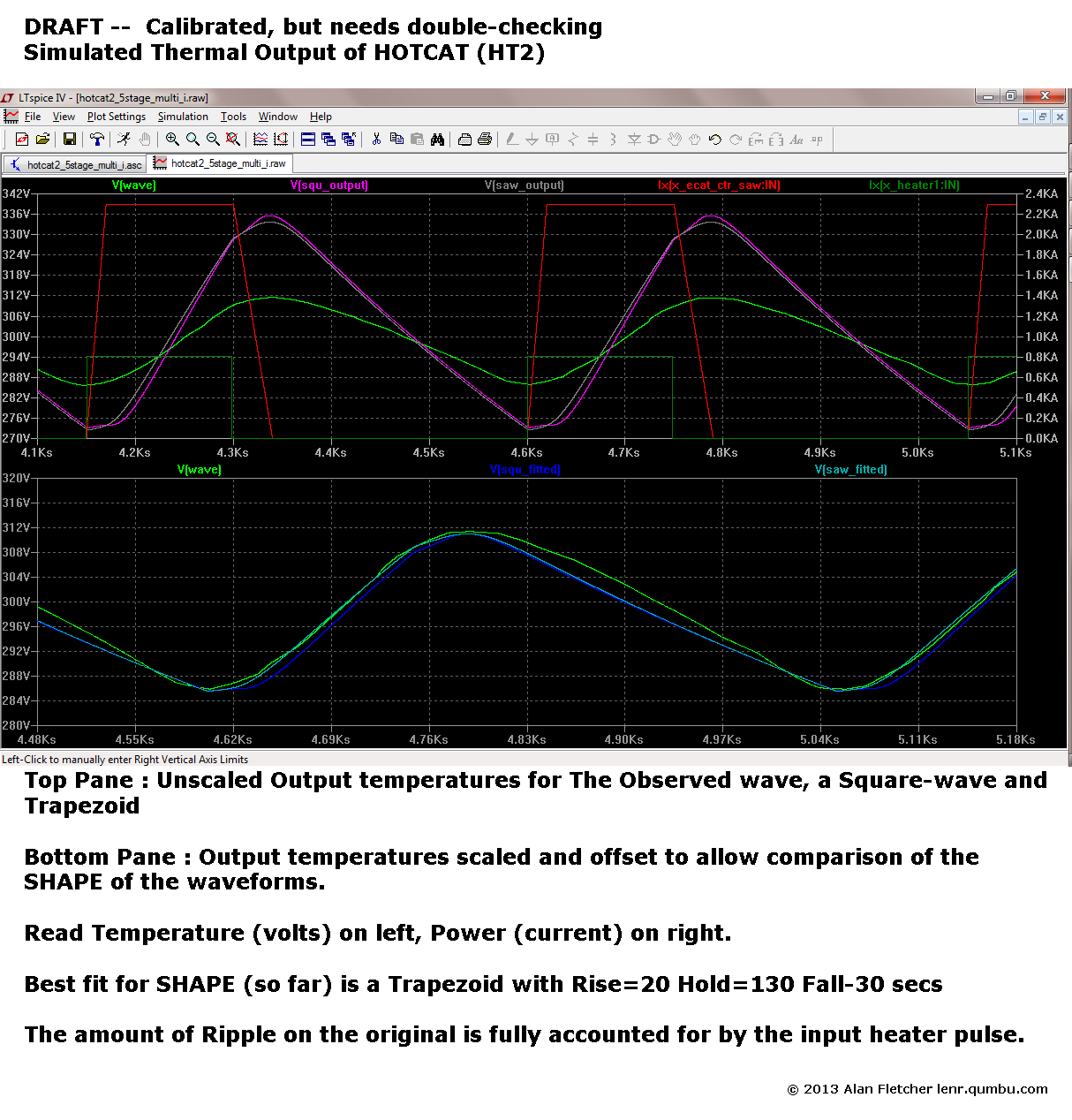
> My current "best fit" for the waveforms is an almost-trapezoid Rise=20
> Hold=130 Fall=30
>
> http://lenr.qumbu.com/web_hotcat_spice/130625_spice_01.png
>
> I've done a "good enough" digitization of the original waveform.
>
> Note that the amount of ripple in the waveform is fully accounted for by
> the input square-wave pulse. Any other ripple is additive.
>
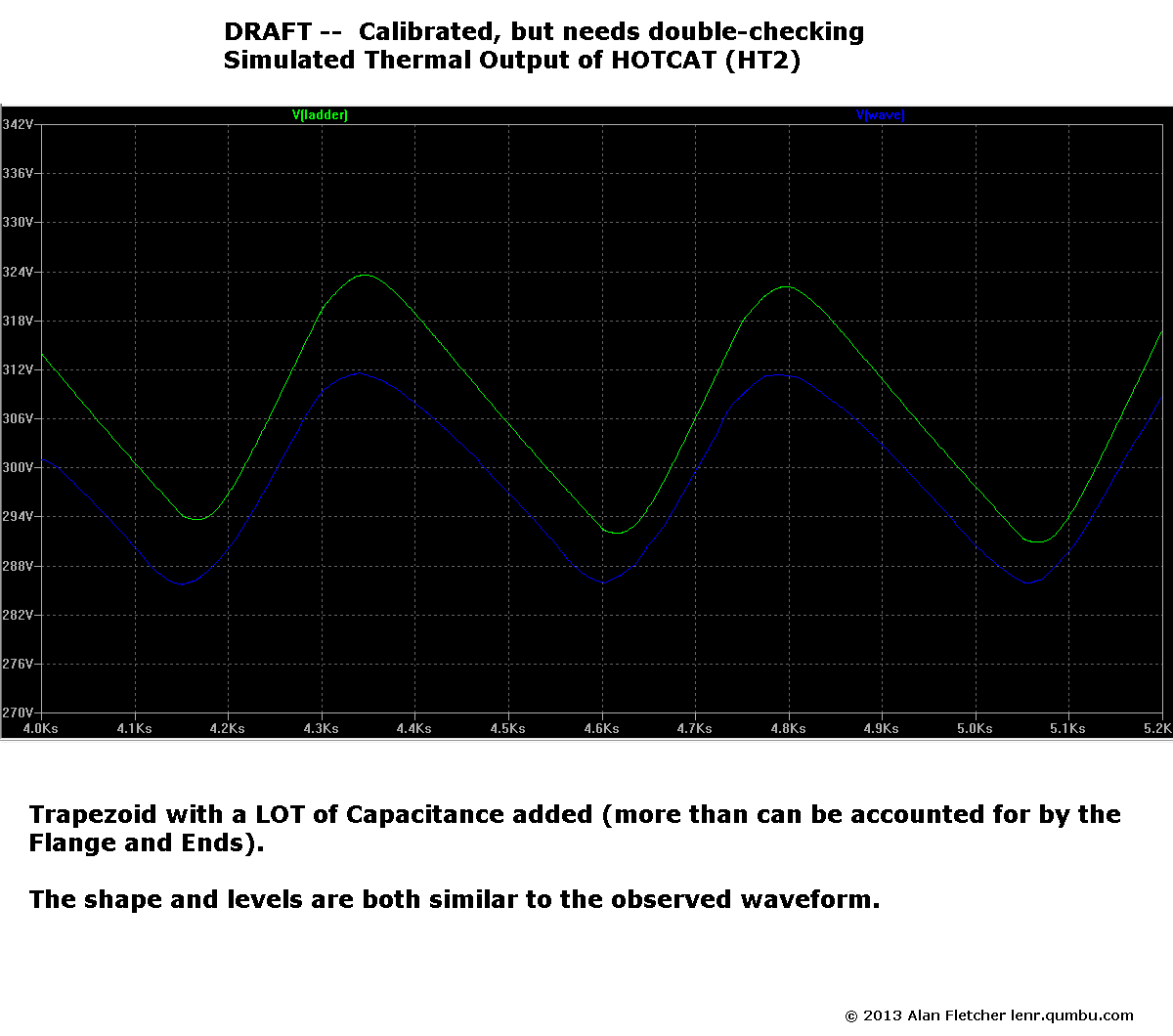
> The only other explanation is that there's more "RC" in the circuit than
> in my model, which would cause the signal to "hold" longer at the tail.
>  There is some RC in the flange and the ends .. but they also provide a
> path for pulling it down.
>
> http://lenr.qumbu.com/web_hotcat_spice/130625_spice_03.png
>
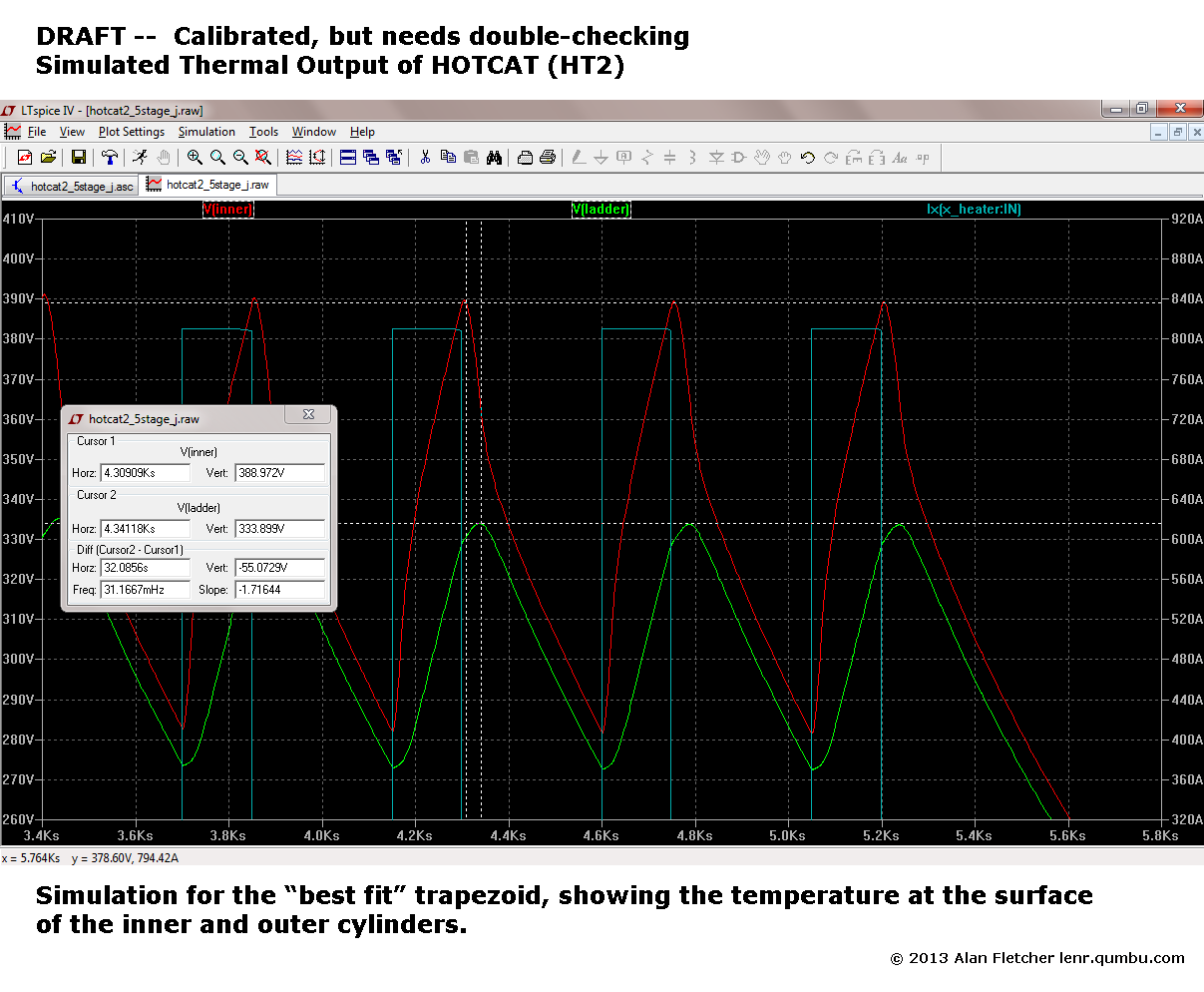
> And for that waveform, these are the temperatures at the inner and outer
> steel cylinders.
>
> http://lenr.qumbu.com/web_hotcat_spice/130625_spice_02.png
>
> There's only a 55C difference between the two. I expected it to be much
> higher.
> (The reason is that corundum is a good thermal conductor).
>
>
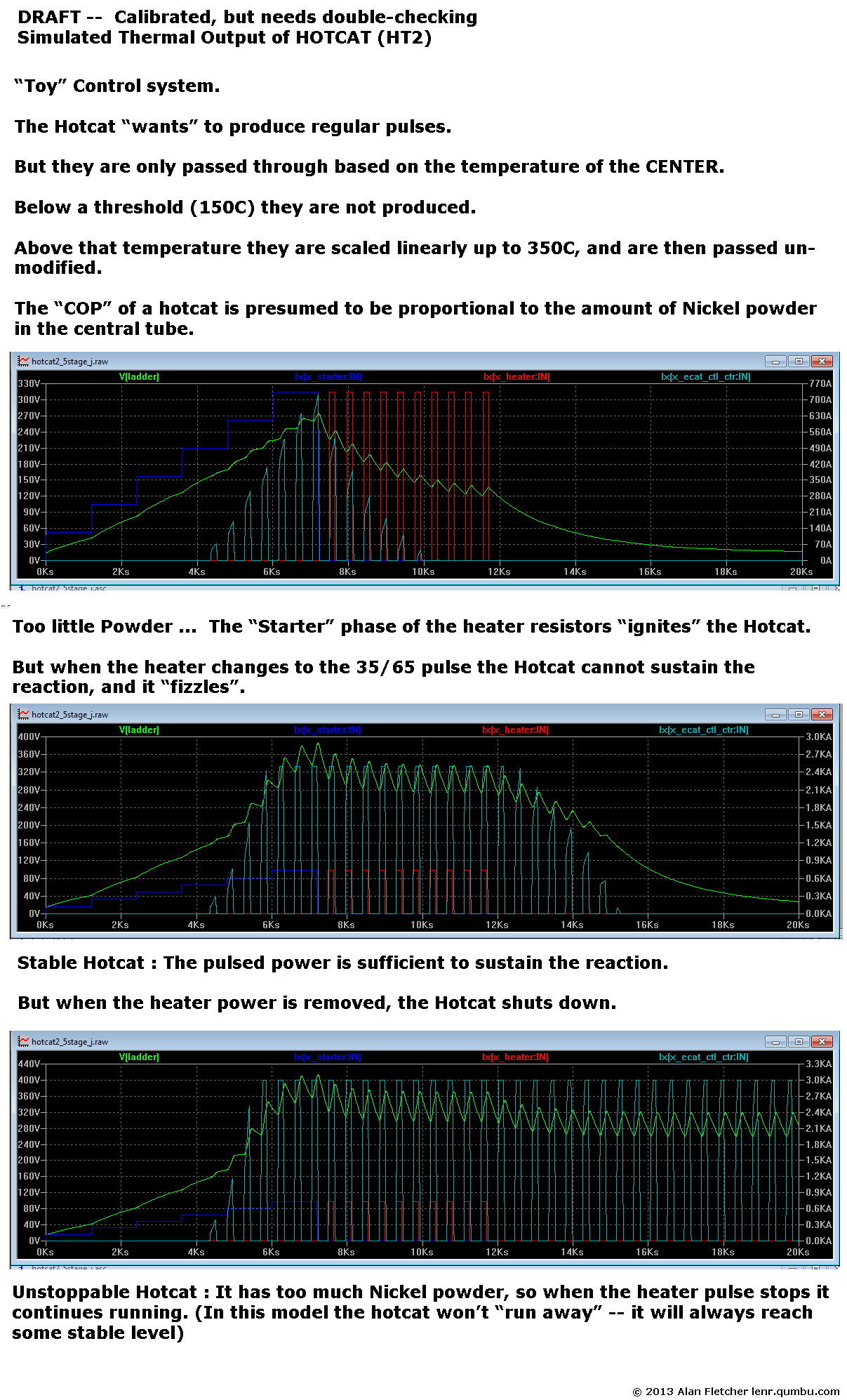
> The following is an ILLUSTRATION of a "Toy" control system, in which the
> Hotcat requires a threshold center temperature before it fires (150C),
> increases linearly up to 350C and then stays constant (and therefore won't
> increase exponentially).
>
> It shows how the addition of the "pulse" heat allows the reaction to
> continue, but withdrawing it causes it to stop.
>
> http://lenr.qumbu.com/web_hotcat_spice/130625_spice_10_12.png
>
> (I don't attempt to explain how the pulses of Hotcat energy are formed, or
> are synchronized with the heater pulse).
>
>