On Fri, Feb 21, 2014 at 2:51 PM, David Roberson <[email protected]> wrote:
Harry, I am currently supporting the idea that acceleration is the main
> reason for the clock differences because it would not appear reasonble to
> expect a difference in clock readings if both observers continued to move
> at constant velocities.


This is similar to the explanation I have heard.  It is something like this
-- the commonly known rules of relativity apply two observers in different
*inertial* frames.  When one of the parties accelerates, the situation
changes.  The act of accelerating appears to decrease the rate at which
time progresses for the friend who accelerates, and then to speed it back
up when he decelerates later on.

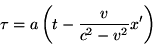
https://www.fourmilab.ch/etexts/einstein/specrel/www/figures/img27.gif

For the curious, following is an equation from Einstein's 1905 paper that
relates time for two bodies in motion relative to one another.  Here I
believe the coordinates of the two inertial frames are set up so that only
x and x' differ, such that *x' = x - vt*.  I think one of the bodies is
understood to be at velocity *v*=0.

Eric