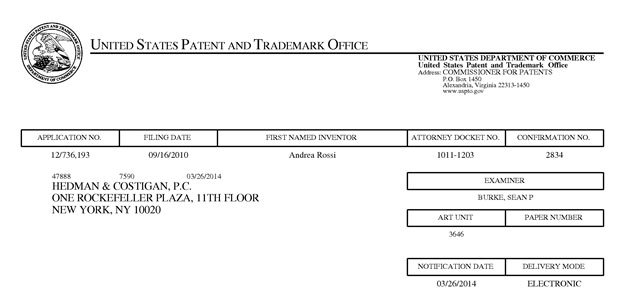
US Examiner Addresses Andrea Rossi US Patent Application

Previous<http://coldfusionnow.org/2014-cflanr-colloquium-at-mit-video-files/>
Next<http://coldfusionnow.org/lenr-the-promise-of-clean-and-affordable-energy-at-university-of-northern-iowa/>
   -
<http://coldfusionnow.org/wp-content/uploads/2014/03/Title-Rossi-Patent.jpg>


   -
   -

US Examiner Addresses Andrea Rossi US Patent Application

The US Examiner at the United States Patent Office has finally reached
the patent
application
<http://appft.uspto.gov/netacgi/nph-Parser?Sect1=PTO2&Sect2=HITOFF&p=1&u=%2Fnetahtml%2FPTO%2Fsearch-bool.html&r=6&f=G&l=50&co1=AND&d=PG01&s1=andrea.IN.&s2=Rossi.IN.&OS=IN/andrea+AND+IN/Rossi&RS=IN/andrea+AND+IN/Rossi>of
Andrea Rossi. That application was first filed as an Italian filing on
April 9, 2008. It was translated into English and up-graded into an
application under the Patent Cooperation Treaty
<http://patentscope.wipo.int/search/en/WO2009125444>- PCT on August 4,
2009. And it finally arrived at the US Patent Office as of September 16,
2010.

The text of the disclosure in this application became frozen as of the date
of the PCT filing, August 4, 2009. It is not permissible to amend the story
after the “final” filing of a regular patent application, which is how a
PCT application is treated. Therefore this application represents Rossi’s
understanding of his invention as of August 4, 2009.

As is usual with a first initiative by a US Patent Office Examiner, this Office
Action<http://coldfusionnow.org/wp-content/uploads/2014/03/Rossi-US-appln-SN12-736193-Office-Action-rejection-7pgs-24Mar141.pdf>rejects
the application. Rossi now has three months from March 26, 2014,
extendable upon fee payments up to six months, to file a Response. That
Response must overcome the Examiner’s objections or the application will go
abandoned, unless Rossi pays fees for Continued Examination or files an
appeal.

The key claim that Rossi was endeavoring to obtain reads as follows:

“1. A method for carrying out an hexothermal reaction of nickel and
hydrogen, characterized in that said method comprises the steps of
providing a metal tube, introducing into said metal tube a nanometric
particle nickel powder and injecting into said metal tube a hydrogen gas
having a temperature much greater than 150.degree. C. and a pressure much
greater than 2 bars.”

“Hexothermal” is spelling error for “exothermal” which can easily be
corrected. This claim is supposed to identify a new method which will
produce excess heat.

While the application explicitly states, in para [0065]: “the invention
actually provides a true nuclear cold fusion”, the Examiner’s Office Action
does not use the expression “Cold Fusion” to criticize the filing. Instead,
the Examiner expressed doubt that the described invention would be able to
provide the heat as alleged and claimed. He therefore concluded that,
unless shown to the contrary, he was going to rule that the invention does
not work, i.e. it is “inoperable”. An invention must be useful to qualify
for a patent. Therefore, unless Rossi can prove the contrary, this
application will be rejected for failing to meet the utility requirement of
Section 101 of the US Patent Act.

While Rossi cannot add any further text to the disclosure in this
application by way of amendment, if he can show that, following the recipes
set-out in his original disclosure, the results as promised can actually be
achieved, then the Examiner may withdraw this objection. Rossi would have
to provide authoritative evidence to this effect, probably from an
independent source such as a Research Institute or an established
Engineering firm in order to be sure of satisfying the Examiner. That may
cost a substantial amount of money.

Unfortunately, any outside evaluator would be required to follow the
procedures described in the application based on knowledge as it existed as
of the date of the PCT filing on August 4, 2009. This may prove a barrier
to demonstrating utility.

As an additional ground of rejection, the Examiner has also alleged that
the disclosure is inadequate as failing to meet the requirements of Section
112 of the US Patent Act which reads as follows:

“The specification shall contain a written description of the invention,
and of the manner and process of making and using it, in such full, clear,
concise, and exact terms as to enable any person skilled in the art to
which it pertains, or with which it is most nearly connected, to make and
use the same, and shall set forth the best mode contemplated by the
inventor of carrying out his invention.”

Rossi faces the challenge that he must not only prove that the invention as
described in the application actually works in the manner as promised, but
also that the disclosure is sufficient to enable others to achieve such
useful results.

The Examiner did not refer to this specific passage in the disclosure of
the Rossi patent application:

“[0025] In applicant exothermal reaction the hydrogen nuclei, due to a high
absorbing capability of nickel therefor, are compressed about the metal
atom nuclei, while said high temperature generates internuclear percussions
which are made stronger by the catalytic action of optional elements,
thereby triggering a capture of a proton by the nickel powder, with a
consequent transformation of nickel to copper and a beta+ decay of the
latter to a nickel nucleus having a mass which is by an unit larger than
that of the starting nickel.”

The feature of using catalyzing material is addressed in one of the
dependent claims as follows:

“8. A method according to claim 1, characterized in that in said method
catalyze materials are used.”

Claim 8 could never go forward. There is no description in the disclosure
identifying what constitutes the specific catalyzing materials. Nothing can
be claimed that it is not supported by an enabling disclosure in the body
of the patent specification.

Furthermore, applicants are expected to describe the: “best mode
contemplated by the inventor of carrying out his invention”. If the
applicant knows of special catalytic materials that make the invention work
better, then he is required to disclose them in the application. Having
acknowledged that such materials exist and having failed to identify them,
this application violates the requirements of Section 112 and could be
rejected on that basis. The Examiner may raise this point in a future
Office Action if prosecution continues.

This is a serious deficiency in this application.

Another example of inadequate patent drafting is the following statement in
the disclosure:

“[0062] The above mentioned apparatus, which has not been yet publicly
disclosed, has demonstrated that, for a proper operation, the hydrogen
injection must be carried out under a variable pressure.”

If it is known that a mandatory procedure must be employed in order to make
a claimed process operate properly, then that procedure has to be included
in the principal claim, Claim 1. In this case, such a limitation has not
been incorporated into Claim 1. This claim could have been rejected on that
basis alone.

One of the depending dependent claims does provide as follows:

“4. A method according to claim 1, characterized in that said hydrogen is
injected into said tube under a pulsating pressure.”

Being a dependent claim, Claim 4 overcomes this deficiency of Claim 1 in
that it does incorporate a feature asserted to be essential in the
disclosure. The limitations of Claim 4 are therefore directly available to
be added to Claim 1 in an attempt to repair its deficiency.

However, claims must also be definite and an Examiner would typically ask
for limitations to be included in the claim that characterize the types of
pulsations suitable to ensure that the claim covers a fully functional
procedure. If a Response were to be filed, it would be appropriate to
search through the disclosure for ranges and other limitations on pressure
pulses to be incorporated into Claim 1 in order to ensure that Claim 1
describes a method that actually works.

There are no references in the disclosure as to the nature of the
pulsations: their strength, frequency, duration, waveform or other
parameters. If the Examiner were to raise this type of objection the
consequences would be fatal to the application

There are therefore many grounds for the Examiner to have rejected this
application. Not all were applied in this first Office Action. Instead, the
Examiner relied upon lack of operability as the primary objection. In
addition, he also made a novelty objection based on the assertion that
Claim 1 describes something that had been done before, referring to
published experiments wherein nickel was converted to copper by ionic
bombardment using a linear accelerator. This is a pretty lame objection. A
reading of Claim 1 will show that there is no stipulation in the claim that
a nuclear transmutation will occur. Rather, it is in the discussion of
theory in the disclosure that such allegations are made. The Examiner is
wrong in criticizing Claim 1 on this basis. The Examiner was simply
confused or inattentive in making this objection.

The disclosure contains an extended discussion of theory which, rather than
helping an applicant will usually only get an applicant in difficulty. It’s
not necessary to describe a theory why something should work. It’s
essential to describe a procedure by which an actual operating version of
the invention can be implemented. Any description of a theory is
superfluous. Indeed, it is dangerous to suggest a theory; the theory might
be wrong. As has occurred here the Examiner has seized upon flaws in the
theories recited to justify his skepticism that the invention actually
works as promised. It would have been much better, for patenting purposes,
not to have included any discussion of theory.

One can only speculate how a patent application such as this was originally
drafted and managed to go forward. It must have cost the applicant tens of
thousands of dollars, including translations from the Italian, to get to
this stage. Was this done intentionally, knowingly that the application was
deficient? This is not logical. It’s more likely that the original patent
attorney simply wrote down the material as reported to him by the inventor
without giving feedback and guidance on the inadequacy of the disclosure.
This happens all too often.

Inventors should be more aware of what is really expected to produce a
patent application that will support a valid patent grant. This is quite
apart from the separate issue of producing a valuable patent which is
meaningful and effective. To minimize the risks of spending money futilely,
in the case of important inventions, it would be appropriate to get a
second opinion from a second attorney. This should be done well before the
end of the initial priority year in time to make adjustments and
corrections before the one-year deadline arrives.

This application by Andrea Rossi has been available for public examination
for several years. If it describes a working invention one would presume
that others would have followed the instructions in the disclosure and
achieved the promise of excess energy. Though not proof of the inadequacy
of the disclosure, such validating demonstrations have not been publicly
disclosed. One can only speculate why this has not occurred.

Andrea Rossi is entitled to file further applications containing an
improved disclosure so long as his claims focus on material that is new,
i.e., are limited covering only things not previously available to the
public. Such applications are not published until they have been pending
for 18 months from the earliest, original filing date. It is possible that
Mr. Rossi has a follow-on application that has already been filed but is
not yet published. We can only wait in order to see if this is true.
*David French is a retired patent attorney and the principal and CEO of
Second Counsel Services. Second Counsel provides guidance for companies
that wish to improve their management of Intellectual Property. For more
information visit: www.SecondCounsel.com <http://www.secondcounsel.com/>. *


On Sun, May 11, 2014 at 4:35 PM, Blaze Spinnaker
<[email protected]>wrote:

> Define what you mean by protection.
>
> Rossi is not going to get a patent on anything until he actually explains
> exactly what he's doing.
>
>
> On Sun, May 11, 2014 at 3:39 PM, Bob Cook <[email protected]> wrote:
>
>>  Daniel--
>>
>> What is your understanding of when day 1 starts--when the patent is
>> approved or when the application is made?  Rossi's application was made in
>> 2009 TMK, and 17 years of protection is added from the day the patent is
>> approved or issued by the PO, if that happens.
>>
>> Bob
>>
>> ----- Original Message -----
>> *From:* Daniel Rocha <[email protected]>
>> *To:* John Milstone <[email protected]>
>> *Sent:* Sunday, May 11, 2014 2:50 PM
>> *Subject:* Re: [Vo]:Re: [Vo] Rossi Effect Not Before June--
>>
>> For patents, protection starts on day 1. I really don't know what Rossi
>> can do.
>>
>>
>> 2014-05-11 18:43 GMT-03:00 Bob Cook <[email protected]>:
>>
>>> [image: Boxbe] <https://www.boxbe.com/overview> This message is
>>> eligible for Automatic Cleanup! ([email protected]) Add cleanup
>>> rule<https://www.boxbe.com/popup?url=https%3A%2F%2Fwww.boxbe.com%2Fcleanup%3Ftoken%3DmRRux2H3q%252B9F%252BuWwp1Mrx6gWi5zk7GqQVeOFTaOE37MtA%252B4BLepSvOOe7mBVZATvrJ0ZZifEGIoto0W%252B6cAwryMD7g9cZjGhlrySa8i2GsJMkBLAQc5RlQ%252F3%252BQACYaEWOprEYR6ukS6u3GmK%252Bszt2g%253D%253D%26key%3DKrGP2iBQpgwFNT3TnEBKL2EZKxSbV4fSt1Sy8YFOttY%253D&tc_serial=17214702678&tc_rand=1549094390&utm_source=stf&utm_medium=email&utm_campaign=ANNO_CLEANUP_ADD&utm_content=001>|
>>>  More
>>> info<http://blog.boxbe.com/general/boxbe-automatic-cleanup?tc_serial=17214702678&tc_rand=1549094390&utm_source=stf&utm_medium=email&utm_campaign=ANNO_CLEANUP_ADD&utm_content=001>
>>>
>>>  Rossi's partners at Industrial Heat (IH) are probably familiar with
>>> the patent system and are stringing out the issuance as long as possible.
>>>
>>
>> --
>> Daniel Rocha - RJ
>> [email protected]
>>
>>
>