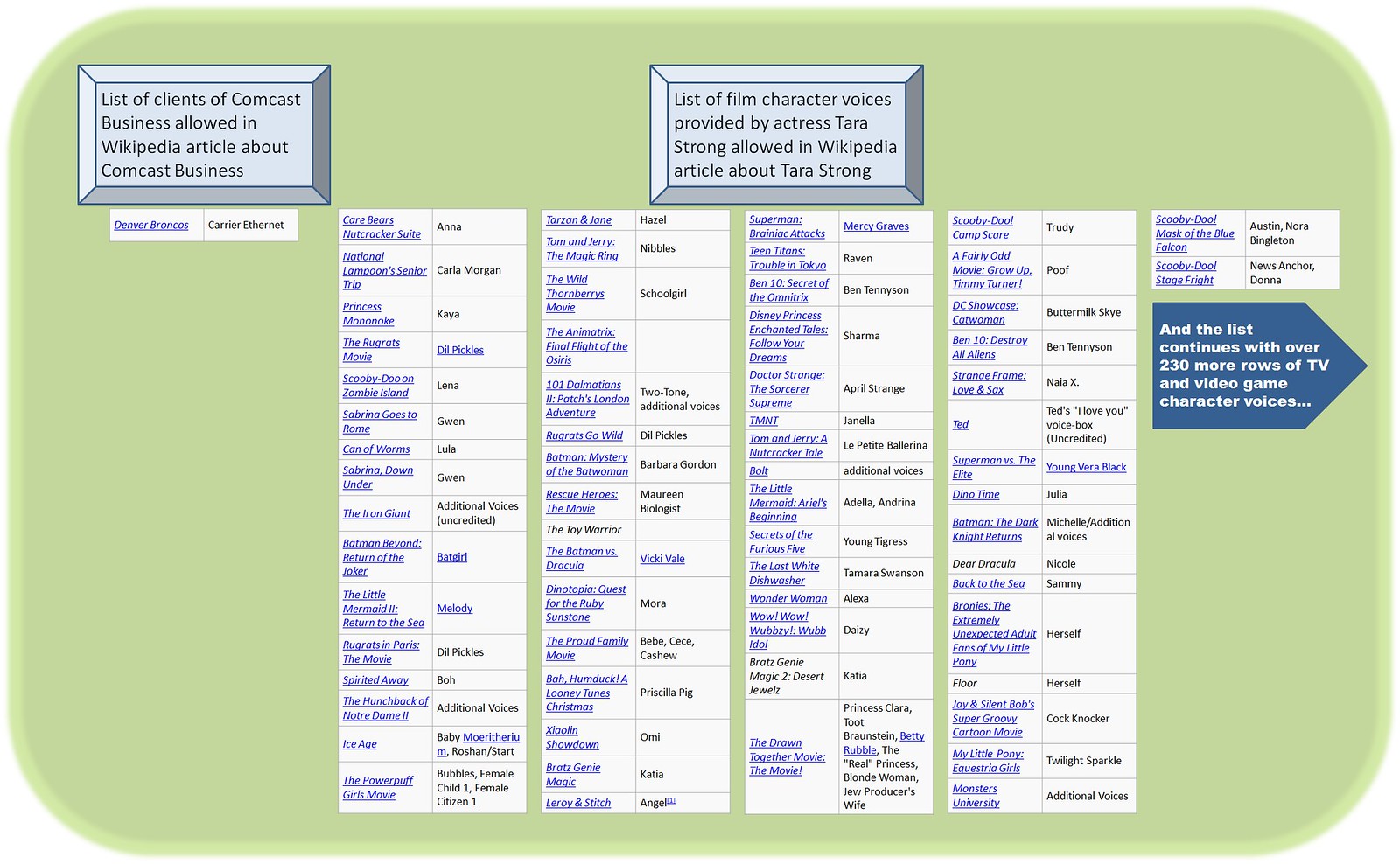
Christophe's comment about Wikipedia's company articles not being very
complete reminded me of a fun infographic:
http://farm6.staticflickr.com/5474/11871822903_714f36a83e_h.jpg

There is a strange, systemic hostility towards business at work in the
English Wikipedia. Combined with a love for pop trivia ...


On Fri, Jan 10, 2014 at 12:34 PM, Christophe Henner <
[email protected]> wrote:

> Hi everyone,
>
> I'll try to elaborate on this topic :)
>
> First of all, in 2011 in Haifa I did a first talk about companies and
> Wikipedia. I did that because I was making a "study" (emphasis on the
> " as I'm not keen to say it's a study and more of a detailed
> observation) of the state of the articles of the top 40 french
> companies.
>
> During that talk I explained how I believe companies could help us
> improve our projects. I won't get too much into that as, since then,
> the debate evolved from "companies editing Wikipedia" to "Paid editing
> is evil".
>
> This year at Wikimania I gave two talks about this very topic, one
> about how third party organizations can help us and the second on a
> framework to have editing.
>
> Of course, as usual, some people were "against it".
>
> But how can we, as a community, be against "paid editing" on one hand
> when on the other hand we seek "paid editing" from GLAMs, researchers
> from state organizations, etc.
>
> The question whether we allow, or not, paid editing is non-existent.
> Paid editing is allowed, we already allowed it, we even support it;
>
> Now, the question about "paid advocacy". Again, one of our core
> principle is NPOV. We don't want people to push their POV. Whether
> they're paid or not, is not relevant.
>
> So, to me, the "paid foobar" question is not the one in debate here.
> The one we're actually debating about is "do we want for profit
> organization to edit Wikipedia".
>
> So yes, paid organizations have an interest in editing Wikipedia, but
> just as much as GLAMs have an interest in editing our projects. In
> fact, when Wikimedian meets GLAMs one of the key arguments is "look at
> (pick past project that got great coverage such as the bundesarchives,
> British Museum, etc)". We show them they have an interest in
> committing resources, both financial and human, to improve Wikimedia
> projects.
>
> So the "they have an interest in editing" isn't an argument in the
> end, as, of course a lot of editors have an interest in editing. And
> we're using it. When we think or work on how researchers valorize
> their edits in their cursus, those researchers have an interest in
> editing Wikipedia.
>
> So, really what is that people working for a company have that makes
> it so we have to ban them to edit? If we already have people paid to
> edit, if we have people with interests (henceforth some sort of COI),
> what do they have the others don't?
>
> Now, why do I strongly believe we should encourage companies to edit
> Wikipedia.
>
> First of all, as I said some years ago I evaluated the quality of
> company articles on the French Wikipedia. Most of them were crap.
> Either outdated, incomplete or with wrong information, all those
> articles were poor; And we're talking about the top 40 french
> companies, such as Orange, L'Oréal, Renault, BNP, etc.
>
> The volunteer community isn't keen to improve and maintain those
> articles. Companies are willing to do it. So we prefer to have poor
> articles instead of good ones because there's a risk companies will
> act wrongfully (I hope I'm not the only one to see the irony in this
> situation where we prefer to ban editors because there's a risk
> they'll do wrong. We should do that for all the projects, Close them
> to editing because there's a risk people will do wrong.).
>
> Adapting our projects to provide a framework where companies can
> easily fit in and edit as a direct consequence, improve the quality of
> their articles.
>
> Companies that have the resources to commit to such things are,
> usually, big and sometimes old company. Imagine that in a few year,
> being involved with the Wikimedia projects is so natural for those
> companies that they release their archives on the Wikimedia Projects.
> What archives do you ask?
>
> Orange, for example, is the former organization in charge of the
> french telecom. They managed telephone for a very long time and have a
> long history in R&D. Their archives must be astounding. Containing
> documents, pictures and videos about telecomunication that should be
> awesome. That are part of our history.
> Right now, those archives are dusting in some building. And in few
> years they might disappear.
> Our stance, being so opposed to companies making the first step
> (editing) prevent companies to go the next step, release. And in fact,
> indirectly, we're preventing knowledge to be freed. Awesome.
>
> Lastly, those companies have huge R&D budgets and employ thousands of
> researchers and engineers. Imagine a company that employs 1 000
> researchers. And imagine that company to do 2 things:
> 1/ that a company, as part of its CSR politic, says they commit 1 day
> per year per researcher to improve one article. And to provide to
> those researchers a one day training session about Wikipedia. This
> means 1 000 days of editing from specialized researchers and 1 000
> researchers evangelized and trained to edit.
> 2/ that this company would commit 0.0001% of it's R&D global budget to
> open a Q&A desk so wikimedians could ask their researchers for
> bibliography or proof reading articles
>
> Those things are not wild dreams, they could definitely happen
> (especially when you see how much money is spent in CSR actions). But
> we, as a community, refuse to tap into this.
>
> I'll stop here, my email is already quiet long, but by "baning" any
> "paid foobar" we are actually preventing the improvement of
> corporations related articles, destroying potential free knowledge and
> refusing to train and advocate about Wikipedia to thousand of people
> at a time.
>
> When I see the strategy of the movement, how much we need to get new
> editors and how poorly we do in some fields, I'm shocked by how easily
> we ban those possibilities to happen. And for what reason? Because
> they're for-profit companies.
>
> Best,
>
> PS: a short matrix of what we, as a community, we allow/disallow from
> reality and from discussions. If you can't see the problem there...
> https://meta.wikimedia.org/wiki/User:Schiste/editing_matrix
> --
> Christophe
>
>
> On 10 January 2014 00:52, Erlend Bjørtvedt <[email protected]> wrote:
> > I agree with you, Dariusz.
> >
> > We have discussed this at length in the community, and at Wikipedia
> Academy
> > in Oslo in december.
> >
> > There is minimal support of a ban of paid editing. One thing is the fact
> > that we have both Wikipedians in Residence and editing scholarships with
> > GLAM institutions. It is naive to believe that cultural institutions like
> > museums, etc, are not commercial. I am myself among those receiving USD
> > 1.500 from the Directorate of Cultural Heritage to write about 19th
> century
> > trappers' huts at Spitsbergen. Commercial? Probably not. Paid editing?
> > Definitely.
> >
> > The debate among admins and at the Academy last month, revealed more or
> > less consensus along several lines of thought.
> >
> > 1) A ban of paid editing is illusionary and impractible, and will just
> > force paid editors "underground"
> > 2) A ban will deprive us of invaluable expertise on a wide array of
> > subjects that would otherwise not be covered
> > 3) Guidelines and 5 pillars take presedence over COI anyway, judge people
> > by what they do, and not who they are.
> > 4) In-house employee editing is not only tolerated, but quite common at
> > no-wiki.
> > 5) The line runs at paid advocacy = third-party for-pay editing for a
> > commercial customer, or for-pay POV editing.
> >
> > During the discussion, it appeared that a large proportion of the admins
> > and bureaucrats who joined the discussion, had edited the articles about
> > their employers. Most were aware of the COI potential involved, but
> > asserted being able to write  objectively even about an employer.
> >
> > Cheers,
> > Erlend Bjørtvedt
> > Norway
> >
> >
> > 2014/1/9 Dariusz Jemielniak <[email protected]>
> >
> >> On Thu, Jan 9, 2014 at 10:28 AM, Tomasz Ganicz <[email protected]>
> >> wrote:
> >>
> >> > Yes, but the question is how to enable such a system. If the rules for
> >> >  paid editors were to be very strict - many paid editors would have
> >> > still decide to do it in secrecy anyway,
> >>
> >>
> >> oh, but there will ALWAYS be those lurking in the shadows. However,
> >> currently we frown upon edits which are according to the rules just as
> much
> >> as upon those which cross the line. I think it would be good to make and
> >> explicit, ostensive bright line, like Jimbo suggested - I just think the
> >> line should be elsewhere.
> >>
> >> Paid editing, when done according to the rules, and when subjected to
> >> transparent community control, is definitely better than a system in
> which
> >> paid editors are, in fact, motivated NOT TO reveal their affiliations.
> >>
> >> best,
> >>
> >> dariusz "pundit"
> >> _______________________________________________
> >> Wikimedia-l mailing list
> >> [email protected]
> >> Unsubscribe: https://lists.wikimedia.org/mailman/listinfo/wikimedia-l,
> >> <mailto:[email protected]?subject=unsubscribe>
> >>
> >
> >
> >
> > --
> > *Erlend Bjørtvedt*
> > Nestleder, Wikimedia Norge
> > Vice chairman, Wikimedia Norway
> > Mob: +47 - 9225 9227
> >  http://no.wikimedia.org <http://no.wikimedia.org/wiki/About_us>
> > _______________________________________________
> > Wikimedia-l mailing list
> > [email protected]
> > Unsubscribe: https://lists.wikimedia.org/mailman/listinfo/wikimedia-l,
> <mailto:[email protected]?subject=unsubscribe>
>
> _______________________________________________
> Wikimedia-l mailing list
> [email protected]
> Unsubscribe: https://lists.wikimedia.org/mailman/listinfo/wikimedia-l,
> <mailto:[email protected]?subject=unsubscribe>
>
_______________________________________________
Wikimedia-l mailing list
[email protected]
Unsubscribe: https://lists.wikimedia.org/mailman/listinfo/wikimedia-l,
<mailto:[email protected]?subject=unsubscribe>