Question #239900 on Yade changed:
https://answers.launchpad.net/yade/+question/239900
    Status: Open => Answered

Bruno Chareyre proposed the following answer:
>if one damping parameter of the contact is zero, then as the two
dashpot are considered in series, the equivalent damping should be zero.

I tend to fully agree if you speak of single dashpots in series.
However, if you say each particle's surface is deformable in a visco-
elastic manner and the deformations of the two sufaces are cumulative
(reason behind the harmonic average of stiffness) then it could make
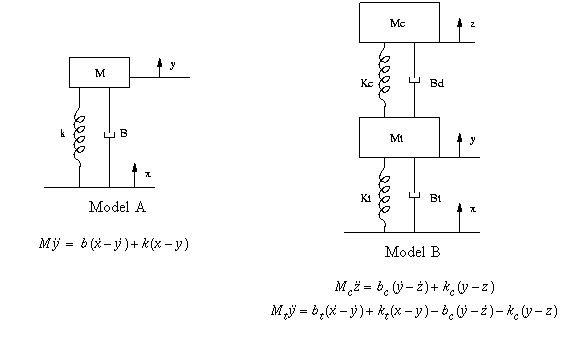
more sense to say that you have two parallel spring-dashpots systems in
series, like model B in [1]  except that Mt=0.

Then the question becomes: what is the equivalent viscosity (if possible
to define one, it may not be the case[*]) of such system? I don't think
it is cn = cn1cn2/(cn1+cn2). It should not be zero either when one of
the particles is purely elastic (cn=0), since the second one is still
viscous.

[1] http://www.sccs.swarthmore.edu/users/06/dluong1/e12/Lab4/diagrams/models.gif
[*] The more I think to it the less I see it feasible to have a unique
equivalent viscosity. For instance, if the force is constant then each surface
deformation is taking place following an exponential trend. Since the sum of
two exponential functions does not give an exponential function, it seems you
can't reduce the 2x{spring+dashpot} system to a {spring+dashpot} with
equivalent properties.

--
You received this question notification because you are a member of
yade-users, which is an answer contact for Yade.

_______________________________________________
Mailing list: https://launchpad.net/~yade-users
Post to     : [email protected]
Unsubscribe : https://launchpad.net/~yade-users
More help   : https://help.launchpad.net/ListHelp