>it'squite clear from both the public and private discussions around DNT
>that there is a big detachment between user expectations of DNT and
>what the protocol actually does, and so we should probably avoid
>treating that protocol as a flag.
On a less technical amore philosophical note I think that there is nothing
preventing is from taking a strong stand and saying "do not track" equals
"do not collect".

The EFF on this topic:

"Intuitively, users who we've talked to want Do Not Track to provide
meaningful limits on collection and retention of data. From the user's
perspective, sending the DNT browser signal to websites should indicate:
don't keep any records of my information, and collect the *bare minimum*
amount of information required to provide me with the service that you are
offering."

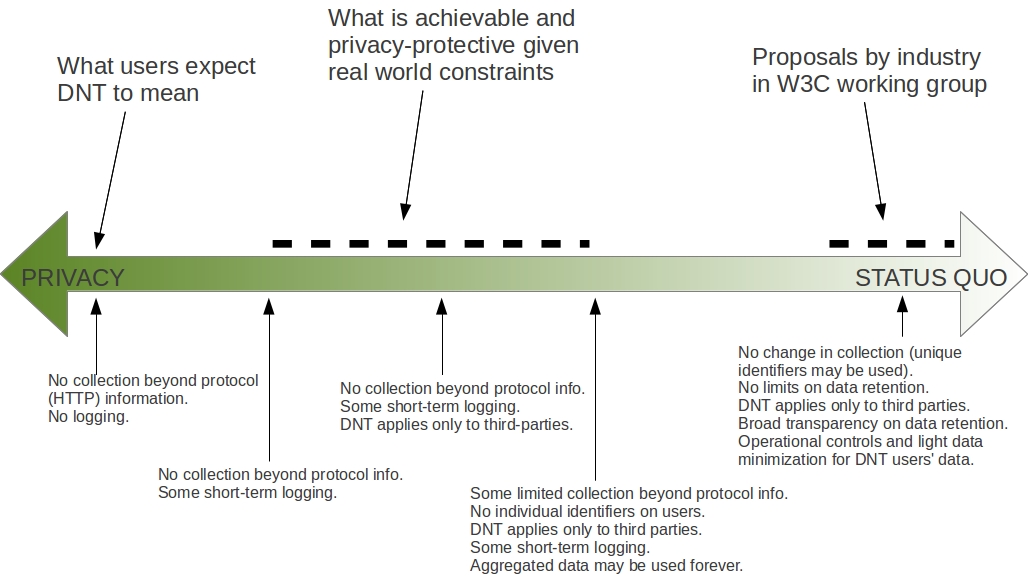
Excellent graphical representation of the user expectations vs what is
going on at the w3 standards group:
https://www.eff.org/files/images_insert/dnt_chart_0.jpg


On Wed, Jan 14, 2015 at 11:18 AM, Oliver Keyes <[email protected]> wrote:

> And, IE11? 12? My point is that yes, we can go about writing a lot of
> exceptions for specific use cases, and coming up with solutions for
> each browser's DNT idiosyncracies, but the costs of that trade-off
> increase the more we have to support.
>
> I'd much rather we built a uniform system that asked users to
> explicitly opt-out, and made clear what they were opting out of: it's
> quite clear from both the public and private discussions around DNT
> that there is a big detachment between user expectations of DNT and
> what the protocol actually does, and so we should probably avoid
> treating that protocol as a flag.
>
> On 14 January 2015 at 13:45, Nuria Ruiz <[email protected]> wrote:
> >>For example, not collecting usage data about certain sections of our
> >> population (e.g. IE10 users where DNT is set by default) >means that we
> >> don't know if our software works for them.  This isn't free, and in the
> >> long-term, it can have substantial negative >effects.  If DNT was always
> >> disabled by default in major browsers, I would expect such biases to be
> >> minimal.
> > IE faulty support, downright wrong support or no support of many of the
> web
> > apis is no news to anyone doing web development in the last 10 years and
> > nothing to write your mom about, really.
> >
> > IE is treated it specially in many areas and we might do so in this one
> too
> > if it turns out that:
> >
> > - No service pack install has corrected the DNT default (sounds like no,
> > this did not happen)
> >
> > - IE10 traffic is significant. I will get those numbers as I checked
> > browsers stats more than 6 months ago and things might have
> > changed significantly. Last time I checked I *believe* (going from
> memory)
> > we had quite a bit less traffic from ie10 than ie8.
> >
> > Thanks,
> >
> > Nuria
> >
> >
> > On Wed, Jan 14, 2015 at 10:07 AM, Aaron Halfaker <
> [email protected]>
> > wrote:
> >>
> >> Ori, I don't think you addressed the point I made about that study.
> They
> >> didn't ask users what they thought *their* browser setting meant and
> what
> >> they expected.  They asked what they thought a big red button with "DO
> NOT
> >> TRACK" on it meant -- and the most common answer had to do with their
> local
> >> browser history!
> >>
> >> Regardless, I think you make a good point.  The cost of getting
> something
> >> wrong here may not be symmetrical, but it's not clear to me that erring
> on
> >> collecting absolutely no data is less costly.
> >>
> >> For example, not collecting usage data about certain sections of our
> >> population (e.g. IE10 users where DNT is set by default) means that we
> don't
> >> know if our software works for them.  This isn't free, and in the
> long-term,
> >> it can have substantial negative effects.  If DNT was always disabled by
> >> default in major browsers, I would expect such biases to be minimal.
> >>
> >> Also, I think that if a user sets DNT and expects it to do something it
> >> isn't supposed to do, we can always point them to the spec.   It's a sad
> >> fact that, if you want to remain private on the web, you're going to
> need to
> >> inform yourself about how such things work.  Just because we adopt an
> >> extreme/overly-simplistic doesn't mean that the people you really don't
> want
> >> to have your behavioral data will to -- but it certainly has the
> potential
> >> to make research & product's job much more difficult.
> >>
> >> Really, what I'm trying to say is that if I "decline to collect data
> about
> >> [you]", you shouldn't say, "meh".  You should be concerned about how
> we're
> >> not considering what works and does not work for people like you when we
> >> design, test and deploy software changes.  In a way, it's like taking
> away
> >> your vote.  And if you don't believe that, I'd like to suggest that the
> only
> >> alternative is that the work that I do does not bring value to our
> users --
> >> and I'd beg to differ.
> >>
> >> -Aaron
> >>
> >> On Wed, Jan 14, 2015 at 11:40 AM, Ori Livneh <[email protected]> wrote:
> >>>
> >>> On Tue, Jan 13, 2015 at 3:17 PM, Aaron Halfaker <
> [email protected]>
> >>> wrote:
> >>>>
> >>>> They're really only asking what people think of when they read the
> words
> >>>> "Do Not Track".  I'd be more interested in knowing what people expect
> when
> >>>> then look at their particular browser setting and what it is they
> actually
> >>>> hope it will accomplish.
> >>>
> >>>
> >>> While it's true that there is ambiguity about what users are objecting
> to
> >>> when they turn on DNT (3rd party tracking? behavioral tracking? all
> data
> >>> collection?), the costs of getting it wrong not symmetrical. If I
> object to
> >>> all forms of data collection, and you collect data about me anyway,
> I'd be
> >>> pretty upset. But if I'm OK with certain forms of data collection, and
> you
> >>> decline to collect data about me.. meh.
> >>>
> >>> _______________________________________________
> >>> Analytics mailing list
> >>> [email protected]
> >>> https://lists.wikimedia.org/mailman/listinfo/analytics
> >>>
> >>
> >>
> >> _______________________________________________
> >> Analytics mailing list
> >> [email protected]
> >> https://lists.wikimedia.org/mailman/listinfo/analytics
> >>
> >
> >
> > _______________________________________________
> > Analytics mailing list
> > [email protected]
> > https://lists.wikimedia.org/mailman/listinfo/analytics
> >
>
>
>
> --
> Oliver Keyes
> Research Analyst
> Wikimedia Foundation
>
> _______________________________________________
> Analytics mailing list
> [email protected]
> https://lists.wikimedia.org/mailman/listinfo/analytics
>
_______________________________________________
Analytics mailing list
[email protected]
https://lists.wikimedia.org/mailman/listinfo/analytics