Agreed! There's no philosophical blocker. In a universe in which DNT
was uniformly treated, and uniformly opt-in, without substantial
variations in status between demographies, I would have absolutely no
problem with equating the two. As a user, I until very recently
assumed DNT == DNC.
Unfortunately we do not live in that universe. If we want to
transition to it, relying on DNT will not allow us to strike a balance
between research and privacy that doesn't totally tank one of the two.

On 14 January 2015 at 17:39, Nuria Ruiz <[email protected]> wrote:
>>it'squite clear from both the public and private discussions around DNT
>>that there is a big detachment between user expectations of DNT and
>>what the protocol actually does, and so we should probably avoid
>>treating that protocol as a flag.
>
> On a less technical amore philosophical note I think that there is nothing
> preventing is from taking a strong stand and saying "do not track" equals
> "do not collect".
>
> The EFF on this topic:
>
> "Intuitively, users who we've talked to want Do Not Track to provide
> meaningful limits on collection and retention of data. From the user's
> perspective, sending the DNT browser signal to websites should indicate:
> don't keep any records of my information, and collect the bare minimum
> amount of information required to provide me with the service that you are
> offering."
>
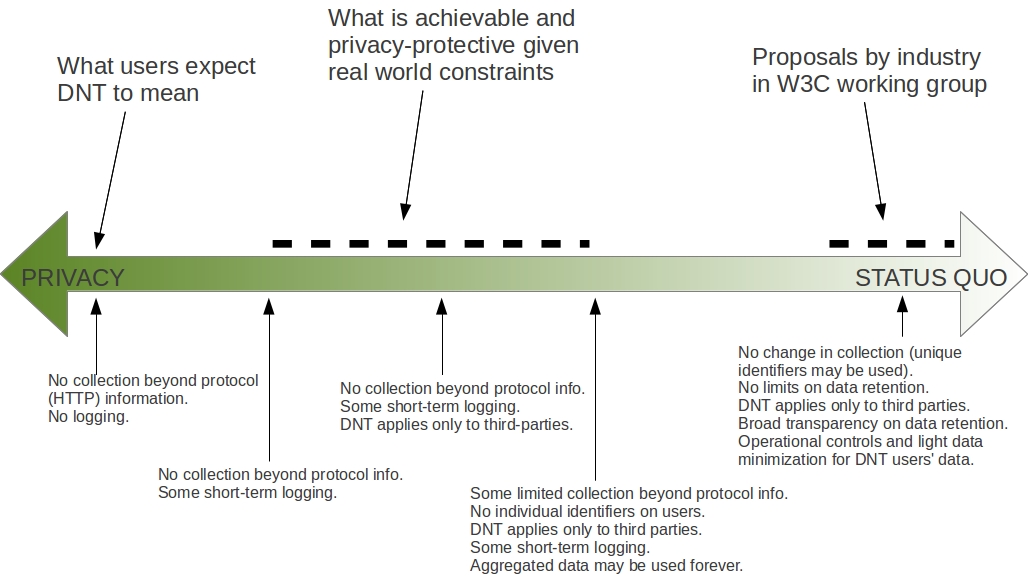
> Excellent graphical representation of the user expectations vs what is going
> on at the w3 standards group:
> https://www.eff.org/files/images_insert/dnt_chart_0.jpg
>
>
>
> On Wed, Jan 14, 2015 at 11:18 AM, Oliver Keyes <[email protected]> wrote:
>>
>> And, IE11? 12? My point is that yes, we can go about writing a lot of
>> exceptions for specific use cases, and coming up with solutions for
>> each browser's DNT idiosyncracies, but the costs of that trade-off
>> increase the more we have to support.
>>
>> I'd much rather we built a uniform system that asked users to
>> explicitly opt-out, and made clear what they were opting out of: it's
>> quite clear from both the public and private discussions around DNT
>> that there is a big detachment between user expectations of DNT and
>> what the protocol actually does, and so we should probably avoid
>> treating that protocol as a flag.
>>
>> On 14 January 2015 at 13:45, Nuria Ruiz <[email protected]> wrote:
>> >>For example, not collecting usage data about certain sections of our
>> >> population (e.g. IE10 users where DNT is set by default) >means that we
>> >> don't know if our software works for them.  This isn't free, and in the
>> >> long-term, it can have substantial negative >effects.  If DNT was
>> >> always
>> >> disabled by default in major browsers, I would expect such biases to be
>> >> minimal.
>> > IE faulty support, downright wrong support or no support of many of the
>> > web
>> > apis is no news to anyone doing web development in the last 10 years and
>> > nothing to write your mom about, really.
>> >
>> > IE is treated it specially in many areas and we might do so in this one
>> > too
>> > if it turns out that:
>> >
>> > - No service pack install has corrected the DNT default (sounds like no,
>> > this did not happen)
>> >
>> > - IE10 traffic is significant. I will get those numbers as I checked
>> > browsers stats more than 6 months ago and things might have
>> > changed significantly. Last time I checked I *believe* (going from
>> > memory)
>> > we had quite a bit less traffic from ie10 than ie8.
>> >
>> > Thanks,
>> >
>> > Nuria
>> >
>> >
>> > On Wed, Jan 14, 2015 at 10:07 AM, Aaron Halfaker
>> > <[email protected]>
>> > wrote:
>> >>
>> >> Ori, I don't think you addressed the point I made about that study.
>> >> They
>> >> didn't ask users what they thought *their* browser setting meant and
>> >> what
>> >> they expected.  They asked what they thought a big red button with "DO
>> >> NOT
>> >> TRACK" on it meant -- and the most common answer had to do with their
>> >> local
>> >> browser history!
>> >>
>> >> Regardless, I think you make a good point.  The cost of getting
>> >> something
>> >> wrong here may not be symmetrical, but it's not clear to me that erring
>> >> on
>> >> collecting absolutely no data is less costly.
>> >>
>> >> For example, not collecting usage data about certain sections of our
>> >> population (e.g. IE10 users where DNT is set by default) means that we
>> >> don't
>> >> know if our software works for them.  This isn't free, and in the
>> >> long-term,
>> >> it can have substantial negative effects.  If DNT was always disabled
>> >> by
>> >> default in major browsers, I would expect such biases to be minimal.
>> >>
>> >> Also, I think that if a user sets DNT and expects it to do something it
>> >> isn't supposed to do, we can always point them to the spec.   It's a
>> >> sad
>> >> fact that, if you want to remain private on the web, you're going to
>> >> need to
>> >> inform yourself about how such things work.  Just because we adopt an
>> >> extreme/overly-simplistic doesn't mean that the people you really don't
>> >> want
>> >> to have your behavioral data will to -- but it certainly has the
>> >> potential
>> >> to make research & product's job much more difficult.
>> >>
>> >> Really, what I'm trying to say is that if I "decline to collect data
>> >> about
>> >> [you]", you shouldn't say, "meh".  You should be concerned about how
>> >> we're
>> >> not considering what works and does not work for people like you when
>> >> we
>> >> design, test and deploy software changes.  In a way, it's like taking
>> >> away
>> >> your vote.  And if you don't believe that, I'd like to suggest that the
>> >> only
>> >> alternative is that the work that I do does not bring value to our
>> >> users --
>> >> and I'd beg to differ.
>> >>
>> >> -Aaron
>> >>
>> >> On Wed, Jan 14, 2015 at 11:40 AM, Ori Livneh <[email protected]> wrote:
>> >>>
>> >>> On Tue, Jan 13, 2015 at 3:17 PM, Aaron Halfaker
>> >>> <[email protected]>
>> >>> wrote:
>> >>>>
>> >>>> They're really only asking what people think of when they read the
>> >>>> words
>> >>>> "Do Not Track".  I'd be more interested in knowing what people expect
>> >>>> when
>> >>>> then look at their particular browser setting and what it is they
>> >>>> actually
>> >>>> hope it will accomplish.
>> >>>
>> >>>
>> >>> While it's true that there is ambiguity about what users are objecting
>> >>> to
>> >>> when they turn on DNT (3rd party tracking? behavioral tracking? all
>> >>> data
>> >>> collection?), the costs of getting it wrong not symmetrical. If I
>> >>> object to
>> >>> all forms of data collection, and you collect data about me anyway,
>> >>> I'd be
>> >>> pretty upset. But if I'm OK with certain forms of data collection, and
>> >>> you
>> >>> decline to collect data about me.. meh.
>> >>>
>> >>> _______________________________________________
>> >>> Analytics mailing list
>> >>> [email protected]
>> >>> https://lists.wikimedia.org/mailman/listinfo/analytics
>> >>>
>> >>
>> >>
>> >> _______________________________________________
>> >> Analytics mailing list
>> >> [email protected]
>> >> https://lists.wikimedia.org/mailman/listinfo/analytics
>> >>
>> >
>> >
>> > _______________________________________________
>> > Analytics mailing list
>> > [email protected]
>> > https://lists.wikimedia.org/mailman/listinfo/analytics
>> >
>>
>>
>>
>> --
>> Oliver Keyes
>> Research Analyst
>> Wikimedia Foundation
>>
>> _______________________________________________
>> Analytics mailing list
>> [email protected]
>> https://lists.wikimedia.org/mailman/listinfo/analytics
>
>
>
> _______________________________________________
> Analytics mailing list
> [email protected]
> https://lists.wikimedia.org/mailman/listinfo/analytics
>


--
Oliver Keyes
Research Analyst
Wikimedia Foundation

_______________________________________________
Analytics mailing list
[email protected]
https://lists.wikimedia.org/mailman/listinfo/analytics