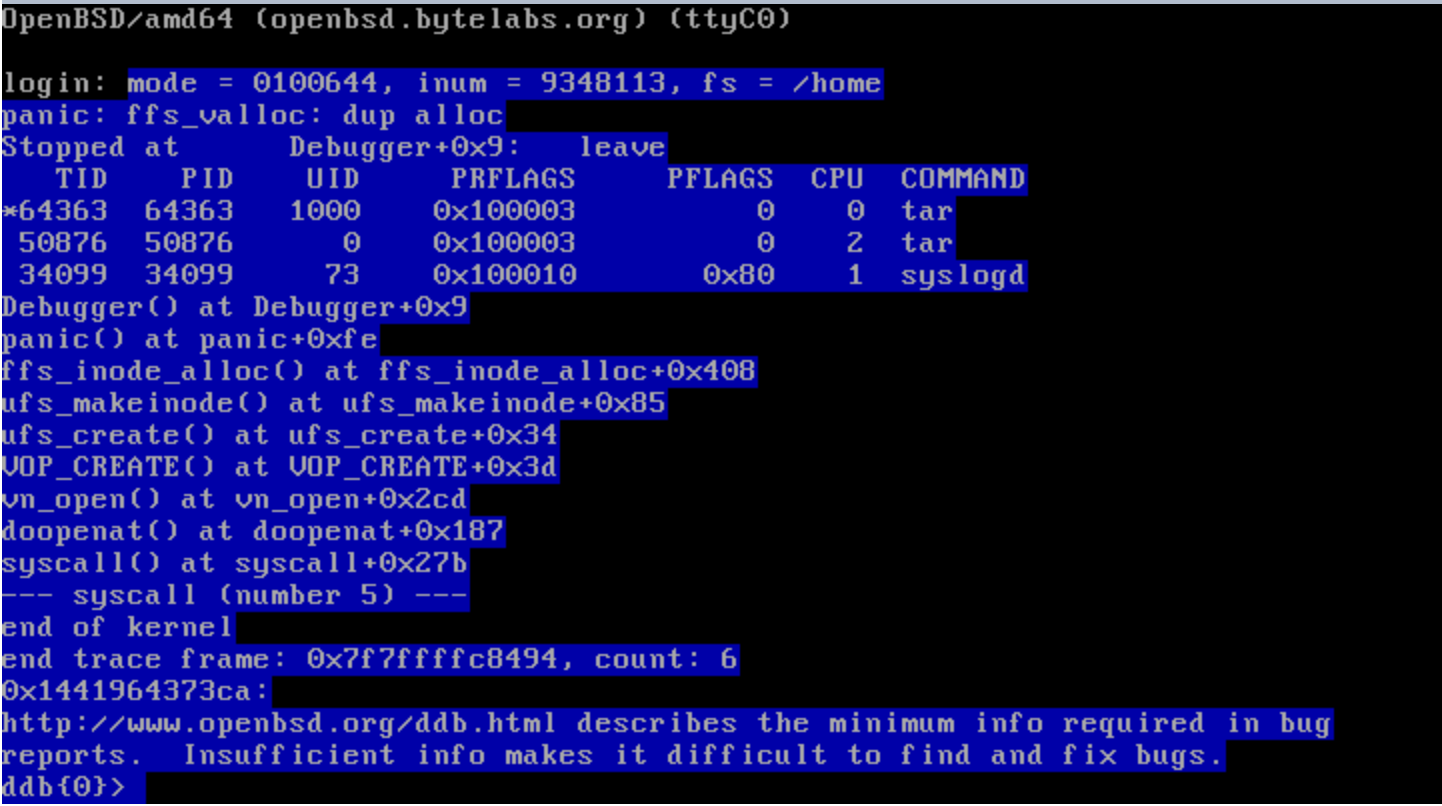
Here some additional information on the issue:

Stack-trace core0 converted from
[http://bytelabs.org/openbsd-6.0-bug-report/0-panic.png] using OCR:
> OpenBSD/amd64 (openbsd.bytelabs.org) (ttyC0)
> login: mode = 0100644, inum = 9348113, fs = /home
> panic: ffs_valloc: dup alloc
> Stopped at Debugger+0x9: leave
>     TID   PID  UID PRFLAGS  PFLAGS CPU COMMAND
> * 64363 64363 1000 0x100003      0   0 tar
>   50876 50876    0 0x100003      0   2 tar
>   34099 34099   73 0x100010   0x80   1 syslogd
> Debugger() at Debugger+ox9
> panic() at panic+0xfe
> ffs_inode_alloc() at ffs_inode_alloc+0x408
> ufs_makeinode() at ufs_makeinode+0x85
> ufs_create() at ufs_create+0x34
> VOP_CREATE() at VOP_CREATE+0x3d
> vn_open() at vn_open+0x2cd
> dnoopenat() at doopenat+0x187
> syscall() at syscall+0x27b
> --- syscall (number 5) ---
> end of kernel
> end trace frame: 0x7f7ffffc8494, count: 6
> 0x1441964373ca:
> http://www.openbsd.org/ddb.html describes the minimum info required in bug
> Reports. Insufficient info makes it difficult to find and fix bugs.
> ddb{0}>
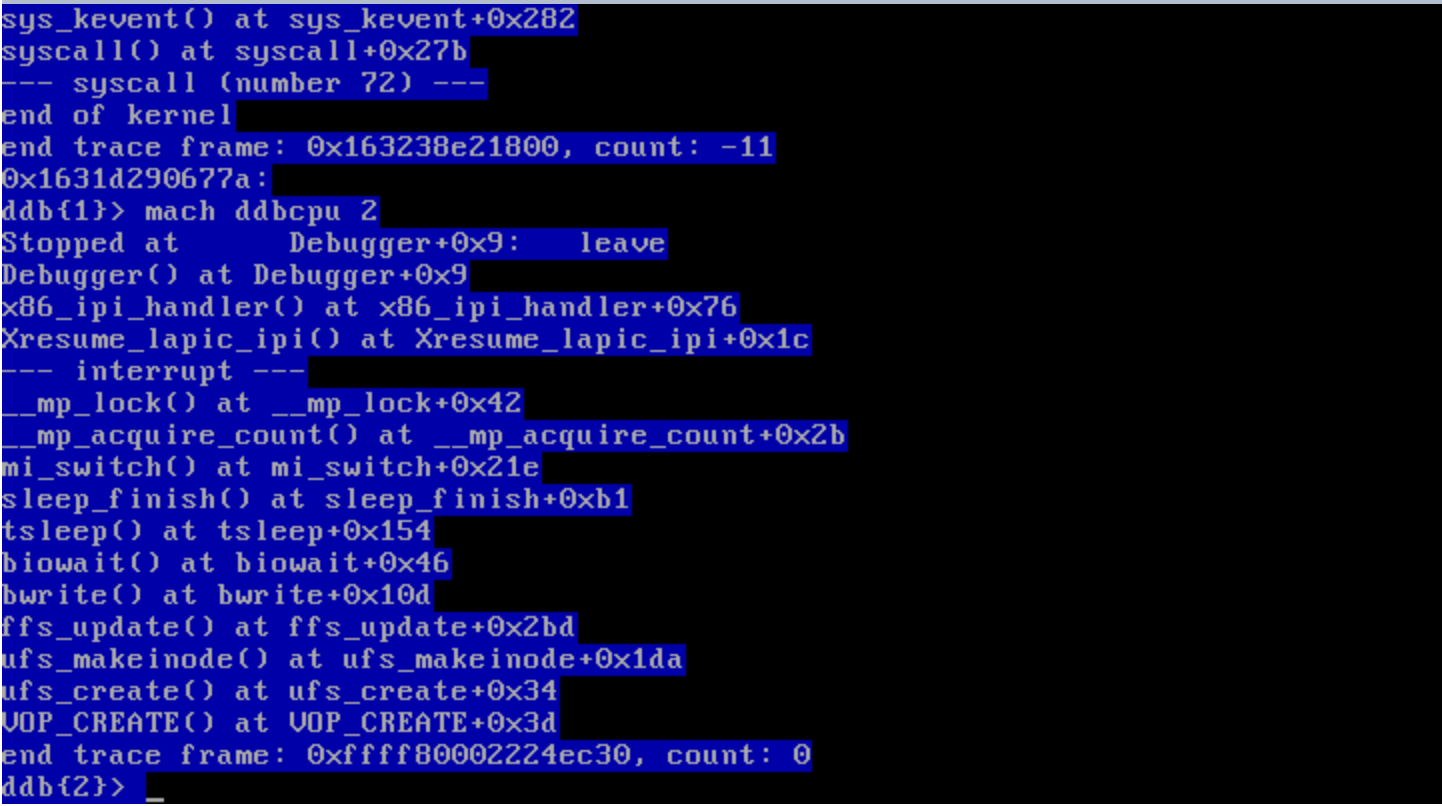
Stack-trace core2 converted from
[http://bytelabs.org/openbsd-6.0-bug-report/3-core2%20trace.png] using OCR:
> ddb{1}> mach ddbcpu 2
> Stopped at Debugger+0x9: leave
> Debugger() at Debugger+0x9
> x86_ipi_handler() at x86_ipi_handler+0x76
> Xresume_lapic_ipi() at Xresume_lapic_ipi+0x1c
> --- interrupt ---
> __mp_lock() at __mp_lock+0x42
> __mp_acquire_count() at __mp_acquire_count+0x2b
> mi_switch() at mi_switch+0x21e
> sleep_finish() at sleep_finish+0xb1
> tsleep() at tsleep+0x154
> biowait() at biowait+0x46
> bwrite() at bwrite+0x10d
> ffs_update() at ffs_update+0x2bd
> ufs_makeinode() at ufs_makeinode+0x1da
> ufs_create() at ufs_create+0x34
> VOP_CREATE() at VOP_CREATE+ox3d
> end trace frame: 0xffff80002224ec30, count: 0
> ddb{2}>

From these two traces we see that both cores are executing ufs_create() which
then calls ufs_makeinode().

Skimming over ufs_makeinode() we see that core0 is executing ffs_inode_alloc()
which is one of the first functions called by ufs_makeinode().

Core2 is executing ffs_update() which happens *after* having executed
ffs_inode_alloc().

Here is the function in question with some highlighting:
> int
> ufs_makeinode(int mode, struct vnode *dvp, struct vnode **vpp,
>     struct componentname *cnp)
> {
>       struct inode *ip, *pdir;
>       struct direct newdir;
>       struct vnode *tvp;
>       int error;
>
>       pdir = VTOI(dvp);
> #ifdef DIAGNOSTIC
>       if ((cnp->cn_flags & HASBUF) == 0)
>               panic("ufs_makeinode: no name");
> #endif
>       *vpp = NULL;
>       if ((mode & IFMT) == 0)
>               mode |= IFREG;
>
>       if ((error = UFS_INODE_ALLOC(pdir, mode, cnp->cn_cred, &tvp)) != 0) {
Core0 is currently executing UFS_INODE_ALLOC aka ffs_inode_alloc() in this
context.
Core2 has already executed this function.

>               pool_put(&namei_pool, cnp->cn_pnbuf);
>               vput(dvp);
>               return (error);
>       }
>
>       ip = VTOI(tvp);
>
>       DIP_ASSIGN(ip, gid, DIP(pdir, gid));
>       DIP_ASSIGN(ip, uid, cnp->cn_cred->cr_uid);
>
>       if ((error = getinoquota(ip)) ||
>           (error = ufs_quota_alloc_inode(ip, cnp->cn_cred))) {
>               pool_put(&namei_pool, cnp->cn_pnbuf);
>               UFS_INODE_FREE(ip, ip->i_number, mode);
>               vput(tvp);
>               vput(dvp);
>               return (error);
>       }
>
>       ip->i_flag |= IN_ACCESS | IN_CHANGE | IN_UPDATE;
>       DIP_ASSIGN(ip, mode, mode);
>       tvp->v_type = IFTOVT(mode);     /* Rest init'd in getnewvnode(). */
>       ip->i_effnlink = 1;
>       DIP_ASSIGN(ip, nlink, 1);
>       if (DOINGSOFTDEP(tvp))
>               softdep_change_linkcnt(ip, 0);
>       if ((DIP(ip, mode) & ISGID) &&
>               !groupmember(DIP(ip, gid), cnp->cn_cred) &&
>           suser_ucred(cnp->cn_cred))
>               DIP_AND(ip, mode, ~ISGID);
>
>       /*
>        * Make sure inode goes to disk before directory entry.
>        */
>       if ((error = UFS_UPDATE(ip, !DOINGSOFTDEP(tvp))) != 0)
Core2 is currently executing UFS_UPDATE aka ffs_update()

>               goto bad;
>
>       ufs_makedirentry(ip, cnp, &newdir);
>       if ((error = ufs_direnter(dvp, tvp, &newdir, cnp, NULL)) != 0)
>               goto bad;
>
>       if ((cnp->cn_flags & SAVESTART) == 0)
>               pool_put(&namei_pool, cnp->cn_pnbuf);
>       vput(dvp);
>       *vpp = tvp;
>       return (0);
>
> bad:
>       /*
>        * Write error occurred trying to update the inode
>        * or the directory so must deallocate the inode.
>        */
>       pool_put(&namei_pool, cnp->cn_pnbuf);
>       vput(dvp);
>       ip->i_effnlink = 0;
>       DIP_ASSIGN(ip, nlink, 0);
>       ip->i_flag |= IN_CHANGE;
>       if (DOINGSOFTDEP(tvp))
>               softdep_change_linkcnt(ip, 0);
>       tvp->v_type = VNON;
>       vput(tvp);
>
>       return (error);
> }

The actual panic happens in the ffs_inode_alloc() following function, see
highlighted code:
> int
> ffs_inode_alloc(struct inode *pip, mode_t mode, struct ucred *cred,
>     struct vnode **vpp)
> {
>       static struct timeval fsnoinodes_last;
>       struct vnode *pvp = ITOV(pip);
>       struct fs *fs;
>       struct inode *ip;
>       ufsino_t ino, ipref;
>       int cg, error;
>
>       *vpp = NULL;
>       fs = pip->i_fs;
>       if (fs->fs_cstotal.cs_nifree == 0)
>               goto noinodes;
>
>       if ((mode & IFMT) == IFDIR)
>               ipref = ffs_dirpref(pip);
>       else
>               ipref = pip->i_number;
>       if (ipref >= fs->fs_ncg * fs->fs_ipg)
>               ipref = 0;
>       cg = ino_to_cg(fs, ipref);
>
>       /*
>        * Track number of dirs created one after another
>        * in a same cg without intervening by files.
>        */
>       if ((mode & IFMT) == IFDIR) {
>               if (fs->fs_contigdirs[cg] < 255)
>                       fs->fs_contigdirs[cg]++;
>       } else {
>               if (fs->fs_contigdirs[cg] > 0)
>                       fs->fs_contigdirs[cg]--;
>       }
>       ino = (ufsino_t)ffs_hashalloc(pip, cg, ipref, mode, ffs_nodealloccg);
>       if (ino == 0)
>               goto noinodes;
>       error = VFS_VGET(pvp->v_mount, ino, vpp);
>       if (error) {
>               ffs_inode_free(pip, ino, mode);
>               return (error);
>       }
>
>       ip = VTOI(*vpp);
>
>       if (DIP(ip, mode)) {
>               printf("mode = 0%o, inum = %u, fs = %s\n",
>                   DIP(ip, mode), ip->i_number, fs->fs_fsmnt);
>               panic("ffs_valloc: dup alloc");

This is where we bail out! The following field is expected to be zero but isn't
for some reason:
    struct ufs2_dinode {
            u_int16_t       di_mode;        /*   0: IFMT, permissions; see
below. */
            int16_t         di_nlink;       /*   2: File link count. */
            u_int32_t       di_uid;         /*   4: File owner. */
            ...
    };

The following show what values di_mode can have I believe:
    /* File permissions. */
    #define IEXEC           0000100         /* Executable. */
    #define IWRITE          0000200         /* Writeable. */
    #define IREAD           0000400         /* Readable. */
    #define ISVTX           0001000         /* Sticky bit. */
    #define ISGID           0002000         /* Set-gid. */
    #define ISUID           0004000         /* Set-uid. */

    /* File types. */
    #define IFMT            0170000         /* Mask of file type. */
    #define IFIFO           0010000         /* Named pipe (fifo). */
    #define IFCHR           0020000         /* Character device. */
    #define IFDIR           0040000         /* Directory file. */
    #define IFBLK           0060000         /* Block device. */
    #define IFREG           0100000         /* Regular file. */
    #define IFLNK           0120000         /* Symbolic link. */
    #define IFSOCK          0140000         /* UNIX domain socket. */
    #define IFWHT           0160000         /* Whiteout. */


>       }
>
>       if (DIP(ip, blocks)) {
>               printf("free inode %s/%d had %lld blocks\n",
>                   fs->fs_fsmnt, ino, (long long)DIP(ip, blocks));
>               DIP_ASSIGN(ip, blocks, 0);
>       }
>
>       DIP_ASSIGN(ip, flags, 0);
>
>       /*
>        * Set up a new generation number for this inode.
>        * XXX - just increment for now, this is wrong! (millert)
>        *       Need a way to preserve randomization.
>        */
>       if (DIP(ip, gen) != 0)
>               DIP_ADD(ip, gen, 1);
>       if (DIP(ip, gen) == 0)
>               DIP_ASSIGN(ip, gen, arc4random() & INT_MAX);
>
>       if (DIP(ip, gen) == 0 || DIP(ip, gen) == -1)
>               DIP_ASSIGN(ip, gen, 1); /* Shouldn't happen */
>
>       return (0);
>
> noinodes:
>       if (ratecheck(&fsnoinodes_last, &fserr_interval)) {
>               ffs_fserr(fs, cred->cr_uid, "out of inodes");
>               uprintf("\n%s: create/symlink failed, no inodes free\n",
>                   fs->fs_fsmnt);
>       }
>       return (ENOSPC);
> }

It looks like Core0 tries to allocate something that is currently being
processed/updated by Core2.

HTH

Cheers,
Igor


On 7 Sep 2016, at 02:12, Igor Boehm <[email protected]> wrote:

> This bug-report with all information can also be found here:
> - http://bytelabs.org/openbsd-6.0-bug-report/
>
> 1. The exact sequence of steps from startup necessary to reproduce the
> problem:
> - Boot freshly installed OpenBSD6.0/amd64/bsd.mp system running on the
> following vServer [https://www.hetzner.de/lt/hosting/produkte_vserver/cx50]
> - Login via SSH
> - Copy ports.tgz into /tmp
> - Extract /tmp/ports.tgz into /usr
> - Second login via SSH
> - Extract /tmp/ports.tgz into /home
> - Kernel panic occurs
>
> 2. The output you got:
>   2.1 Panic Message: [panic.png]
>   2.2 Traces for Core0-Core3: [core0 trace.png ... core3 trace.png]
>   2.3 PS output: [ps output 0.png ... ps output 2.png]
>   2.4 Output of show uvm: [show uvm.png]
>   2.5 Output of show bcstats: [show bcstats.png]
>   2.6 mount output (below)
>   2.7 /etc/fstab contents (below)
>   2.8 /var/run/dmesg.boot contents (below)
>
> 3. Probably completely wrong guess at what the problem is but I try anyway:
>   - Core0 is executing ufs_makeinode() without acquiring any locks (i.e. I do
> not see any __mp_lock() in the trace) [core0 trace.png].
>
>   - Core2 is executing ufs_makeinode() as well *at the same time* [core2
> trace.png] and it seems to include some form of synchronisation (i.e.
> __mp_lock()).
>
>   - It seems like a race condition leading to a corrupted data-structure.
>
> $ mount
> /dev/sd0a on / type ffs (local)
> /dev/sd0k on /home type ffs (local, nodev, nosuid)
> /dev/sd0d on /tmp type ffs (local, nodev, nosuid)
> /dev/sd0f on /usr type ffs (local, nodev)
> /dev/sd0g on /usr/X11R6 type ffs (local, nodev)
> /dev/sd0h on /usr/local type ffs (local, nodev, wxallowed)
> /dev/sd0j on /usr/obj type ffs (local, nodev, nosuid)
> /dev/sd0i on /usr/src type ffs (local, nodev, nosuid)
> /dev/sd0e on /var type ffs (local, nodev, nosuid)
>
> $ cat /etc/fstab
> d7be661125b20dff.b none swap sw
> d7be661125b20dff.a / ffs rw 1 1
> d7be661125b20dff.k /home ffs rw,nodev,nosuid 1 2
> d7be661125b20dff.d /tmp ffs rw,nodev,nosuid 1 2
> d7be661125b20dff.f /usr ffs rw,nodev 1 2
> d7be661125b20dff.g /usr/X11R6 ffs rw,nodev 1 2
> d7be661125b20dff.h /usr/local ffs rw,wxallowed,nodev 1 2
> d7be661125b20dff.j /usr/obj ffs rw,nodev,nosuid 1 2
> d7be661125b20dff.i /usr/src ffs rw,nodev,nosuid 1 2
> d7be661125b20dff.e /var ffs rw,nodev,nosuid 1 2
>
> $ cat /var/run/dmesg.boot
> OpenBSD 6.0 (GENERIC.MP) #2319: Tue Jul 26 13:00:43 MDT 2016
>     [email protected]:/usr/src/sys/arch/amd64/compile/GENERIC.MP
> real mem = 17162960896 (16367MB)
> avail mem = 16638332928 (15867MB)
> mpath0 at root
> scsibus0 at mpath0: 256 targets
> mainbus0 at root
> bios0 at mainbus0: SMBIOS rev. 2.8 @ 0xf62e0 (10 entries)
> bios0: vendor SeaBIOS version "1.8.2" date 04/01/2014
> bios0: Hetzner vServer
> acpi0 at bios0: rev 0
> acpi0: sleep states S5
> acpi0: tables DSDT FACP APIC HPET
> acpi0: wakeup devices
> acpitimer0 at acpi0: 3579545 Hz, 24 bits
> acpimadt0 at acpi0 addr 0xfee00000: PC-AT compat
> cpu0 at mainbus0: apid 0 (boot processor)
> cpu0: Intel(R) Xeon(R) CPU E5-26xx (Sandy Bridge), 2100.31 MHz
> cpu0:
> FPU,VME,DE,PSE,TSC,MSR,PAE,MCE,CX8,APIC,SEP,MTRR,PGE,MCA,CMOV,PAT,PSE36,CFLUSH,MMX,FXSR,SSE,SSE2,HTT,SSE3,PCLMUL,SSSE3,CX16,SSE4.1,SSE4.2,x2APIC,POPCNT,DEADLINE,AES,XSAVE,AVX,HV,NXE,LONG,LAHF,ARAT
> cpu0: 64KB 64b/line 2-way I-cache, 64KB 64b/line 2-way D-cache, 512KB
> 64b/line 16-way L2 cache
> cpu0: ITLB 255 4KB entries direct-mapped, 255 4MB entries direct-mapped
> cpu0: DTLB 255 4KB entries direct-mapped, 255 4MB entries direct-mapped
> cpu0: smt 0, core 0, package 0
> mtrr: Pentium Pro MTRR support, 8 var ranges, 88 fixed ranges
> cpu0: apic clock running at 999MHz
> cpu1 at mainbus0: apid 1 (application processor)
> cpu1: Intel(R) Xeon(R) CPU E5-26xx (Sandy Bridge), 2100.03 MHz
> cpu1:
> FPU,VME,DE,PSE,TSC,MSR,PAE,MCE,CX8,APIC,SEP,MTRR,PGE,MCA,CMOV,PAT,PSE36,CFLUSH,MMX,FXSR,SSE,SSE2,HTT,SSE3,PCLMUL,SSSE3,CX16,SSE4.1,SSE4.2,x2APIC,POPCNT,DEADLINE,AES,XSAVE,AVX,HV,NXE,LONG,LAHF,ARAT
> cpu1: 64KB 64b/line 2-way I-cache, 64KB 64b/line 2-way D-cache, 512KB
> 64b/line 16-way L2 cache
> cpu1: ITLB 255 4KB entries direct-mapped, 255 4MB entries direct-mapped
> cpu1: DTLB 255 4KB entries direct-mapped, 255 4MB entries direct-mapped
> cpu1: smt 0, core 1, package 0
> cpu2 at mainbus0: apid 2 (application processor)
> cpu2: Intel(R) Xeon(R) CPU E5-26xx (Sandy Bridge), 2100.01 MHz
> cpu2:
> FPU,VME,DE,PSE,TSC,MSR,PAE,MCE,CX8,APIC,SEP,MTRR,PGE,MCA,CMOV,PAT,PSE36,CFLUSH,MMX,FXSR,SSE,SSE2,HTT,SSE3,PCLMUL,SSSE3,CX16,SSE4.1,SSE4.2,x2APIC,POPCNT,DEADLINE,AES,XSAVE,AVX,HV,NXE,LONG,LAHF,ARAT
> cpu2: 64KB 64b/line 2-way I-cache, 64KB 64b/line 2-way D-cache, 512KB
> 64b/line 16-way L2 cache
> cpu2: ITLB 255 4KB entries direct-mapped, 255 4MB entries direct-mapped
> cpu2: DTLB 255 4KB entries direct-mapped, 255 4MB entries direct-mapped
> cpu2: smt 0, core 2, package 0
> cpu3 at mainbus0: apid 3 (application processor)
> cpu3: Intel(R) Xeon(R) CPU E5-26xx (Sandy Bridge), 2100.01 MHz
> cpu3:
> FPU,VME,DE,PSE,TSC,MSR,PAE,MCE,CX8,APIC,SEP,MTRR,PGE,MCA,CMOV,PAT,PSE36,CFLUSH,MMX,FXSR,SSE,SSE2,HTT,SSE3,PCLMUL,SSSE3,CX16,SSE4.1,SSE4.2,x2APIC,POPCNT,DEADLINE,AES,XSAVE,AVX,HV,NXE,LONG,LAHF,ARAT
> cpu3: 64KB 64b/line 2-way I-cache, 64KB 64b/line 2-way D-cache, 512KB
> 64b/line 16-way L2 cache
> cpu3: ITLB 255 4KB entries direct-mapped, 255 4MB entries direct-mapped
> cpu3: DTLB 255 4KB entries direct-mapped, 255 4MB entries direct-mapped
> cpu3: smt 0, core 3, package 0
> ioapic0 at mainbus0: apid 0 pa 0xfec00000, version 11, 24 pins
> acpihpet0 at acpi0: 100000000 Hz
> acpiprt0 at acpi0: bus 0 (PCI0)
> acpicpu0 at acpi0: C1(@1 halt!)
> acpicpu1 at acpi0: C1(@1 halt!)
> acpicpu2 at acpi0: C1(@1 halt!)
> acpicpu3 at acpi0: C1(@1 halt!)
> "ACPI0006" at acpi0 not configured
> "PNP0303" at acpi0 not configured
> "PNP0F13" at acpi0 not configured
> "PNP0700" at acpi0 not configured
> "PNP0501" at acpi0 not configured
> "PNP0A06" at acpi0 not configured
> "PNP0A06" at acpi0 not configured
> "QEMU0002" at acpi0 not configured
> "PNP0A06" at acpi0 not configured
> pvbus0 at mainbus0: KVM
> pci0 at mainbus0 bus 0
> pchb0 at pci0 dev 0 function 0 "Intel 82441FX" rev 0x02
> pcib0 at pci0 dev 1 function 0 "Intel 82371SB ISA" rev 0x00
> pciide0 at pci0 dev 1 function 1 "Intel 82371SB IDE" rev 0x00: DMA, channel 0
> wired to compatibility, channel 1 wired to compatibility
> pciide0: channel 0 disabled (no drives)
> atapiscsi0 at pciide0 channel 1 drive 0
> scsibus1 at atapiscsi0: 2 targets
> cd0 at scsibus1 targ 0 lun 0: <QEMU, QEMU DVD-ROM, 2.5+> ATAPI 5/cdrom
> removable
> cd0(pciide0:1:0): using PIO mode 4, DMA mode 2
> uhci0 at pci0 dev 1 function 2 "Intel 82371SB USB" rev 0x01: apic 0 int 11
> piixpm0 at pci0 dev 1 function 3 "Intel 82371AB Power" rev 0x03: apic 0 int 9
> iic0 at piixpm0
> vga1 at pci0 dev 2 function 0 "Bochs VGA" rev 0x02
> wsdisplay0 at vga1 mux 1: console (80x25, vt100 emulation)
> wsdisplay0: screen 1-5 added (80x25, vt100 emulation)
> virtio0 at pci0 dev 3 function 0 "Qumranet Virtio Network" rev 0x00
> vio0 at virtio0: address 52:54:a2:01:85:cd
> virtio0: msix shared
> virtio1 at pci0 dev 4 function 0 "Qumranet Virtio SCSI" rev 0x00
> vioscsi0 at virtio1: qsize 128
> scsibus2 at vioscsi0: 255 targets
> sd0 at scsibus2 targ 0 lun 0: <QEMU, QEMU HARDDISK, 2.5+> SCSI3 0/direct fixed
> sd0: 390625MB, 512 bytes/sector, 800000000 sectors, thin
> virtio1: msix shared
> virtio2 at pci0 dev 5 function 0 "Qumranet Virtio Memory" rev 0x00
> viomb0 at virtio2
> virtio2: apic 0 int 10
> isa0 at pcib0
> isadma0 at isa0
> fdc0 at isa0 port 0x3f0/6 irq 6 drq 2
> fd0 at fdc0 drive 1: density unknown
> com0 at isa0 port 0x3f8/8 irq 4: ns16550a, 16 byte fifo
> pckbc0 at isa0 port 0x60/5 irq 1 irq 12
> pckbd0 at pckbc0 (kbd slot)
> wskbd0 at pckbd0: console keyboard, using wsdisplay0
> pms0 at pckbc0 (aux slot)
> wsmouse0 at pms0 mux 0
> pcppi0 at isa0 port 0x61
> spkr0 at pcppi0
> usb0 at uhci0: USB revision 1.0
> uhub0 at usb0 "Intel UHCI root hub" rev 1.00/1.00 addr 1
> nvram: invalid checksum
> uhidev0 at uhub0 port 1 configuration 1 interface 0 "QEMU QEMU USB Tablet"
> rev 2.00/0.00 addr 2
> uhidev0: iclass 3/0
> ums0 at uhidev0: 3 buttons, Z dir
> wsmouse1 at ums0 mux 0
> vscsi0 at root
> scsibus3 at vscsi0: 256 targets
> softraid0 at root
> scsibus4 at softraid0: 256 targets
> root on sd0a (d7be661125b20dff.a) swap on sd0b dump on sd0b
> clock: unknown CMOS layout
>
> If needed I can provide access to the machine for further testing.
>
> Thanks in advance for your help.
>
> Cheers,
> Igor
>