"The best estimate we have of the "true" B factor is the model B factors
we get at the end of refinement, once everything is converged, after we
have done all the building we can.  It is this "true B factor" that is a
property of the data, not the model, "
If this is the case, why can't we use model B factors to validate our
structure? I know some people are skeptical about this approach because B
factors are refinable parameters.

Rangana

On Sat, Mar 7, 2020 at 8:01 PM James Holton <[email protected]> wrote:

> Yes, that's right.  Model B factors are fit to the data.  That Boverall
> gets added to all atomic B factors in the model before the structure is
> written out, yes?
>
> The best estimate we have of the "true" B factor is the model B factors
> we get at the end of refinement, once everything is converged, after we
> have done all the building we can.  It is this "true B factor" that is a
> property of the data, not the model, and it has the relationship to
> resolution and map appearance that I describe below.  Does that make sense?
>
> -James Holton
> MAD Scientist
>
> On 3/7/2020 10:45 AM, dusan turk wrote:
> > James,
> >
> > The case you’ve chosen is not a good illustration of the relationship
> between atomic B and resolution.   The problem is that during scaling of
> Fcalc to Fobs also B-factor difference between the two sets of numbers is
> minimized. In the simplest form  with two constants Koverall and Boverall
> it looks like this:
> >
> > sum_to_be_minimized = sum (FOBS**2 -  Koverall * FCALC**2 * exp(-1/d**2
> * Boverall) )
> >
> > Then one can include bulk solvent correction, anisotripic scaling, … In
> PHENIX it gets quite complex.
> >
> > Hence, almost regardless of the average model B you will always get the
> same map, because the “B" of the map will reflect the B of the FOBS.  When
> all atomic Bs are equal then they are also equal to average B.
> >
> > best, dusan
> >
> >
> >> On 7 Mar 2020, at 01:01, CCP4BB automatic digest system <
> [email protected]> wrote:
> >>
> >>> On Thu, 5 Mar 2020 01:11:33 +0100, James Holton <[email protected]>
> wrote:
> >>>
> >>>> The funny thing is, although we generally regard resolution as a
> primary
> >>>> indicator of data quality the appearance of a density map at the
> classic
> >>>> "1-sigma" contour has very little to do with resolution, and
> everything
> >>>> to do with the B factor.
> >>>>
> >>>> Seriously, try it. Take any structure you like, set all the B factors
> to
> >>>> 30 with PDBSET, calculate a map with SFALL or phenix.fmodel and have a
> >>>> look at the density of tyrosine (Tyr) side chains.  Even if you
> >>>> calculate structure factors all the way out to 1.0 A the holes in the
> >>>> Tyr rings look exactly the same: just barely starting to form.  This
> is
> >>>> because the structure factors from atoms with B=30 are essentially
> zero
> >>>> out at 1.0 A, and adding zeroes does not change the map.  You can
> adjust
> >>>> the contour level, of course, and solvent content will have some
> effect
> >>>> on where the "1-sigma" contour lies, but generally B=30 is the point
> >>>> where Tyr side chains start to form their holes.  Traditionally, this
> is
> >>>> attributed to 1.8A resolution, but it is really at B=30.  The point
> >>>> where waters first start to poke out above the 1-sigma contour is at
> >>>> B=60, despite being generally attributed to d=2.7A.
> >>>>
> >>>> Now, of course, if you cut off this B=30 data at 3.5A then the Tyr
> side
> >>>> chains become blobs, but that is equivalent to collecting data with
> the
> >>>> detector way too far away and losing your high-resolution spots off
> the
> >>>> edges.  I have seen a few people do that, but not usually for a
> >>>> published structure.  Most people fight very hard for those faint,
> >>>> barely-existing high-angle spots.  But why do we do that if the map is
> >>>> going to look the same anyway?  The reason is because resolution and B
> >>>> factors are linked.
> >>>>
> >>>> Resolution is about separation vs width, and the width of the density
> >>>> peak from any atom is set by its B factor.  Yes, atoms have an
> intrinsic
> >>>> width, but it is very quickly washed out by even modest B factors (B >
> >>>> 10).  This is true for both x-ray and electron form factors. To a very
> >>>> good approximation, the FWHM of C, N and O atoms is given by:
> >>>> FWHM= sqrt(B*log(2))/pi+0.15
> >>>>
> >>>> where "B" is the B factor assigned to the atom and the 0.15 fudge
> factor
> >>>> accounts for its intrinsic width when B=0.  Now that we know the peak
> >>>> width, we can start to ask if two peaks are "resolved".
> >>>>
> >>>> Start with the classical definition of "resolution" (call it after
> Airy,
> >>>> Raleigh, Dawes, or whatever famous person you like), but essentially
> you
> >>>> are asking the question: "how close can two peaks be before they merge
> >>>> into one peak?".  For Gaussian peaks this is 0.849*FWHM. Simple
> enough.
> >>>> However, when you look at the density of two atoms this far apart you
> >>>> will see the peak is highly oblong. Yes, the density has one maximum,
> >>>> but there are clearly two atoms in there.  It is also pretty obvious
> the
> >>>> long axis of the peak is the line between the two atoms, and if you
> fit
> >>>> two round atoms into this peak you recover the distance between them
> >>>> quite accurately.  Are they really not "resolved" if it is so clear
> >>>> where they are?
> >>>>
> >>>> In such cases you usually want to sharpen, as that will make the
> oblong
> >>>> blob turn into two resolved peaks.  Sharpening reduces the B factor
> and
> >>>> therefore FWHM of every atom, making the "resolution" (0.849*FWHM) a
> >>>> shorter distance.  So, we have improved resolution with sharpening!
> Why
> >>>> don't we always do this?  Well, the reason is because of noise.
> >>>> Sharpening up-weights the noise of high-order Fourier terms and
> >>>> therefore degrades the overall signal-to-noise (SNR) of the map.  This
> >>>> is what I believe Colin would call reduced "contrast".  Of course,
> since
> >>>> we view maps with a threshold (aka contour) a map with SNR=5 will look
> >>>> almost identical to a map with SNR=500. The "noise floor" is generally
> >>>> well below the 1-sigma threshold, or even the 0-sigma threshold
> >>>> (https://doi.org/10.1073/pnas.1302823110).  As you turn up the
> >>>> sharpening you will see blobs split apart and also see new peaks
> rising
> >>>> above your map contouring threshold.  Are these new peaks real?  Or
> are
> >>>> they noise?  That is the difference between SNR=500 and SNR=5,
> >>>> respectively.  The tricky part of sharpening is knowing when you have
> >>>> reached the point where you are introducing more noise than signal.
> >>>> There are some good methods out there, but none of them are perfect.
> >>>>
> >>>> What about filtering out the noise?  An ideal noise suppression filter
> >>>> has the same shape as the signal (I found that in Numerical Recipes),
> >>>> and the shape of the signal from a macromolecule is a Gaussian in
> >>>> reciprocal space (aka straight line on a Wilson plot). This is true,
> by
> >>>> the way, for both a molecule packed into a crystal or free in
> solution.
> >>>> So, the ideal noise-suppression filter is simply applying a B factor.
> >>>> Only problem is: sharpening is generally done by applying a negative B
> >>>> factor, so applying a Gaussian blur is equivalent to just not
> sharpening
> >>>> as much. So, we are back to "optimal sharpening" again.
> >>>>
> >>>> Why not use a filter that is non-Gaussian?  We do this all the time!
> >>>> Cutting off the data at a given resolution (d) is equivalent to
> blurring
> >>>> the map with this function:
> >>>>
> >>>> kernel_d(r) = 4/3*pi/d**3*sinc3(2*pi*r/d)
> >>>> sinc3(x) = (x==0?1:3*(sin(x)/x-cos(x))/(x*x))
> >>>>
> >>>> where kernel_d(r) is the normalized weight given to a point "r"
> Angstrom
> >>>> away from the center of each blurring operation, and "sinc3" is the
> >>>> Fourier synthesis of a solid sphere.  That is, if you make an HKL file
> >>>> with all F=1 and PHI=0 out to a resolution d, then effectively all
> hkls
> >>>> beyond the resolution limit are zero. If you calculate a map with
> those
> >>>> Fs, you will find the kernel_d(r) function at the origin.  What that
> >>>> means is: by applying a resolution cutoff, you are effectively
> >>>> multiplying your data by this sphere of unit Fs, and since a
> >>>> multiplication in reciprocal space is a convolution in real space, the
> >>>> effect is convoluting (blurring) with kernel_d(x).
> >>>>
> >>>> For comparison, if you apply a B factor, the real-space blurring
> kernel
> >>>> is this:
> >>>> kernel_B(r) = (4*pi/B)**1.5*exp(-4*pi**2/B*r*r)
> >>>>
> >>>> If you graph these two kernels (format is for gnuplot) you will find
> >>>> that they have the same FWHM whenever B=80*(d/3)**2.  This "rule" is
> the
> >>>> one I used for my resolution demonstration movie I made back in the
> late
> >>>> 20th century:
> >>>> https://bl831.als.lbl.gov/~jamesh/movies/index.html#resolution
> >>>>
> >>>> What I did then was set all atomic B factors to B = 80*(d/3)^2 and
> then
> >>>> cut the resolution at "d".  Seemed sensible at the time.  I suppose I
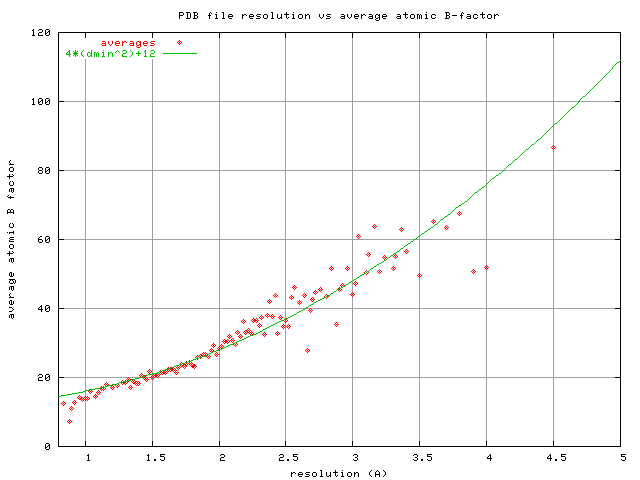
> >>>> could have used the PDB-wide average atomic B factor reported for
> >>>> structures with resolution "d", which roughly follows:
> >>>> B = 4*d**2+12
> >>>> https://bl831.als.lbl.gov/~jamesh/pickup/reso_vs_avgB.png
> >>>>
> >>>> The reason I didn't use this formula for the movie is because I didn't
> >>>> figure it out until about 10 years later.  These two curves cross at
> >>>> 1.5A, but diverge significantly at poor resolution.  So, which one is
> >>>> right?  It depends on how well you can measure really really faint
> >>>> spots, and we've been getting better at that in recent decades.
> >>>>
> >>>> So, what I'm trying to say here is that just because your data has
> CC1/2
> >>>> or FSC dropping off to insignificance at 1.8 A doesn't mean you are
> >>>> going to see holes in Tyr side chains.  However, if you measure your
> >>>> weak, high-res data really well (high multiplicity), you might be able
> >>>> to sharpen your way to a much clearer map.
> >>>>
> >>>> -James Holton
> >>>> MAD Scientist
> >>>>
> > ########################################################################
> >
> > To unsubscribe from the CCP4BB list, click the following link:
> > https://www.jiscmail.ac.uk/cgi-bin/webadmin?SUBED1=CCP4BB&A=1
>
> ########################################################################
>
> To unsubscribe from the CCP4BB list, click the following link:
> https://www.jiscmail.ac.uk/cgi-bin/webadmin?SUBED1=CCP4BB&A=1
>

########################################################################

To unsubscribe from the CCP4BB list, click the following link:
https://www.jiscmail.ac.uk/cgi-bin/webadmin?SUBED1=CCP4BB&A=1