As I wrote in my previous email, I get the impression that this program was
relatively expensive compared to the number of content contributors (who in
this case are academics). I am keeping in mind that this was a pilot, and that
initial planning and the first iteration for many programs like this require
some one-time expenses and some debugging. My guess is that for future rounds
WikiEd can make the program be more efficient, and that this will be a work in
progress.
This program is not without financial costs, both for the pilot and for future
rounds. I return to the questions that I asked LiAnna in my previous email: who
funded WikiEd's expenses for this project, and what thoughts does WikiEd have
regarding how the project can be scaled up in a way that is more efficient in
terms of cost per participant?
I am hoping that WikiEd has a reliable funding source for the next round, and
that WikiEd is currently planning how to increase the cost-effectiveness.
Stepping back to consider the larger problem of too few knowledgable volunteers
supporting too many novices throughout the wikiverse, I get the impression that
WMF is spending increasing amounts of money on training and one-on-one help for
technical and content contributors, both by directly funding WMF employees and
by providing funds to grantees. I anticipate that the trend will continue, and
I am anxious to see it be effective in increasing content contributor
longevity, content quality, content quantity, diversity of contributors, and
measues of community health. I am glad to see WikiEd working in this domain
with academics, and I would like for this program to be successful, financially
sustainable, and cost-effective in the medium to long term.
Pine
( https://meta.wikimedia.org/wiki/User:Pine )


-------- Original message --------From: James Salsman <[email protected]>
Date: 5/23/18  7:07 PM  (GMT-08:00) To: Wikimedia Education
<[email protected]>, Pine W <[email protected]> Subject: Re:
[Wikimedia Education] Evaluation report on Wikipedia Fellows pilot
Pine, why would you be concerned about the cost-effectiveness or
sustainability. This program looks great to me, except for the
mismatch between needs and recruiting.

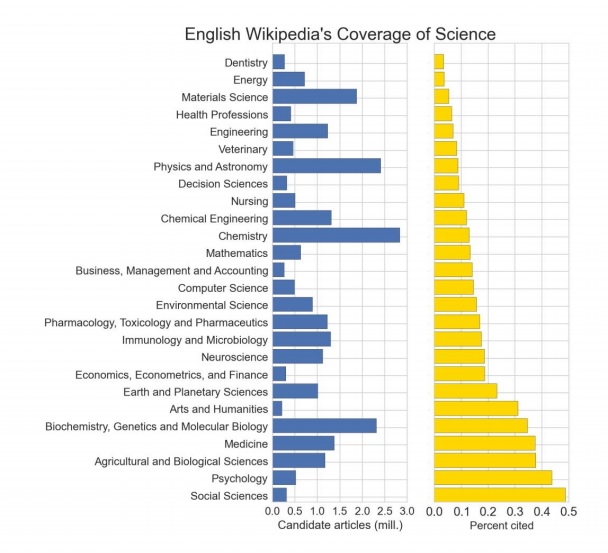
On that point, there is an alternative to
http://blogs.lse.ac.uk/impactofsocialsciences/files/2015/09/figure-1-wikipedia-open-access1.jpg

(Beyond expanding it from the sciences to the humanities and ranking
it by the damage quality issues do to society for each topic.)

Which is: https://www.youtube.com/watch?v=t7cHxlGgEt4&t=46m

Math is the most valuable topic for donations. I'm interested in
suggesting improvements to
https://en.wikipedia.org/wiki/Frobenius_manifold

On Wed, May 23, 2018 at 6:59 PM, Pine W <[email protected]> wrote:
> Hi LiAnna,
>
> Thank you for this report. Increasing the number of good-faith contributors
> to Wikipedia is always nice to see. I believe that at least a few people in
> WMF, the affiliates, and the long-term volunteer population have been
> interested for many years in increasing the number of academics who
> contribute to Wikipedia.
>
> The program sounds like it was relatively labor intensive on the part of
> WikiEd, and the number of academic participants was small. Who funded
> WikiEd's expenses for this project, and what thoughts does WikiEd have
> regarding how the project can be scaled up in a way that is more efficient in
> terms of cost per participant?
>
> I would like to see this project scale up, but I am concerned about its
> cost-effectiveness and financial sustainability.
>
> As you probably know, I am continuing my development of training materials,
> primarily videos, for new Wikimedians, although the audience that I have in
> mind is more typical of ENWP's volunteer population instead of being focused
> on the specific interests and mindsets of academic contributors.
>
> Regards,
> Pine
> ( https://meta.wikimedia.org/wiki/User:Pine )
> -------- Original message --------From: LiAnna Davis <[email protected]>
> Date: 5/22/18  9:51 AM  (GMT-08:00) To: Wikimedia Education
> <[email protected]> Subject: [Wikimedia Education] Evaluation
> report on Wikipedia Fellows pilot
> Greetings, all!
>
> At the beginning of 2018, the Wiki Education Foundation ran a 3-month pilot
> to engage academic experts (mostly professors at universities in the U.S.)
> to improve English Wikipedia articles related to their areas of expertise.
> We're pretty happy with how the pilot turned out -- we had some great
> improvements to articles, and, more importantly for a pilot, we learned a
> *lot* about how to run a program like this successfully.
>
> The team that worked on it put together this extensive evaluation report on
> what we did, what we learned, and what the outcomes were from the pilot:
> https://meta.wikimedia.org/wiki/Wiki_Education_Foundation/Wikipedia_Fellows_pilot_evaluation
>
> I also put together a short blog post about it:
> https://wikiedu.org/blog/2018/05/22/wiki-education-publishes-evaluation-of-fellows-pilot/
>
> We already have calls for applications out for additional cohorts to begin
> in June, and we're eager to learn even more from future iterations of the
> Wikipedia Fellows program. I hope sharing our learnings like this can be
> helpful for other education programs in the Wikimedia movement who might
> also be interested in engaging subject matter experts to edit.
>
> We're happy to answer questions on this list or on the talk page of the
> evaluation report on Meta.
>
> LiAnna
>
>
> --
> LiAnna Davis
> Director of Programs; Deputy Director
> Wiki Education
> www.wikiedu.org
> _______________________________________________
> Education mailing list
> [email protected]
> https://lists.wikimedia.org/mailman/listinfo/education
> _______________________________________________
> Education mailing list
> [email protected]
> https://lists.wikimedia.org/mailman/listinfo/education
_______________________________________________
Education mailing list
[email protected]
https://lists.wikimedia.org/mailman/listinfo/education