On Wed, 24 May 2006, Jobst Heitzig wrote:

> a week ago I suggested using social welfare functions (such as the Gini
> welfare function) to evaluate election methods.
I have also been trying to run simulations that count up the social
welfare, but my initial results caused me to doubt my implementation.

The equation I got from this discussion of the form f_ave - (big cross
comparison term) gave me results which seemed to just be f_ave minus a
relatively constant factor. It didn't seem to change the relative
positions of the election methods versus their plain average social
utility.

I was also unable to reconcile the equation from this forum with the
wikipedia version here:
http://en.wikipedia.org/wiki/Gini_coefficient
But maybe that's just because my algebra is rusty.

Anyway, I'll take any equation with anyone's name on it if the equation
can be well characterized and shown to measure the properties we want to
measure.

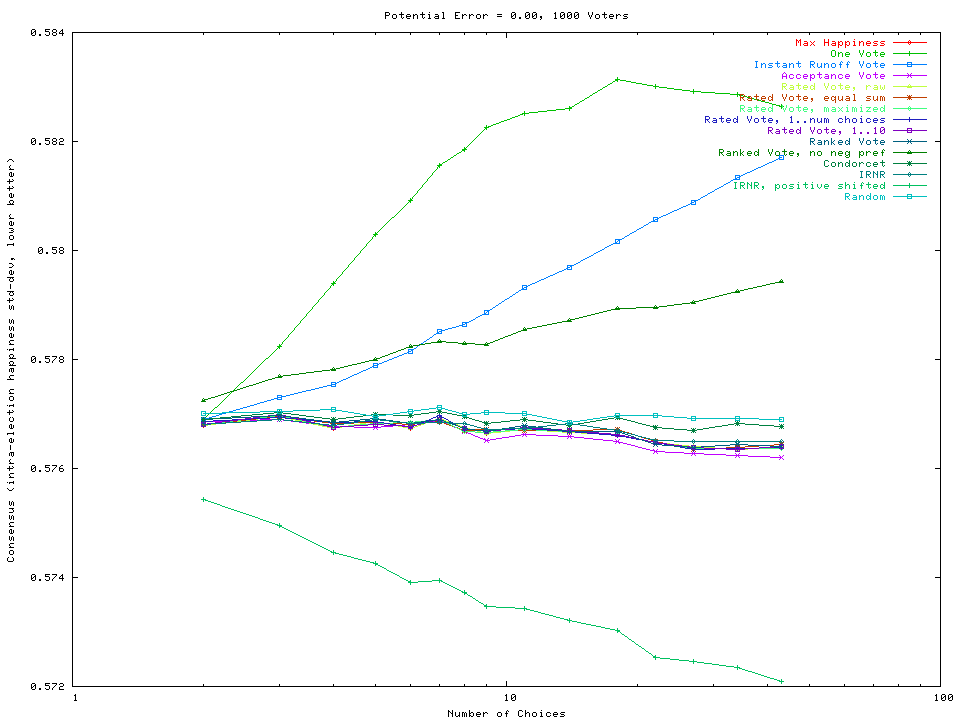
In my previous simulations I measured the standard deviation of happiness
within an election. I got data like this:
http://bolson.org/voting/graph/cv1000/e0_00.png

I'm still interested in a better measure than standard deviation if we can
find one. What's the qualitative difference between Gini and standard
deviation? (both in one way or another measure how widely distributed the
population is) What exactly is the right thing to measure?

I guess I'm still thinking about it.

Brian Olson
http://bolson.org/
----
election-methods mailing list - see http://electorama.com/em for list info