Jon,

I am very glad that you are doing this, I have wanted to do it
myself for a long time. I have always felt that the CUI encoders,
while being admirably cheap, are not as good as an optical
encoder, but I have had no data to support my belief. Maybe you
are about to come up with some.
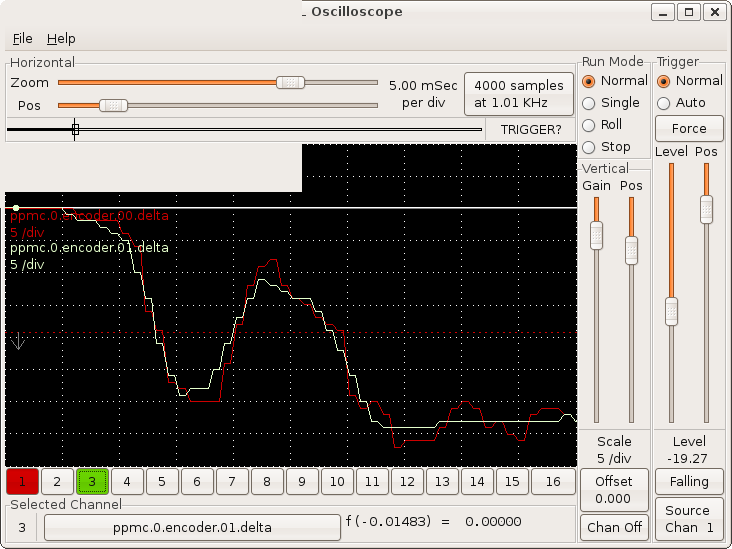
In the last picture you mentioned, yes, I do see the "lag" (again,
encoder in light-green, CUI in red) and also I see a "lead", where
it seems to realize that it's way behind and it starts to "hurry",
resulting in a steeper slope than the encoder, and an overshoot.
If you look at the right side where it's fairly level, the CUI
oscillates a time or two. So overall it gives the appearance that
(at least in this case) its "estimator" is "overtuned". This is
not necessarily a criticism, because I'm sure it has to be tuned
for the "general case", or to fit in everywhere if possible.

The problem as I see it is that the CUIs are inferred measurement
devices, and so take some finagling to arrive at the result.
Whereas an encoder is strictly a measuring device, like the
barrel of a micrometer. You look, you get a measurement, and
that's it. Even a resolver is a little bit of an inferred
measurement, but I think there's a little less finagling with
a resolver than with the CUIs.

I suspect that the CUI encoders would be very good for adding to
open-loop stepper systems for use as following-error monitors.
(Follow the cautions in the data sheets about mounting them too
close to strong magnets, like stepper motors!). That way, if there
are any problems with them, you can just loosen the following-
error limits a smidgen, and everything will work fine. The tuning
of the machine would not be dependent upon them.

I'd like to see you do a graph of static error vs. rotation, using
some kind of precision degree wheel. In format, something like the
monotonicity error of an A/D or D/A converter. If CUI does not
have a graph like that, one is needed. If they do, you'd be
keeping them honest.

Carry on, Jon, and let us know what you find, please write it up
when you've got some good results there. It should make for a very
interesting report.

Kim


On 06/17/2011 10:17 PM, Jon Elson wrote:
> OK, I think I get it, and it is about what I expected from an encoder
> with interpolation.
> It isn't exactly a velocity lag, it is an ACELLERATION lag!  I did
> another plot at
> expanded time resolution, http://pico-systems.com/images/vel.png
> and it looks like there is a real lag in responding to changes in velocity.
>
> Does anybody agree that is what I'm seeing here?
>
> Thanks,
>
> Jon
>

------------------------------------------------------------------------------
EditLive Enterprise is the world's most technically advanced content
authoring tool. Experience the power of Track Changes, Inline Image
Editing and ensure content is compliant with Accessibility Checking.
http://p.sf.net/sfu/ephox-dev2dev
_______________________________________________
Emc-developers mailing list
[email protected]
https://lists.sourceforge.net/lists/listinfo/emc-developers