Will and Steve,

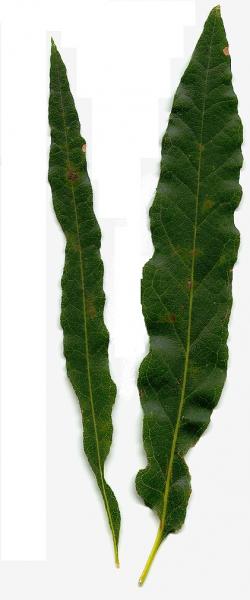
The oak cannot be Q. petraea 'Mesipilifolia'. The 'Mespilifolia' is a
cultivar, thus all the individuals are ~identical. Here is a photo of
'Mespilifolia' leaves:
http://www.uspza.cz/obrazky5/13-dub_17_big.jpg

You can see that the vein patterns are totally different.
Unfortunately, I cannot help more. It is not any Japanese or west
Asian/European species. What exists between those regions, is unknown
to me.

- Kouta

On 30 marras, 17:31, Steve Galehouse <[email protected]> wrote:
> Will-
>
> Possibly *Quercus petraea mespilifolia*, a variety of the Durmast oak,
> native to Europe and western Asia. The sessile acorns seem to imply that
> variety.
>
> Steve
>
> On Mon, Nov 30, 2009 at 11:03 AM, Will <[email protected]> wrote:
> >  I know this is the Eastern *Native* Tree society, but I wondered if any
> > of you with knowledge of exotic species might help me with an ID. I found
> > this oak yesterday (killing time while others were in the mall) on
> > Savannah's southside on Abercorn Ext adjacent to the campus of Armstrong
> > Atlantic Univ. I would assume it is probably an Asian Native as many of the
> > nearby trees owe their existence to the former USDA Plant Introduction
> > Station outside of Savannah known locally as the Old Bamboo Farm. This
> > station specialized in and imported much plant material from SE Asia back in
> > the 1920's and 30's. It closed in the 1950's and laid dormant for years and
> > used to be full of many trees and plants of Asian linage. The Cooperative
> > Extension service took over it after its closure and used it for research
> > and about 25 years ago they unfortunately cleared many of the old trees to
> > make way for field crops under research. There is still a fair collection of
> > trees and plant material there, although many of the old oak
> > species (Quercus, Lithocarpus, Castenopsis, Castenea) fell to the bulldozer.
> > Many folks including myself collected seed and seedlings from those
> > trees and planted them around SE GA.
>
> > The leaves of the oak are strongly veined both on top and bottom, very
> > similar in texture to a loquat, but not as hairy. I didn't take a hand lens,
> > but I would say for a cursory description they were glabrous. The leaves
> > were 5-8 inches long and the acorns about 3/4 inches. Pictures 1-4 are of
> > the oak. I also found a maple and dogwood I had never seen before, but they
> > appear to be a Yunan or Leather-leaf Maple and a Himalayan Dogwood.
>
> > photo 1   oak leaves
>
> > photo 2   oak buds
>
> > photo 3   oak acorns
>
> > photo 4   oak bark
>
> > photo 5   Leather-leaf maple
>
> > photo 6   Himalayan dogwood
>
> > --
> > Eastern Native Tree Societyhttp://www.nativetreesociety.org
> > Send email to [email protected]
> > Visit this group athttp://groups.google.com/group/entstrees?hl=en
> > To unsubscribe send email to
> > [email protected]<entstrees%[email protected]>

--
Eastern Native Tree Society http://www.nativetreesociety.org
Send email to [email protected]
Visit this group at http://groups.google.com/group/entstrees?hl=en
To unsubscribe send email to [email protected]