EV Digest 2538

Topics covered in this issue include:
  1) Re: application of NASA supercap technology
        by "[EMAIL PROTECTED]" <[EMAIL PROTECTED]>
  2) Re: application of NASA supercap technology
        by "[EMAIL PROTECTED]" <[EMAIL PROTECTED]>
  3) Re: application of NASA supercap technology
        by "[EMAIL PROTECTED]" <[EMAIL PROTECTED]>
  4) Re: application of NASA supercap technology
        by Seth <[EMAIL PROTECTED]>
  5) Re: DC-DC converters...
        by Victor Tikhonov <[EMAIL PROTECTED]>
  6) Re: application of NASA supercap technology
        by "Roy LeMeur" <[EMAIL PROTECTED]>
  7) Re: newbie EV questions
        by "Roy LeMeur" <[EMAIL PROTECTED]>
  8) Re: newbie EV questions
        by "1sclunn" <[EMAIL PROTECTED]>
  9) Re:  PFC20 vs Sparrow - there is hope
        by "Roy LeMeur" <[EMAIL PROTECTED]>
 10) Re: EV wanted in Reno, NV
        by "Lawrence Rhodes" <[EMAIL PROTECTED]>
 11) Re: PFC20 vs Sparrow - there is hope
        by Rich Rudman <[EMAIL PROTECTED]>
 12) RE: Battery heaters
        by "George Tylinski" <[EMAIL PROTECTED]>
 13) Tango battery thermal management (was: Aquarium Chillers)
        by Lee Hart <[EMAIL PROTECTED]>
 14) Re: EV Warrior info needed
        by Lee Hart <[EMAIL PROTECTED]>
 15) Re: DC-DC converters...
        by Lee Hart <[EMAIL PROTECTED]>
 16) Re: newbie EV questions
        by Lee Hart <[EMAIL PROTECTED]>
 17) Re: EV Warrior info needed
        by "BORTEL" <[EMAIL PROTECTED]>
 18) Re: EV Warrior info needed
        by [EMAIL PROTECTED]
 19) PFC-50 in a Sparrow installation
        by Bruce EVangel Parmenter <[EMAIL PROTECTED]>
 20) Re: Tango battery thermal management (was: Aquarium Chillers)
        by Sam Uzi <[EMAIL PROTECTED]>
 21) weird efficiency
        by "Mark Hanson" <[EMAIL PROTECTED]>
 22) Re: Tango battery thermal management (was: Aquarium Chillers)
        by Gordon Niessen <[EMAIL PROTECTED]>
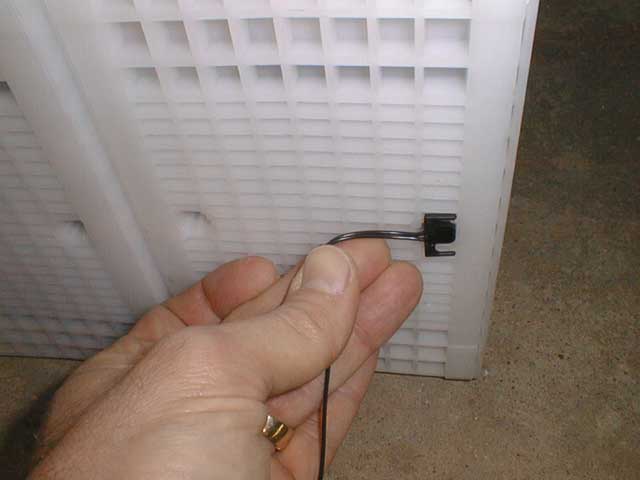
 23) Saft Ni-Cad temperature sensor - 4th failure
        by Matt Trevaskis <[EMAIL PROTECTED]>
 24) BC-20 charger problem
        by David Brandt <[EMAIL PROTECTED]>
 25) Electric Scooter
        by "James Jarrett" <[EMAIL PROTECTED]>
 26) RE: Saft Ni-Cad temperature sensor - 4th failure
        by "Tom Hudson" <[EMAIL PROTECTED]>
 27) Blackhawk 400
        by "James Jarrett" <[EMAIL PROTECTED]>
 28) Re: Tango battery thermal management (was: Aquarium Chillers)
        by John Lussmyer <[EMAIL PROTECTED]>
--- Begin Message ---
At 08:43 AM 1/15/03, you wrote:
----- Original Message -----
From: <[EMAIL PROTECTED]>
To: <[EMAIL PROTECTED]>
Sent: Tuesday, January 14, 2003 11:50 PM
Subject: Re: application of NASA supercap technology


   Hi Bill;

    Bummer! Maybe they don't want to get into bikes, in an SUV economy.
Actually, I think that they picked the "home team" in Illinois.
Also, NetGain has a very good PR machine and PR is what NASA wants most.
_ /| Bill "Wisenheimer" Dube'
\'o.O' <[EMAIL PROTECTED]>
=(___)=
U
Check out the bike -> http://www.KillaCycle.com
--- End Message ---
--- Begin Message ---
At 11:20 AM 1/15/03, you wrote:
Too bad you didn't get the supercaps Bill, I'm sure you would have
put them to good use!

If it doesn't give anything away or violate any agreements or
anything, enquiring minds would love to hear your thoughts on
controllers using supercaps.
To squeeze the most kW-hrs per pound from a cap, you must make the
voltage swing as big as possible. Thus, the controller must have a very
broad range for the input voltage.
_ /| Bill "Wisenheimer" Dube'
\'o.O' <[EMAIL PROTECTED]>
=(___)=
U
Check out the bike -> http://www.KillaCycle.com
--- End Message ---
--- Begin Message ---
At 04:57 AM 1/15/03, you wrote:
Are you at liberty to say whose cap they are, and how many of what
capacity? I didn't see a name in the article.
They were really secretive. The fellow that contacted me wouldn't
even give me the last name of the NASA engineer working on the project.
They were very careful not to mention the name of the capacitor company. If
they did, it would instantly put NASA out of the loop. The source of the
caps was the only thing of value that NASA could offer, actually. Thus, it
was, as still is, kept carefully secret by the NASA folks.
If anyone has any clue, let me know and I'll attempt an end run
around NASA.
_ /| Bill "Wisenheimer" Dube'
\'o.O' <[EMAIL PROTECTED]>
=(___)=
U
Check out the bike -> http://www.KillaCycle.com
--- End Message ---
--- Begin Message ---
There aren't that many players in the field.

Maxwell
Ness
Saft
ESMA

There are the first I would investigate.


http://www.faradnet.com/company/ultracap.htm

lists more, but they seem more virtual than real, IMHO

Seth

"[EMAIL PROTECTED]" wrote:
>
> At 04:57 AM 1/15/03, you wrote:
> >Are you at liberty to say whose cap they are, and how many of what
> >capacity? I didn't see a name in the article.
>
>          They were really secretive. The fellow that contacted me wouldn't
> even give me the last name of the NASA engineer working on the project.
> They were very careful not to mention the name of the capacitor company. If
> they did, it would instantly put NASA out of the loop. The source of the
> caps was the only thing of value that NASA could offer, actually. Thus, it
> was, as still is, kept carefully secret by the NASA folks.
>
>          If anyone has any clue, let me know and I'll attempt an end run
> around NASA.
>
>     _ /|        Bill "Wisenheimer" Dube'
>    \'o.O'     <[EMAIL PROTECTED]>
> =(___)=
>         U
> Check out the bike -> http://www.KillaCycle.com

--
vze3v25q@verizondotnet
--- End Message ---
--- Begin Message ---
Rod Hower wrote:
>
> Victor,
> Many of the low cost wall plugs now have universal input (up to 265Vac).
> Most of them are designed with TOPSWITCHs.  I see no reason why you could
> not use on of these with a DC input?  Up to 350Vdc no problem with
> reverse polarity
> protection.

Yes, that would do it. Do you know how to figure out what a given
wall plug contain, tiny 60 Hz transformer+diodes or TOPSWITCH?

> 3.3V to 300V?  We'll, no suggestions there!
>
Thanks Rod,

Unless I wind up my custom flyback, I'll have to do this in
2 stages - 3.3V to 48 V and 48V to 300V.

Browsing web yielded http://www.mpja.com/ which has some DC-DC
converters; supposedly new. They sell, for instance, Lambda or
Cosel ones up to about 10 times cheaper (!) than these company's
"official" distributors. Is there something wrong with this
picture or with MPJA?

Any thoughts?
--- End Message ---
--- Begin Message ---
Bill Dube wrote:
They were really secretive. The fellow that contacted me wouldn't even give
me the last name of the NASA engineer working on the project. They were
very careful not to mention the name of the capacitor company. If they did,
it would instantly put NASA out of the loop. The source of the caps was the
only thing of value that NASA could offer, actually. Thus, it was, as still
is, kept carefully secret by the NASA folks.
If anyone has any clue, let me know and I'll attempt an end run around
NASA.
Just a guess Bill, I talked with someone at Maxwell a few months back when I
was working for Roderick and he indicated that they were close to having
capacitors compatible with EV systems. (substantial military interest) That
is all I know.
www.maxwell.com
--- In [EMAIL PROTECTED], "[EMAIL PROTECTED]" <[EMAIL PROTECTED]> wrote:
At 04:57 AM 1/15/03, you wrote:
>Are you at liberty to say whose cap they are, and how many of what
>capacity? I didn't see a name in the article.
They were really secretive. The fellow that contacted me wouldn't
even give me the last name of the NASA engineer working on the project.
They were very careful not to mention the name of the capacitor company. If
they did, it would instantly put NASA out of the loop. The source of the
caps was the only thing of value that NASA could offer, actually. Thus, it
was, as still is, kept carefully secret by the NASA folks.
If anyone has any clue, let me know and I'll attempt an end run
around NASA.
_ /| Bill "Wisenheimer" Dube'
\'o.O' <[EMAIL PROTECTED]>
=(___)=
U
Check out the bike -> http://www.KillaCycle.com
Roy LeMeur Seattle WA
My Electric Vehicle Pages:
http://www.angelfire.com/ca4/renewables/evpage.html
Informational Electric Vehicle Links:
http://www.angelfire.com/ca4/renewables/evlinks.html
_________________________________________________________________
The new MSN 8 is here: Try it free* for 2 months
http://join.msn.com/?page=dept/dialup
--- End Message ---
--- Begin Message ---
An excellently worded and concise overview Peter, I have saved this for
future reference :^D
--- In [EMAIL PROTECTED], "VanDerWal, Peter MSgt" <[EMAIL PROTECTED]> wrote:
>A somewhat open question: Where are the technology changes happening (for
>basic lower-end EVs)? Most of the conversion kits still feature Advanced
>DC motors. I see a lot of discussion on chargers so I would guess that is
>one area. What others? Regen braking? Is much changing in controllers?
>Are lead-acid batteries getting much better? I want to know what areas an
>older conversion might be behind what I'd put together myself.
DC motors haven't advanced a whole lot in the last 100 years, so unless
it's
a 'really' old motor that might be diffacult finding parts for...don't
worry
about it.
For flooded Golf Cart batteries, newer chargers are nice and may add some
extra features, but old chargers work fine. In fact some folks on this
list
use something dubbed a "bad boy" charger which is nothing more than a
bridge
rectifier and enough extension cords to provide the proper resistance to
limit charging current. As the pack voltage comes up you remove extension
cords.
At any rate for flooded batteries, any working charger is fine.
For sealed batteries you want a charger that can at least do a two step and
preferably a three step charging profile that matches the requirements for
the particular batteries being used.
The biggest advances in EVs recently have been controllers. In the 1970's
contactor controllers were popular (just wires and switches). Late 70's
early 80's it was SCR controllers (efficiency is not so great). Early 90's
saw some MOSFET and lots of IGBT controllers. For voltages under 200V
MOSFETs are generally more efficient, above 200V IGBTs have start to be
more
efficient and they are much cheaper than MOSFETs.
Some of the older conversions still come with contactor controllers (like
most citicars and comutavans) and some still have SCR controllers (like the
"Jet" series from the '80s)
Regen controllers for series wound motors are pretty much a wash. To work
OK you need a motor with interpole windings. I believe the only one
currently available is the Kostov (is Warp coming out with one?). If the
motor doesn't have interpoles (like the ADCs don't) then you need to set
your brushes for a neutral position which lowers efficiency when driving.
Either way it doesn't add much, if any, to range. It does help out with
braking though.
New series regen controllers for 120V and higher are difficult
(impossible?)
to find these days. There are a few refurbished Curtis regen controllers
floating around.
Don't expect to see any earth shattering improvements in lead-acid
batteries. Flooded batteries have not changed a whole lot in the last 140
years. AGMs are pretty much at the peak of their potential.
Any major improvements in batteries are going to come from some other
technology.
Some cars have DC Separate Excited motors (SEPEX) which offers inherent
regen. New SEPEX motors/controllers are somewhat hard to find.
Other technologies that offer inherent regen are BLDC and AC. Making BLDC
motors for typical size cars is rather expensive so you won't see many of
those. AC seems to be the up and coming technology, Victor Tikhonov offers
some Siemens AC setups (Motor + controller with integrated DC-DC, main
contactors and throttle position sensor) at very reasonable rates (for an
AC
setup)
http://www.metricmind.com/
Up side is effective regen and a wide operating RPM (up to 10,000 rpm),
down
side is slightly higher cost and they pretty much require a high voltage
pack (156-350 volts). They will work at lower voltages (120-144V) but
performance is lacking.
High voltage (200V+) packs pretty much require AGM or sealed batteries (GC
batteries get too heavy), which pretty much requires a battery management
system of some kind ($25 to $60 per battery) and an intelligent charger.
Roy LeMeur Seattle WA
My Electric Vehicle Pages:
http://www.angelfire.com/ca4/renewables/evpage.html
Informational Electric Vehicle Links:
http://www.angelfire.com/ca4/renewables/evlinks.html
_________________________________________________________________
The new MSN 8 is here: Try it free* for 2 months
http://join.msn.com/?page=dept/dialup
--- End Message ---
--- Begin Message ---
> At the low end, things are pretty stable. Most EVs are built with used
> parts and/or parts designed for some other purpose like fork lifts.
>
> > Most of the conversion kits still feature Advanced DC motors.
>
> Because they are the easiest to get.


I get asked a lot "what were those(adc"9) motors used in" are or were the
adc motors used for somthing other than EV cars ?
--- End Message ---
--- Begin Message ---
John G. Lussmyer wrote:
______________
It is NOT wired in! (yet)
I had to remove the Zivan mounting bracket/battery hold down.
The DC-DC will have to be moved. (it's kinda flopped over up in the corner
in that picture.)
I'll probably need to trim/cut off part of the PFC-20 mounting flange.
(Just take a Sawzall to it, right Rich? :-)
I then need to build some kind of mounting bracket and battery hold
down. (Just need to let the charger get within a 1/4" or so of the top of
the middle of the batteries. The old bracket forced it up at least a full
inch.)
_____________________________
Another edition of the PFC-20 does not have this flange, uses 1/4" aluminum
blocks (removable)for mounting.
Possibly you can exchange the cover you have for one without the flange (or
just cut it off).
Since you are not that far from Rich you can probably just exchange it
easily.
See pic of PFC-20 without flange but with aluminum blocks here:
(large JPG)
http://www.manzanitamicro.com/pfc20r2metal.jpg
Am I right on this Rich?
Roy LeMeur Seattle WA
My Electric Vehicle Pages:
http://www.angelfire.com/ca4/renewables/evpage.html
Informational Electric Vehicle Links:
http://www.angelfire.com/ca4/renewables/evlinks.html
_________________________________________________________________
STOP MORE SPAM with the new MSN 8 and get 2 months FREE*
http://join.msn.com/?page=features/junkmail
--- End Message ---
--- Begin Message ---
The Nissan Altra comes to mind.  Since they are an institution they would
have a better chance at getting one.  Rav4 might work also... Lawrence
Rhodes
----- Original Message -----
From: "gail" <[EMAIL PROTECTED]>
To: <[EMAIL PROTECTED]>
Cc: "Liz Sotoodeh" <[EMAIL PROTECTED]>
Sent: Wednesday, January 15, 2003 11:36 AM
Subject: EV wanted in Reno, NV


>
> The Desert Research Institute, Reno NV is interested in acquiring an
> EV for running errands such as picking up mail and packages.  It would
> need to go about 35-40 miles at up to 65 mph and have the capacity of
> a small min-van or station wagon.  They do not want a fixer-upper or
> something that will need a lot of maintenance.  I could not think of
> anything they could purchase new from any of the major manufacturers
> so would like to hear of cars you might know of that would serve
> their purpose and be within a reasonable transport range, as CA, NV or
> other nearby states.  It is quite disheartening to me that I cannot just
> tell them which local dealer could accomodate them. Other than Lectra
> Motors, a Nevada EV manufacturer of many years ago, I don't think there
> have been any commercially available vehicles here except the NEVs.
>
> Thanks for any suggestions.  I would love to have an EV in use at DRI
> but I can't really make any recommendations since all of the possibilities
> are rapidly going off the market.
>
> Gail
>
--- End Message ---
--- Begin Message ---
John G. Lussmyer wrote:
>
> I want to install my PFC-20 into my Sparrow, but I really do NOT want to
> put it in the back "tool" area.  Too much wiring and airflow problems.
> Last night at the SEVA meeting we joked about modifying the Sparrow hood so
> that the PFC-20 could be mounted where the Zivan is.
> A PFC-20 is a LOT bigger than a Zivan NG3, right?  Well... not really.  I
> did some measuring this morning.  The Zivan is a couple inches longer (main
> body, not mounting flanges), the same width, and only 1" shorter.  So the
> only real problem is the extra 1" height of the PFC-20.
> There already is a little free space above the ZIvan.
> So I pulled the Zivan out, and started fiddling with placing the PFC-20.
> Final results are:
> http://www.casadelgato.com/EV/Sparrow/PFC20HoodClosed.JPG
> http://www.casadelgato.com/EV/Sparrow/PFC20-MayFit.JPG
>
> It is NOT wired in! (yet)
> I had to remove the Zivan mounting bracket/battery hold down.
> The DC-DC will have to be moved. (it's kinda flopped over up in the corner
> in that picture.)
> I'll probably need to trim/cut off part of the PFC-20 mounting flange.
> (Just take a Sawzall to it, right Rich? :-)
> I then need to build some kind of mounting bracket and battery hold
> down.  (Just need to let the charger get within a 1/4" or so of the top of
> the middle of the batteries.  The old bracket forced it up at least a full
> inch.)
> --
> John G. Lussmyer      mailto:[EMAIL PROTECTED]
> Dragons soar and Tigers prowl while I dream....         http://www.CasaDelGato.com


Hey John and Sparrow listers.

The newer SN#36 and up Pfc20s don't have that mounting flange, they have
screw on feet that can be removed if nessary. This gives alternate
mounting ideas. And cuts about 4 lbs off the Charger weight. This one
#20 is a STEEL box, the current is #46 and it's all Aluminum. I won't
have any problems in helping you all to kit this idea, or what ever it
takes to get PFC20s in Sparrows.

EX Sparrow owner from DCPower systems... I wish I still had it...
Sigh!!!

Also the 300 or so Sparrows out there.. are a pretty good market...
Who knows the current count???? I think mine was #89 or 92. It's back
east in Rochester NY I think. It has a DCP 1200 Raptor in it.


Who's gonna be the first PFC50 Sparrow owner??? it can charge a Sparrow
at 65+ amps. For those nice 20 minute fill ups....


--
Rich Rudman
Manzanita Micro
www.manzanitamicro.com
1-360-297-7383,Cell 1-360-620-6266
--- End Message ---
--- Begin Message ---
Nice to hear of others' solutions, especially with results data. It can
be a lot of work, and money, to prototype these things. Celebrate when
it works!

If you can, use "snap-action" thermostatic switches, they will last
longer due to the fast action which limits arcing. Also be sure, like
any other switch, that they are rated for the voltage and AC v. DC you
need. Although I confess I used AC rated devices from "Thermic" on DC
power and they held up pretty well for ?X10^3 cycles. 120VAC on 28VDC
IIRC. The Thermics came with pigtails and the case was not isolated, so
those Farnell things are a good score. Sometimes you can also choose the
hysteresis on these things, which is awfully nice.

80W for 5 batteries is pretty gentle heating (just takes more time
perhaps).

- GT

> -----Original Message-----
> From: Richard Bebbington [mailto:[EMAIL PROTECTED]]
> Sent: Wednesday, January 15, 2003 12:50 PM
> To: [EMAIL PROTECTED]
> Subject: Re: Battery heaters
>
>
> Here's an idea for John Lussmeyer's Sparrow
> problems ( specifically battery heating ).
>
> I have Optimas in my Mini Pickup.
> Last time I was in Canada, I popped into my
> local Canadian Tire and bought a couple of
> battery heater blankets. The 80 watt units
> run from 110 Vac, and are long enough to
> cover 5 "Optima widths" , i.e they will
> cover the length of 5 Optimas, arranged side
> by side. Yes, they're expensive, but they do
> come with some insulation on one side, and are
> made for heating batteries.
> Other places like JC Whitney probably have things
> like these too, especially where winter is nasty...
>
> To control the temperature, I bought two
> 30 deg C bimetallic thermal switches, they come
> in a small can about 1/2 inch diameter, 1/4 inch
> thick with two spade terminals on. There's a
> ring which bolts the end of the can onto the thing
> you want to control the temperature of, and the can
> itself is electrically isolated from the terminals.
> Digikey probably carry these, I bought mine from
> Farnell here in the UK.
> (hint, Farnell can get US stuff from Newark Electronics,
>    so they may be in the Newark catalogue)
>
> I bolted each one to a 4 inch x 4 inch aluminium
> plate ( thin stuff, from old electronics boxes ).
> Each one of these assemblies fits snugly against
> the ends of two adjancent Optimas, with the
> thermal switch itself nestling in the space created
> by the rounded corners of the batteries. The aluminium
> plate acts as a heatsink, meaning the switch will track
> the battery temperature better. The heater blankets
> cover the whole lot.
>
> On my setup, the two heater blankets are wired in series,
> since all our domestic AC power here in the UK is 240 Vac,
> together with the two thermal switches ( also in series ).
> That way, either of the two switches can turn off the heaters.
>
> Works great, batteries sit at around 25 deg C. ( 70 F ).
> I do have some insulation around my battery box, but
> it doesn't get too cold here in the UK.
>
> Surely something like this could be crammed into
> a Sparrow? I know the thermal switches can be had
> with almost any switch-off temperature, from
> 10 deg C up to 130 deg C
> ( I have one of these inside my ceramic heater assembly
>    in the pickup too )
>
> H.T.H.
>
> Richard Bebbington
> Electric Mini Pickup
>
--- End Message ---
--- Begin Message ---
Thomas Shay wrote:
> I don't recall reading much about battery cooling here and I'm not
> sure why. There must be quite a few who have battery [over]heating
> problems. Maybe they don't realize they have a problem.
>
> It makes my brain tired trying to think about using aquarium coolers
> or some other source of chilled water to cool batteries. The chilled
> water must be delivered and its flow regulated to each battery.
> There are issues with clogs, leaks, pinched hoses, valves, pumps,
> battery temperature equalization, etc.

We're trying an experimental battery heating/cooling system on Rick
Woodbury's Tango. Let me describe it for everyone's comments and
critique.

The Tango has its 25 Optima batteries in one large box. The box has
styrafoam insulation on all sides, so heat flow in/out of the box is
limited.

There are vents in two corners of the box, each about 15 sq.in. in area.
A squirrel cage blower forces air into one, which exhausts out the
other. If ambient air was always at a suitable temperature, this is all
that would be needed. It's not, of course.

The air intake and exhaust duct into the interior of the car (plus some
make-up air from outside). You wouldn't want to do this with floodeds
because of the gassing and smell, but this is acceptable with sealed
batteries.

When the Tango's heater or air conditioner are running, the battery box
air is thus automatically heated or cooled to whatever the driver
considers "comfortable". Since lead acid batteries have the same basic
"comfort" zone as people, this can manage battery temperature. (The
Toyota Prius does the same thing to control its battery temperature).
The heater or air conditioner can also be run when the car is parked and
charging, to both control battery temperature and to preheat/cool the
interior.

Finally, the batteries can act as a tremendous thermal "flywheel". It
takes many hours to raise or lower their temperature. For example, in
winter the batteries can be maintained at 80 deg.F by running the heater
while plugged into AC. When you start driving, the air coming out of the
battery box will be close to battery temperature, instead of near
outdoor temperature. The batteries are cooling off, but heating the
interior in the process. Thus, the amount of heater power required is
less.

There is a more aggressive heating/cooling system as well. Each battery
has its own 12v 15amp charger. These "BatChargers" are small (about 6.5"
x 3" x 1"), and mount right on top of each battery. They are liquid
cooled by a 1/2" O.D. hose that loops thru them. Since they are tightly
coupled to the battery, heat can also be transferred in/out of the
battery by the liquid coolant.

The Tango has a heat exchanger that looks like a small radiator, but
with 3 sets of lines in it. One for the hot-water heater, one for the
air conditioner, and one for the liquid coolant loop for the chargers
and controller. So again, the air conditioner or heater can be run to
heat or cool the BatChargers and batteries.

All this is probably overkill, but it provides flexibility and allows us
to experiment to see just how much thermal management is needed.
--
Lee A. Hart                Ring the bells that still can ring
814 8th Ave. N.            Forget your perfect offering
Sartell, MN 56377 USA      There is a crack in everything
leeahart_at_earthlink.net  That's how the light gets in - Leonard Cohen
--- End Message ---
--- Begin Message ---
Roy LeMeur wrote:
> I have been trying to find a wiring diagram for an EV Warrior
> electric bike... Just got off the phone with one of the few places
> which sells parts for them and this is what I got:
> Me- Hi, I'm looking for a wiring diagram for an EV Warrior
> Them- Yes, we have them, it comes in a manual that sells for $100.00

Wasn't there someone selling surplus EV Warrior parts? I think it was
Mendelson Electronics, but don't see them in their catalog.

I am looking for a source of motors for our BEST program, for 4th-6th
graders to build electric go-kart type vehicles. Anyone have any ideas?
--
Lee A. Hart                Ring the bells that still can ring
814 8th Ave. N.            Forget your perfect offering
Sartell, MN 56377 USA      There is a crack in everything
leeahart_at_earthlink.net  That's how the light gets in - Leonard Cohen
--- End Message ---
--- Begin Message ---
Rod Hower wrote:
>> Many of the low cost wall plugs now have universal input (up to
>> 265Vac). Most of them are designed with TOPSWITCHs. I see no reason
>> why you could not use on of these with a DC input?

Some are voltage doublers; 2 diodes and 2 capacitors. They won't work
with a DC input. Others just have a bridge and one capacitor, and will
work with Dc inputs.

Victor Tikhonov wrote:
> Yes, that would do it. Do you know how to figure out what a given
> wall plug contain, tiny 60 Hz transformer+diodes or TOPSWITCH?

Size and weight. The ones with conventional 60 Hz transformers are
significantly bigger and heavier (but cheaper).

>> 3.3V to 300V?  We'll, no suggestions there!
> Unless I wind up my custom flyback, I'll have to do this in
> 2 stages - 3.3V to 48 V and 48V to 300V.

No; there are lots of sources of 3.3v to 300vdc at low power. One common
use is for fluorescent backlights for laptop computers. There are off
the shelf DC/DC converters with as high as 1000vdc outputs!

> Browsing web yielded http://www.mpja.com/ which has some DC-DC
> converters; supposedly new. They sell, for instance, Lambda or
> Cosel ones up to about 10 times cheaper (!) than these company's
> "official" distributors. Is there something wrong with this
> picture or with MPJA?

They're surplus, so caveat emptor (let the buyer beware). Sometimes
surplus are just overstocks that nobody wanted. Other times they are
rejects that were junked or returned for some QC problem, or "custom"
designs that somebody wanted to be built a little different.
--
Lee A. Hart                Ring the bells that still can ring
814 8th Ave. N.            Forget your perfect offering
Sartell, MN 56377 USA      There is a crack in everything
leeahart_at_earthlink.net  That's how the light gets in - Leonard Cohen
--- End Message ---
--- Begin Message ---
1sclunn wrote:
> I get asked a lot "what were those (adc 9") motors used in"

They were designed for larger industrial electric vehicles, like fork
lifts, mining equipment, towmotors, etc. Advanced DC is kind of a second
tier supplier to these businesses, so they supplement their revenues by
selling to "riff-raff" like us. :-)
--
Lee A. Hart                Ring the bells that still can ring
814 8th Ave. N.            Forget your perfect offering
Sartell, MN 56377 USA      There is a crack in everything
leeahart_at_earthlink.net  That's how the light gets in - Leonard Cohen
--- End Message ---
--- Begin Message ---
----- Original Message -----
From: "Roy LeMeur" <[EMAIL PROTECTED]>
To: <[EMAIL PROTECTED]>
Sent: Wednesday, January 15, 2003 5:20 PM
Subject: EV Warrior info needed


> Hello All
>
> I have been trying to find a wiring diagram for an EV Warrior electric
bike.
>
> Me- Hi, I'm looking for a wiring diagram for an EV Warrior
>
> Them- Yes, we have them, it comes in a manual that sells for $100.00
>

That's crazy. I sell the Curtis 1505 controllers that were made for the EV
Warriors for $35 each and that includes the wiring diagram. I've emailed a
copy of the wiring diagram to Roy off list.
Dan Bortel
--- End Message ---
--- Begin Message ---
* LP8.2: HTML/Attachments detected, removed from message *
--- End Message ---
--- Begin Message ---
If Rich's question in the PFC-20 vs Sparrow thread,
of who is going to be the first to buy a PFC-50, has
me think what modifications need to be made to fit
a PFC-50 under the hood of a Sparrow.

If the Sparrow's hood was removed, measurements would
need to be taken to see if the PFC-50 would fit.

If it did, how hard is it to make a new hood that
would accommodate the taller PFC-50?

I have always thought a large anodized heat sink on
the hood would look really cool and some day, high
performance EVs would use the air flow over the hood
to cool the hi power controller.

The modified hood would change the classic look,
but no different than the muscle cars of the 70's.

They began a look of their own. Their hood was cut
to accommodate the large blower mounted on the ICE. See
http://madmaxmovies.com/cars/interceptor/history2.html


=====
' ____
~/__|o\__
'@----- @'---(=
. http://geocities.com/brucedp/
. EV List Editor & RE newswires
. (originator of the above ASCII art)
=====

__________________________________________________
Do you Yahoo!?
Yahoo! Mail Plus - Powerful. Affordable. Sign up now.
http://mailplus.yahoo.com
--- End Message ---
--- Begin Message ---
> The air intake and exhaust duct into the interior of the car (plus some
> make-up air from outside). You wouldn't want to do this with floodeds
> because of the gassing and smell, but this is acceptable with sealed
> batteries.

if one, or more, of the batteries does spill (cracking from accident, or
unexpected vibrational stress, etc?), is there any danger of introducing
dangerous gas into the passenger compartment? (eg: spilt acid reacting with
any dirt/debris that may have accumulated in the box, etc?)

admitedly an outside case, but imagine the poor bastard that wipes out
(badly enough to disable the car and crack a couple battery casings) in a
desolate blizzard, has to stay in the car to live (it's cold outside), but
is poisoned by (how much would it take?) acid-reaction offgassing?
--- End Message ---
--- Begin Message ---
* LP8.2: HTML/Attachments detected, removed from message *
--- End Message ---
--- Begin Message ---
Wow, I like that idea of one charger for each battery. Each one has much
lower demands on components and could be cheaper to build. As well as
cheaper to repair. Does each charger manage the complete charging
algorithm? Or do you have a central controller initiate the control?
Are you willing to share your design?
At 01:12 AM 1/16/2003, you wrote:
<snip>
There is a more aggressive heating/cooling system as well. Each battery
has its own 12v 15amp charger. These "BatChargers" are small (about 6.5"
x 3" x 1"), and mount right on top of each battery. They are liquid
cooled by a 1/2" O.D. hose that loops thru them. Since they are tightly
coupled to the battery, heat can also be transferred in/out of the
battery by the liquid coolant.

<snip>
Lee A. Hart                Ring the bells that still can ring
814 8th Ave. N.            Forget your perfect offering
Sartell, MN 56377 USA      There is a crack in everything
leeahart_at_earthlink.net  That's how the light gets in - Leonard Cohen
--- End Message ---
--- Begin Message ---
Hi Everyone,

I've got a Peugeot Scoot'elec scooter with 3 Saft STM5-100MR ni-cads which
has recently notched up 11,000 miles, mainly trouble-free apart from a
recurring problem which has now hit again.  The temperature sensor that
clips into the side of one of the "monoblocs" has failed - AGAIN.  This is
the 4th time in just over 3 years.  This has got to be more than just bad
luck, don't you think?

Can anyone offer any suggestions as to why the keep failing?  As far as I
know it is just a negative temperature coefficient thermistor on about 10
inches of "figure-8" wire - there doesn't seem to be anything to go wrong!
I dissected one of the old ones yesterday, thinking that there may have been
an internal bad connection etc. in the potting compound but it seems that
the compound actually forms the resistance material, and the wires just
terminate within it - nothing to break etc.

The one that has failed at the moment has a ~ 200 ohm resistance, which
should be around 2k ohm at room temperature.  I temporarily replaced the
sensor with a normal 2k2 resistor and the dashboard fault light disappears
and it's happy.  Plug the sensor back in and it freaks out again!

Two questions/requests:
1) Any ideas what the electronics could be doing to the sensor to keep
frying them?
2) Any contact in North America for ordering a new sensor quickly and
cheaply?  The only source in the UK is Peugeot's importer (2 week delivery
time and US$55) and Saft don't want to deal directly with me, saying that I
need to go through the vehicle manufacturer.

The importer wants me to transport my scooter on a 200 mile round trip just
to take it to a dealer to plug it into their diagnostic computer which I
know won't tell them anything other than "failed sensor" because it hasn't
done so in the past when they've failed, and they won't replace the sensor
until I do.

Any ideas gratefully received!

Matt Trevaskis
1999 Peugeot Scoot'Elec 11,000 miles
--- End Message ---
--- Begin Message ---
Something odd happened yesterday.  One of our vehicles is down, so my wife
has been using the EV.  She ran to town, ran some errands, then put the EV
on charge at church (or so she thought).  After work, I picked her up to go
eat and returned for the service.  Afterwards, I drove the EV home.  When I
plugged it in at home, I discovered the K & W BC-20 was not putting out any
current.  Adjusting the voltage and current knobs did nothing.  I had
noticed that the buzzing sound it makes was lower that usual when I had
unplugged it back at church, but it was too dark to read the meter on the
charger.

I checked all the usual culprits - fuses, circuit breakers, GFI, wiring,
etc. and found everything in order.  I'm charging (when I am home and can
babysit it) using the fair radio unit, attached to the same terminals the
BC-20 is attached to, and it works fine.  The BC-20 is getting AC power.
The light and fans run and the ammeter jumps for a minute to show that
everything is starting up.

Tonight I plan to check to see that the insides of the charger look OK, but
I do not anticipate any problems there (especially since it was rebuilt not
too long ago and I haven't had any problems since - the only things that
were not replaced were the terminal block, the case, and the rectifier and
triac).

Any ideas what else could be going on?

A little setup info.:  The AC comes in through the fuel filler port.  The
booster transformer and the charger are located in the hatchback area.
There is a 10 gage wire run to the front of the car from there, in its own
loom, strapped to the side of the PVC conduit that carries the battery
cables.  There are Anderson SB50 connectors at both ends.  Everything was
working fine up to this point.

David Brandt


IMPORTANT - THIS MESSAGE (INCLUDING ANY ATTACHMENTS) IS INTENDED ONLY FOR
THE USE OF THE INDIVIDUAL OR ENTITY TO WHICH IT IS ADDRESSED, AND MAY
CONTAIN INFORMATION THAT IS PRIVILEGED, CONFIDENTIAL AND EXEMPT FROM
DISCLOSURE UNDER APPLICABLE LAW. IF YOU ARE NOT THE INTENDED RECIPIENT, YOU
SHOULD DELETE THIS MESSAGE IMMEDIATELY AND YOU ARE HEREBY NOTIFIED THAT ANY
READING, DISSEMINATION, DISTRIBUTION OR COPYING OF THIS MESSAGE, OR THE
TAKING OF ANY ACTION BASED ON IT IS STRICTLY PROHIBITED. THANK YOU.
--- End Message ---
--- Begin Message ---
Hi all,

I'm having a senior moment, can someone remind me who it is that makes the
electric scooter that looks like the old Vespa gasoline scooter?

I'm looking for a short range runabout and I really like these!!

James
--- End Message ---
--- Begin Message ---
Matt, do your sensors look like the ones on my web page?

http://www.portev.org/solectria/ho/saft%20temp%20sensor.jpg

If so, I believe they're 3K ohms at 25C, and I was able to buy these
directly from Saft (Saft P/N 280737) for $35 each (the most expensive
thermistors in history).

Considering the fact that a thermistor from an electronics supplier will
cost you a whopping 66 cents (Mouser part# 334-39302) to $2.27 (Mouser part#
527-1003-3K), it may be worth trying to pick up a few parts at
www.mouser.com and trying them.  These do not have the molded plastic
housing that the real ones have, nor do I know if the response curve is the
same as in the Saft parts, but it would be easy to test with a good sensor
as a reference:

1) Let both sit at room temp, compare resistance.
2) Put outside on a cool/cold day, compare resistance.
3) Put both on a heating pad, compare resistance.

If these readings are comparable, I'd pot up the new component in some epoxy
to fit the hole (stick the real sensor in some non-hardening modeling clay
to make an impression and then put the component in and pour in some epoxy
and let it harden).

I _WOULD NOT_ do this if the scooter is under warranty -- If the charger
circuitry is frying the sensors, that's Peugeot's responsibility and you
might be voiding your warranty.

-Tom

P.S. I lied; I'd do it regardless of the warranty; what you do is up to you!

Thomas Hudson
http://portdistrict5.org -- 5th District Aldermanic Website
http://portev.org -- Electric Vehicles, Solar Power & More
http://portgardenclub.org -- Port Washington Garden Club
http://portlightstation.org -- Light Station Restoration
--- End Message ---
--- Begin Message ---
Has anyone ever seen/driven heard anything about this baby?

http://www.motobykz.co.uk/Esarati/The_Esarati_400_Blackhawk.htm

I'm extremely interested *IF* the price is reasonable and I can find a way
to get one in Charlotte NC.

James


James F. Jarrett
Information Systems Associate
Charlotte Country Day School
(704)943-4562

Asking if computers can think is like asking if submarines can swim.


-----Original Message-----
From: [EMAIL PROTECTED] [mailto:[EMAIL PROTECTED]]On
Behalf Of James Jarrett
Sent: Thursday, January 16, 2003 11:13 AM
To: [EMAIL PROTECTED]
Subject: Electric Scooter


Hi all,

I'm having a senior moment, can someone remind me who it is that makes the
electric scooter that looks like the old Vespa gasoline scooter?

I'm looking for a short range runabout and I really like these!!

James
--- End Message ---
--- Begin Message ---
At 08:07 AM 1/16/2003 -0600, Gordon Niessen stated:
Wow, I like that idea of one charger for each battery. Each one has much
lower demands on components and could be cheaper to build. As well as
cheaper to repair. Does each charger manage the complete charging
algorithm? Or do you have a central controller initiate the control?
Hopefully there is something to tell you if one of the chargers has
failed? Otherwise you will royally wreck that one battery the next time
you drive anywhere....
--
John G. Lussmyer mailto:[EMAIL PROTECTED]
Dragons soar and Tigers prowl while I dream....
http://www.CasaDelGato.Com
--- End Message ---