EV Digest 2910

Topics covered in this issue include:
  1) Re: Charger cost (was: 6 hours...)
        by Victor Tikhonov <[EMAIL PROTECTED]>
  2) Re: Life with a Jet Electrica EV report
        by russco <[EMAIL PROTECTED]>
  3) Re: Life with a Jet Electrica EV report
        by [EMAIL PROTECTED]
  4) Rain out!
        by "Shawn Lawless" <[EMAIL PROTECTED]>
  5) Re: Life with a Jet Electrica EV report
        by Victor Tikhonov <[EMAIL PROTECTED]>
  6) RE: Life with a Jet Electrica EV report
        by "Edward Ang" <[EMAIL PROTECTED]>
  7) Re: Rolling bodies (was: New EV to go...)
        by "Lawrence Rhodes" <[EMAIL PROTECTED]>
  8) Re: Kit car glider for sale Bradley GT
        by "Lawrence Rhodes" <[EMAIL PROTECTED]>
  9) Re: Life with a Jet Electrica EV report
        by Brad Waddell <[EMAIL PROTECTED]>
 10) Re: Rain out!
        by [EMAIL PROTECTED]
 11) Interesting meeting with an EV oldtimer.  NO BI GAS! Parts for sale.
        by "Lawrence Rhodes" <[EMAIL PROTECTED]>
 12) Re: Life with a Jet Electrica EV report
        by "Dave Anderson" <[EMAIL PROTECTED]>
 13) Re: Public design charger
        by Lee Hart <[EMAIL PROTECTED]>
 14) Re: Max equalizing voltage for Sparrow charing ?
        by Lee Hart <[EMAIL PROTECTED]>
 15) Re: Life with a Jet Electrica EV report
        by Lee Hart <[EMAIL PROTECTED]>
 16) Re: Ground Fault question
        by Lee Hart <[EMAIL PROTECTED]>
 17) Re: Public design charger
        by Otmar <[EMAIL PROTECTED]>
 18) Re: Life with a Jet Electrica EV report
        by Victor Tikhonov <[EMAIL PROTECTED]>
 19) Re: RE-switched capacitor battery equalizer
        by Rich Rudman <[EMAIL PROTECTED]>
 20) Re: Life with a Jet Electrica EV report
        by Brad Waddell <[EMAIL PROTECTED]>
 21) Re: Life with a Jet Electrica EV report
        by [EMAIL PROTECTED]
--- Begin Message ---
Tom Hudson wrote:

> That said, if I had to buy a new charger, I'd look for something made in the
> USA, if possible.  Why?  Because these Brusa units, even though they were
> installed in my Solectria vehicles when I bought them, would probably have
> to be shipped to Switzerland for repair if something in them breaks, meaning
> lots of down time waiting for the thing to come back.

USA certainly capable of producing equally good charger, but so far
didn't. Why? I was visiting Brusa plant few month ago and talk about
production and market philosophy.

My impression about the difference:

Brusa sets the goal they want this set of features, and achieve it.
Now, they try to keep the costs down in production by looking at
different suppliers, quantity discounts, etc. Design though is settled
and unaffected. Still expensive? Be it. Made in Switzerland.
Don't like it? I love it. I think much better than in China.

A US company search the charger market and sets the price cap first.
THEN tries to fit as many features in as this cap allows.
Over budget? Cut features and quality (moving off shore),
the cost is first priority. If the feature set is so minimal
that no one wants such a charger anymore, but still expensive,
they assume they're in wrong business and most likely won't
built this particular charger at all.

I don't claim this to be a fact or 100% the case for every
US company. It is my impression after seeing it first hand.

> Speaking of which, give me a break on the pricing issue.  I haven't had to
> actually go out and shop for an EV charger and only knew that the Brusa
> units with all the features I wanted were several thousand bucks.  I
> admitted I was guessing high.  So sue me.

Please relax, no one attacks you. Just quote real numbers.

Victor
--- End Message ---
--- Begin Message ---
You're having fun.  Isn't that what life's about?  Enjoy your EV,
aircraft, and a day in the country fishing.

Dave Anderson wrote:
>
> Plus if you want to go even further, it's absolutely ridiculous how much
> time, effort, and $$ I have put in to what essentially remains a 1981 Ford
> Escort.  The other day I went fishing.  It cost me about $800 to bring home
> a string of trout worth about $10 at the market.  It's not about the
> destination, it's about the journey and the experience.
>
> ----- Original Message -----
> From: "Dave Anderson" <[EMAIL PROTECTED]>
> To: <[EMAIL PROTECTED]>
> Sent: Wednesday, July 09, 2003 12:05 PM
> Subject: Re: Life with a Jet Electrica EV report
>
> Yes all true.  Hobby is right.  :)  The batteries do indeed bring up the
> cost per mile way up.  No doubt that overall it's more "expensive" than
> using a gasoline car.  But what the heck, it's fun.  I have a homebuilt
> experimental aircraft as well.  I *never* total up the costs of running
> that, it would spoil it all.  If I just measure these things by dollars,
> they make no sense at all.
>
> The insurance premium was $200/yr liability only.  It's just a 1981 Escort,
> worth about $50 as a car, so no collision.  Here in WA state, the
> registration was the same as for a ICE.  Too bad I can't get a tax credit,
> or off-peak electricity.
>
> ----- Original Message -----
> From: "russco" <[EMAIL PROTECTED]>
> To: <[EMAIL PROTECTED]>
> Sent: Wednesday, July 09, 2003 11:56 AM
> Subject: Re: Life with a Jet Electrica EV report
>
> Your miles/KWH is about right, but have you considered your cost of
> batteries/mile?
>
> One thousand $$$$$$$$$ for batteries that last 10,000 miles is ten cents
> a mile,  more than your electricity cost.
>
> There goes your 40 MPG down to less than half that.
>
> EV's are a hobby.  That's fine.  But don't expect an EV to cost less to
> operate than the gasoline car you already have.  The EV is extra
> insurance, extra registration, and the cost/mile is greater than an
> equivalent current gasoline car.
>
> I'm sure many will disagree, but the figures speak for themselves.
> After 3 EV's of my own, extremely aggressive driving in my area have
> forced me to a safer conventional car that is fully depreciated and cost
> perhaps $50 per year for maintenance.  Plus 30 mpg for gas at about 6
> cents/mile, that's my cost.
>
> Dave Anderson wrote:
> >
> > I have 200 miles now on my Jet, with about a dozen cycles, so the
> batteries
> > should be broken in.  I installed a sub-meter ($15 on ebay!) so that I
> could
> > keep tabs on the KWH that went in.  Overall, it works out to almost
> exactly
> > 1/2 KWH/mi.  At 8c/KWH (Puget Sound Energy) that is 4c/mi.  Assuming a
> > gallon of dead dinosaurs is $1.60 (about what it is here on the Seattle
> > Eastside) that works out to an equivelant of 40mpg.
> >
> > Overall life is good with an EV!
--- End Message ---
--- Begin Message ---
Yes, but every time I need to change something related to the internal
combustion engine in my 1986 Firebird such as the starter motor,
radiator, heater core, water pump, fuel pump, alternator, exhaust system
(muffler & catalytic converter, pipes), radiator hoses, fan belts, oil &
filter (every 3000 miles for in and around town use), tune ups (plugs,
wires, distributor cap, rotor) or antifreeze I say you know, I don't have
these problems with my EV  :-).    And to make matters even worse, the
internal combustion engine designers don't leave any room or any extra
slack on wires or anything else to make it easy to work on by anyone.
And now you can't even work on some of the newer cars since they have
everything jam packed under the hood especially if you look under the
hood of the Toyota Prius or Honda Insight electrics where they have both
the internal combustion and electric propulsion systems.
Lets not forget the pollution is centralized at the power plant instead
of spread out all over the country and that you are not going to die in a
FIREBALL from gasoline leaking onto a hot catalytic converter after a
collision.
$ 1000 / 10,000 miles is 10 cents per mile,
But 500 cycles (US or Trojan Flooded Lead Acid Batteries) at even 40
miles per charge down to 80 percent DOD is 20,000 miles and that is 5
cents per mile.    Someone must not be taking proper care of their
battery pack or going beyond the 80 percent DOD several times inorder not
to get the rated cycle life.
$ 1.50 per gallon at 30 mpg is 5 cents per mile, but don't forget all the
other costs associated with an infernal combustion engine that I
mentioned above at $ 65 to $ 85 per hour for a mechanic.
Electrics are also very easy to diagnose if they should not run whereas
today's ICE vehicles need to be plugged into a computer just to get an
idea of what might be wrong.
Menlo Park III,
Bill

On Wed, 9 Jul 2003 12:09:24 -0700 "Dave Anderson" <[EMAIL PROTECTED]> writes:
> Plus if you want to go even further, it's absolutely ridiculous how
> much
> time, effort, and $$ I have put in to what essentially remains a
> 1981 Ford
> Escort.  The other day I went fishing.  It cost me about $800 to
> bring home
> a string of trout worth about $10 at the market.  It's not about the
> destination, it's about the journey and the experience.
>
> ----- Original Message -----
> From: "Dave Anderson" <[EMAIL PROTECTED]>
> To: <[EMAIL PROTECTED]>
> Sent: Wednesday, July 09, 2003 12:05 PM
> Subject: Re: Life with a Jet Electrica EV report
>
>
> Yes all true.  Hobby is right.  :)  The batteries do indeed bring up
> the
> cost per mile way up.  No doubt that overall it's more "expensive"
> than
> using a gasoline car.  But what the heck, it's fun.  I have a
> homebuilt
> experimental aircraft as well.  I *never* total up the costs of
> running
> that, it would spoil it all.  If I just measure these things by
> dollars,
> they make no sense at all.
>
> The insurance premium was $200/yr liability only.  It's just a 1981
> Escort,
> worth about $50 as a car, so no collision.  Here in WA state, the
> registration was the same as for a ICE.  Too bad I can't get a tax
> credit,
> or off-peak electricity.
>
> ----- Original Message -----
> From: "russco" <[EMAIL PROTECTED]>
> To: <[EMAIL PROTECTED]>
> Sent: Wednesday, July 09, 2003 11:56 AM
> Subject: Re: Life with a Jet Electrica EV report
>
>
> Your miles/KWH is about right, but have you considered your cost of
> batteries/mile?
>
> One thousand $$$$$$$$$ for batteries that last 10,000 miles is ten
> cents
> a mile,  more than your electricity cost.
>
> There goes your 40 MPG down to less than half that.
>
> EV's are a hobby.  That's fine.  But don't expect an EV to cost less
> to
> operate than the gasoline car you already have.  The EV is extra
> insurance, extra registration, and the cost/mile is greater than an
> equivalent current gasoline car.
>
> I'm sure many will disagree, but the figures speak for themselves.
> After 3 EV's of my own, extremely aggressive driving in my area have
> forced me to a safer conventional car that is fully depreciated and
> cost
> perhaps $50 per year for maintenance.  Plus 30 mpg for gas at about
> 6
> cents/mile, that's my cost.
>
> Dave Anderson wrote:
> >
> > I have 200 miles now on my Jet, with about a dozen cycles, so the
> batteries
> > should be broken in.  I installed a sub-meter ($15 on ebay!) so
> that I
> could
> > keep tabs on the KWH that went in.  Overall, it works out to
> almost
> exactly
> > 1/2 KWH/mi.  At 8c/KWH (Puget Sound Energy) that is 4c/mi.
> Assuming a
> > gallon of dead dinosaurs is $1.60 (about what it is here on the
> Seattle
> > Eastside) that works out to an equivelant of 40mpg.
> >
> > Overall life is good with an EV!
>
>


________________________________________________________________
The best thing to hit the internet in years - Juno SpeedBand!
Surf the web up to FIVE TIMES FASTER!
Only $14.95/ month - visit www.juno.com to sign up today!
--- End Message ---
--- Begin Message ---
* LP8.2: HTML/Attachments detected, removed from message *
--- End Message ---
--- Begin Message ---
I'll reply on this one and it may make you think.

I love EVs, I have one, plan to do another one, but you aren't going
to like this (speaking for Joe Ave):

[EMAIL PROTECTED] wrote:
>
> Yes, but every time I need to change something related to the internal
> combustion engine in my 1986 Firebird such as the starter motor,
> radiator, heater core, water pump, fuel pump, alternator, exhaust system
> (muffler & catalytic converter, pipes), radiator hoses, fan belts, oil &
> filter (every 3000 miles for in and around town use), tune ups (plugs,
> wires, distributor cap, rotor) or antifreeze I say you know, I don't have
> these problems with my EV  :-).

1. You know what? When was last time you had problems with any of this
in USA? The shop gladly taking care of it for you in on every few blocks
in average city, competing to do this work. An old lady or a girl
with an inch long nails can easily take care of her car this way.

On the other hand, who knows what inside of your lectric car?
I'd want one but don't want to mess with it, just drive it and have
someone take care of it. Ready to pay. Who can do it? No one in my
block.
Sorry.

> And to make matters even worse, the
> internal combustion engine designers don't leave any room or any extra
> slack on wires or anything else to make it easy to work on by anyone.
> And now you can't even work on some of the newer cars since they have
> everything jam packed under the hood especially if you look under the
> hood of the Toyota Prius or Honda Insight electrics where they have both
> the internal combustion and electric propulsion systems.

2. I don't buy a car to work on it, I buy it to drive it to places.
That's what a car is for for 95% of the plain people like me.
Why Toyota (at its expense) should make it easy to work on for
remaining 5% you belong to? Get real.

> Lets not forget the pollution is centralized at the power plant instead
> of spread out all over the country and that you are not going to die in a
> FIREBALL from gasoline leaking onto a hot catalytic converter after a
> collision.

3. I may agree, but FOR ME TODAY this does not outweigh 1. and 2.

Until it will, EVs will remain a hobby for these 5%. Nothing wrong
with it, just I, Joe Ave, happen top belong to other 95%.

I met Victor, and he's saying that I got it all wrong. As I see it,
he's nuts, have to have a shop, a skill, a time, a special knowledge
beyond average, an inspiration, other sacrifices just to drive an EV in
places I can drive to without all these problems. And, my 5 liter
Mustang excites *me* no less than his ACRX excites him.

Take care,
Joe.
--- End Message ---
--- Begin Message ---
I just passed 14,000 miles on my current pack of batteries on my Sparrow
this morning.  I used Exide Orbital Deep Cycles that I got almost 2 years
ago for $87 each (from Corbin).  So, my cost per miles is 87*13/14000 = 8
cents and continues to drop everyday.  It will be 6 cents/mile in 4 months
or so.  In this 2 years time, I had every minimum maintenance done.  I don't
even water the batteries because they are sealed.

And, I saved about 1/2 hour of commute time each way using the diamond
lanes.  That equates to about 1*5*52*2 = 520 hours.  This is 22 days 24
hours!  Time is money.  I can't calculate how much money I have already
saved.  Even if I do nothing after getting home early, my Sparrow has earned
me a 22-day vacation over the last 2 years!  Not to mention that, otherwise,
I would have spent 22-day 24 hours looking at other people's license plates
and smelling other people's exhaust.

My point is that even with current AGM technologies, an EV could be operated
at a lower cost than a regular ICE vehicle.  And, with advanced battery
technologies, this cost is substantially lower than that of an ICE.  And,
you save time and reduce stress by using the diamond lanes.  I can't imagine
going back to commute in an ICE.

On the other hand though, the cheapest commute option is always the public
transportation.  If you are really concern about cost/mile.  You should take
public transportation.

Ed Ang

> -----Original Message-----
> From: [EMAIL PROTECTED] [mailto:[EMAIL PROTECTED]
> Behalf Of russco
> Sent: Wednesday, July 09, 2003 11:57 AM
> To: [EMAIL PROTECTED]
> Subject: Re: Life with a Jet Electrica EV report
>
>
> Your miles/KWH is about right, but have you considered your cost of
>
> batteries/mile?
>
>
>
> One thousand $$$$$$$$$ for batteries that last 10,000 miles
> is ten cents
>
> a mile,  more than your electricity cost.
>
>
>
> There goes your 40 MPG down to less than half that.
>
>
>
> EV's are a hobby.  That's fine.  But don't expect an EV to
> cost less to
>
> operate than the gasoline car you already have.  The EV is extra
>
> insurance, extra registration, and the cost/mile is greater than an
>
> equivalent current gasoline car.
>
>
>
> I'm sure many will disagree, but the figures speak for themselves.
>
> After 3 EV's of my own, extremely aggressive driving in my area have
>
> forced me to a safer conventional car that is fully
> depreciated and cost
>
> perhaps $50 per year for maintenance.  Plus 30 mpg for gas at about 6
>
> cents/mile, that's my cost.
>
--- End Message ---
--- Begin Message ---
I just saw an old Saab 96 with 132v of 6v batteries total weight 3800
pounds.  It is a 65.  He also has a 69 glider with vacuum disk brakes.  Best
aero of it's day.  Chuck's email is [EMAIL PROTECTED]
Good luck.  Lawrence Rhodes.....


----------------------------------------------------
This mailbox protected from junk email by Matador
from MailFrontier, Inc. http://info.mailfrontier.com
--- End Message ---
--- Begin Message ---
Jorg are you listening.  This is just what I am talking about.  Lawrence
Rhodes.....


----------------------------------------------------
This mailbox protected from junk email by Matador
from MailFrontier, Inc. http://info.mailfrontier.com

----- Original Message -----
From: <[EMAIL PROTECTED]>
To: "list ev" <[EMAIL PROTECTED]>
Sent: Wednesday, July 09, 2003 6:39 AM
Subject: Kit car glider for sale Bradley GT


> I have no other information about this vehicle and am not in any way
connected.
> But for 200 bucks I thought someone in San Diego area might want to
electrify it.
>
> <http://www.kitcars.com/Classifieds/AdDetails.asp?classified_id=2604>
>
>
>
> Stay Charged!
>
> Hump
>
> --
> __________________________________________________________
> Sign-up for your own FREE Personalized E-mail at Mail.com
> http://www.mail.com/?sr=signup
>
> CareerBuilder.com has over 400,000 jobs. Be smarter about your job search
> http://corp.mail.com/careers
>
--- End Message ---
--- Begin Message ---
At 01:41 PM 07/09/2003 -0700, you wrote:
On the other hand, who knows what inside of your lectric car?
I'd want one but don't want to mess with it, just drive it and have
someone take care of it. Ready to pay. Who can do it? No one in my
block.
Sorry.
Joe,
There are no golf cart dealers or dealers for electric carts for
handicapped people (hospital supply) stores in your area? No marine battery
dealers? No custom auto and racing shops? Better check your phone book
again. There are fewer solutions and very few one-stop shops, but you can
find them. I don't work on electric cars, I just drive them.
brad
EV driver
Brad Waddell ** FLEXquarters.com LLC ** voice-mail/fax: 602-532-7019
Postal: 6965 El Camino Real Ste 105 #488 Carlsbad CA 92009 USA
QODBC Driver for Quickbooks - Unleash your data at www.qodbc.com
--- End Message ---
--- Begin Message ---
Thanks for Awakeing the sport. Dennis
--- End Message ---
--- Begin Message ---
I was comming from San Jose on my way home to San Francisco when I came upon
an old Saab 96 being towed.  It said Electrically Powered and it had a
license plate that said NOBIGAS with a plate frame that said Remember Exxon
Valdez.  Well I was curious and so I followed them(there was a chase car) to
his Redwood city property.  It turns out that I was helpful because they
needed some one that could backup a trailer.  Turns out it was an EVer that
has been doing it since the early 80's Chuck Olsen.  His Saab 96 has 24 6v
batteries for a 132v system.  He needs a controller if he wants to keep
running the Saab.  It turns out that he is in poor health and would like to
sell some of his EV treasures.  A 69 Saab 96 glider.  120v GE motor.  72v
Fork Lift motor.  The corker is an Electric home built scooter that in the
early 80's he held a speed and range record of 30 miles at 30 miles per hour
with two 12 volt batteries.  The bike is in parts with a rebuilt motor.
You can get ahold of Chuck at [EMAIL PROTECTED] .  Seemed like a nice guy.
Will Beckett knows him.  If anyone has a controller (other than a Curtis)
that would work with his 3800 pound Saab give him a call.    Amazing how he
got all that lead in the Saab but it looks good.  I always thought they
would be a good glider.  If his health gets worse he will sell the Saab EV
also. Lawrence Rhodes......


----------------------------------------------------
This mailbox protected from junk email by Matador
from MailFrontier, Inc. http://info.mailfrontier.com
--- End Message ---
--- Begin Message ---
You bet!

----- Original Message -----
From: "russco" <[EMAIL PROTECTED]>
To: <[EMAIL PROTECTED]>
Sent: Wednesday, July 09, 2003 1:17 PM
Subject: Re: Life with a Jet Electrica EV report


You're having fun.  Isn't that what life's about?  Enjoy your EV,
aircraft, and a day in the country fishing.

Dave Anderson wrote:
>
> Plus if you want to go even further, it's absolutely ridiculous how much
> time, effort, and $$ I have put in to what essentially remains a 1981 Ford
> Escort.  The other day I went fishing.  It cost me about $800 to bring
home
> a string of trout worth about $10 at the market.  It's not about the
> destination, it's about the journey and the experience.
>
> ----- Original Message -----
> From: "Dave Anderson" <[EMAIL PROTECTED]>
> To: <[EMAIL PROTECTED]>
> Sent: Wednesday, July 09, 2003 12:05 PM
> Subject: Re: Life with a Jet Electrica EV report
>
> Yes all true.  Hobby is right.  :)  The batteries do indeed bring up the
> cost per mile way up.  No doubt that overall it's more "expensive" than
> using a gasoline car.  But what the heck, it's fun.  I have a homebuilt
> experimental aircraft as well.  I *never* total up the costs of running
> that, it would spoil it all.  If I just measure these things by dollars,
> they make no sense at all.
>
> The insurance premium was $200/yr liability only.  It's just a 1981
Escort,
> worth about $50 as a car, so no collision.  Here in WA state, the
> registration was the same as for a ICE.  Too bad I can't get a tax credit,
> or off-peak electricity.
>
> ----- Original Message -----
> From: "russco" <[EMAIL PROTECTED]>
> To: <[EMAIL PROTECTED]>
> Sent: Wednesday, July 09, 2003 11:56 AM
> Subject: Re: Life with a Jet Electrica EV report
>
> Your miles/KWH is about right, but have you considered your cost of
> batteries/mile?
>
> One thousand $$$$$$$$$ for batteries that last 10,000 miles is ten cents
> a mile,  more than your electricity cost.
>
> There goes your 40 MPG down to less than half that.
>
> EV's are a hobby.  That's fine.  But don't expect an EV to cost less to
> operate than the gasoline car you already have.  The EV is extra
> insurance, extra registration, and the cost/mile is greater than an
> equivalent current gasoline car.
>
> I'm sure many will disagree, but the figures speak for themselves.
> After 3 EV's of my own, extremely aggressive driving in my area have
> forced me to a safer conventional car that is fully depreciated and cost
> perhaps $50 per year for maintenance.  Plus 30 mpg for gas at about 6
> cents/mile, that's my cost.
>
> Dave Anderson wrote:
> >
> > I have 200 miles now on my Jet, with about a dozen cycles, so the
> batteries
> > should be broken in.  I installed a sub-meter ($15 on ebay!) so that I
> could
> > keep tabs on the KWH that went in.  Overall, it works out to almost
> exactly
> > 1/2 KWH/mi.  At 8c/KWH (Puget Sound Energy) that is 4c/mi.  Assuming a
> > gallon of dead dinosaurs is $1.60 (about what it is here on the Seattle
> > Eastside) that works out to an equivelant of 40mpg.
> >
> > Overall life is good with an EV!
--- End Message ---
--- Begin Message ---
Aaron Birenboim wrote:
> for an On-Board charger, how about increasing (multiplying or
> modulating) the input frequency, which should allow you to use
> a smaller (lighter) transformer?
>
> Off-board... go ahead and use a 50 lb. 60 Hz transformer.
> Is there a problem with the complexity or cost of circuitry
> to modulate/switch the 60 Hz wave?

Regular 60 Hz transformers weigh about 20 lbs per KW, so 50 lbs is about
a 2.5kw transformer (i.e 120vac at 20amps). Toroids get this down to
about 10 lbs per KW.

Like motors, transformers can be pushed considerably beyond their
continuous duty ratings for a short time. If your charger is big enough
so it can't run at full power for more than an hour before the batteries
hit 80% SOC, you can undersize the transformer to save some more weight.
You can also add cooling (a fan, or dunk it in oil) to extend its
ratings further.

Doubling the frequency nearly doubles the power a given transformer can
deliver. A 400 Hz transformer (common in aircraft) is about 1/5th the
weight of an equivalent 60 Hz transformer, for example.

Yes, you can have a frequency converter that multiplies the 60 Hz by
some factor, so the resulting isolation transformer could be smaller.
One type is called a cycloconverter (AC in, AC out inverter). Another is
a parametric amplifier (special transformers with some simple external
circuitry). The frequency multiplication factor is not large, so the
weigh savings is also not tremendous. The main drawback is acoustic
noise (60 Hz transformers him; 400 Hz transformers whistle).

The currently popular approach (switching power supply) is to convert
the AC to DC, then convert the DC to high frequency AC so as to use a
very small transformer. However, high frequency transformer design is
very tricky.
--
Lee A. Hart                 Ring the bells that still can ring
814 8th Ave. N.             Forget your perfect offering
Sartell, MN 56377 USA       There is a crack in everything
leeahart_at_earthlink.net   That's how the light gets in -- Leonard
Cohen
--- End Message ---
--- Begin Message ---
[EMAIL PROTECTED] wrote:
> What should be the max voltage during equalizing for a flooded lead
> acid battery (Optimas, Trojans, etc.)?

Well, Optimas are sealed, not flooded. Most Trojans are flooded.

"Equalization" means deliberately overcharging a series string of cells,
to force current to flow thru the fully-charged ones anyway, so the
least-charged ones will also reach full. When you overcharge, the
voltage is by nature very high and somewhat uncontrolled.

The exact voltage during equalization is affected by battery type,
current, temperature, time, age of battery, etc.

Lester flooded battery chargers use 2.58v/cell at C/50 for 2 hours, at
77 deg.F, for a new broken in flooded battery. That's about 7.75v at 5
amps for 2 hours for a flooded golf cart battery.

Sealed AGM battery chargers have a lower limit; more like 2.5v/cell at
C/50 for 1 hour. That's about 15v at 2amps for 1 hour for an Optima.

> ...Sparrow with a 156 volt pack. 191.1 volts is gassing voltage at
> 2.45 volts per cell or 14.7 volts for a twelve volter.

No; gassing begins around 2.37v/cell or 14.22v for a 12v battery. 14.7v
is a "finishing" charge voltage; the voltage you hold the battery at for
an hour or two to get it from 80% SOC to 100% SOC. Equalizing is to go
to a still higher voltage to force it into overcharge.

> I would not let my batteries go above 7.75 volts for any reason

To equalize sealed batteries, you sometimes have to go above this. But
it's pretty rare; mainly for a pack that has sat around for a long time
and is badly out of balance. And, you must limit the current. With
floodeds, you usually find you can't get this high when the current is
limited to a safe level.
--
Lee A. Hart                 Ring the bells that still can ring
814 8th Ave. N.             Forget your perfect offering
Sartell, MN 56377 USA       There is a crack in everything
leeahart_at_earthlink.net   That's how the light gets in -- Leonard
Cohen
--- End Message ---
--- Begin Message ---
Dave Anderson wrote:
> I have 200 miles now on my Jet, with about a dozen cycles, so the
> batteries should be broken in.

They will probably keep getting better for the first few dozen cycles,
though at an ever-slower rate.

> I installed a sub-meter ($15 on ebay!) so that I could keep tabs
> on the KWH that went in. Overall, it works out to almost exactly
> 1/2 KWH/mi.

That's kind of high. It might be from an inefficient charger, excessive
charging, or high rolling resistance in the car (soft tires, wheel
alignment, dragging brakes, that sort of thing).

> Now that the batteries are broken in, I just might attempt to test
> the range. I'm hoping for 60 miles. My plan will be to do my usual
> 12-20 or so miles each day for a few days, but without charging
> overnight...

That's a reasonable plan, but be *very* careful not to overdo it. This
is where most new EVers murder their first battery.

> I don't have an eMeter or other fancy stuff, just a big 'ol analog
> 0-150v voltmeter. 1.75v/cell is what I understand to be a good
> number to use for a bottom limit. 60 cells * 1.75v = 105 volts,
> so I will head home when I am getting close to that.

After each day's drive, measure the individual battery voltages. Mark
down the lowest one. This is your weakest battery. You want to be
careful not to drive to pull *it* below 1.75v/cell under load.

105v is your voltage under load, and the load depends on how you are
driving. What you'll find is that as the batteries get more discharged,
you have to drive and accellerate slower to keep the voltage from going
below this. And, if the batteries are not all identical (and they never
are), when the total is 105v, some are well below 1.75v/cell.
--
Lee A. Hart                 Ring the bells that still can ring
814 8th Ave. N.             Forget your perfect offering
Sartell, MN 56377 USA       There is a crack in everything
leeahart_at_earthlink.net   That's how the light gets in -- Leonard
Cohen
--- End Message ---
--- Begin Message ---
Lee Hart wrote:
>> In other words, they didn't ground the car frame, but connected it
>> to neutral instead. This would have the effect of DEFEATING the GFCI!

[EMAIL PROTECTED] wrote:
> You guesed it. The chassis was connected to neutral and the ground
> only went to the case of the charger which was mounted with plastic
> screws on an insulator. The chassis and the charger case are now at
> ground and the connection from the internal caps to gnd has been
> removed.

> I measured the voltage across a 15k resistor placed between the
> pack and chassis and got only 18mv DC... Not while charging.

>> So, it is possible that you have a lot of capacitance to ground,
>> and high frequency noise from the charger is causing a lot of AC
>> ground current, and the GFCI is not built to reject such noise
>> and so falsely trips.

> Do you have any suggestions for determining if this is the problem
> and how I might fix it?

It's going to be a trial-and-error process, I fear.

Try an isolation transformer. This is almost certain to work, but big
and expensive.

Try a different GFCI. Some are more sensitive than others.

Try an EMI filter between the GFCI and charger. Note that some of them
make matters worse, because they add capacitance to ground.
--
Lee A. Hart                 Ring the bells that still can ring
814 8th Ave. N.             Forget your perfect offering
Sartell, MN 56377 USA       There is a crack in everything
leeahart_at_earthlink.net   That's how the light gets in -- Leonard
Cohen
--- End Message ---
--- Begin Message ---
At 8:02 PM -0700 7/8/03, Lee Hart wrote:
Tom Hudson suggested a open source charger. It sounds like a project
that a lot of people are interested in. But Victor Tikhonov hit on a key
problem...
 "If it fits the specs I want". Trouble is everyone wants different
 specs.
Whether consciously or subconsciously, everyone wants a custom designed
charger just for them, but they don't want to pay anything for the
design.
 Also, I'm afraid, selling such a charger for the cost (if it ever
 gets built) will not save much money.
And this is the second big problem. People expect to save money building
their own charger. But in reality, building one of anything costs more.
I was hoping that if everyone was building the same thing, maybe we
could get some economies of scale.
Otmar wrote:
Here's what I'm thinking for a public project charger:
 5 amps input (~1000 watts at 220V) per module.
 Up to 2 modules per case. 3" square case about 10" long.
Kind of an awkward form factor. Hard to find inductors, capacitors,
circuit breakers etc. that fit.
Actually, I was thinking of half the height and fitting up to two
units in one box. A 2.5" by 1" torroid fits the boost inductor, and
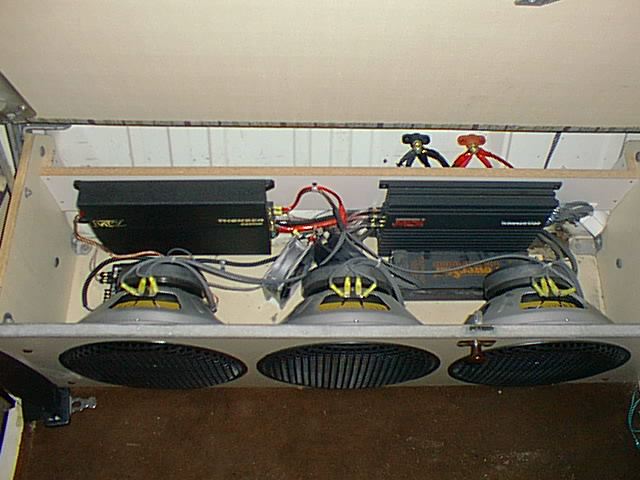
many parts are 1 to 1.25" high. I got the idea from looking at the
old Powerstar inverter in my van. It's on the right under the speaker
in this picture, with the brown writing:
http://evcl.com/vw/InteriorStereo/Amps.jpg
> Air cooled with a 3" fan on one end.
Implies it is not waterproof or sealed. Tough to make it survive in an
automotive environment.
True, but like Rich's chargers, it's cheaper. I've noticed it seems
difficult to water cool magnetics.
> Modules configured for different voltages by changing transformer
windings... Magnetics could be hand wound toroids
Switchmode power supply tranformer design is quite tricky; not something
for the average person to try to build. Toroids in particular are nasty
to wind.
They are annoying, and your hands sure get tired, but I think it's
simple to do once it's designed.
> 1 module could be configured from 96V to 156V nominal.
Modules in series or parallel for more voltage or current.
Accurate power sharing is another tricky area of design.
I intended the main control loop to be only a input current limit.
That way current sharing is assured.
> Topology could be a current fed push pull running at 68 khz.
        Two switches, one inductor and one transformer give a PFC
        isolated supply.
This topology usually requires extra switches for reasonable transient
response and to manage overvoltage spikes. There are special PWM
controller chips for it.
Hmmm, know any chip numbers off hand? I'd be curious to read the data sheets.
I figured transient response is a non issue charging batteries unless
a fuse or connection blows, which brings us to overvoltage spikes.
That is a unresolved issue I was worrying about.
> The charger processor would know the input current, input voltage,
 output voltage and at least one internal temperature. It could
 estimate the output current (for protection) if no master controller
 was watching it for the charge algorithm.
Add a microcomputer provides considerable flexibility, but also
considerable complexity. Now you have to deal with programming, software
bugs, watchdog timers, fail-safe circuitry if the micro crashes, etc.
True. I figured a couple people would focus on that and then provide
code for the others. Of course, someone will always want something
different and may have to learn to program to get it.
> Thoughts anyone?
For the above reasons, I think a high-power computer-controlled
switchmode charger is just too ambitious for a public design to be built
by amateurs. They are hard enough for professionals to build!
Maybe you're right Lee. Ah well, it was an idea anyway...
But, for various reasons, there will always be a need for simple
low-cost chargers that are safe and won't murder batteries. Toward this
end, I think we could provide some basic charger designs that will do
the job. They would be easy to construct, adaptable to any desired
voltage, and include the safety devices and charge control circuitry
that amateurs usually leave off because they don't know they need them.
So, here is how I would approach a public design charger:
......
It sounds very possible. But in the end it's still a heavy charger.
I'm not sure it's "sexy" enough to get people excited about building it. :-)
--
-Otmar-
http://www.CafeElectric.com/  Home of the Zilla.
http://www.evcl.com/914  My electric 914
--- End Message ---
--- Begin Message ---
No one legally licensed and will take care of your conversion EV
and be liable for result, even if they technically capable and
equipped to do it (golf carts etc.)

I thought it's clear.

I can fix an EV, no problem. If you ask me to fix yours, no way, sorry.
If your controller welds on (for unrelated to my repair reason
and your wife god forbid kills herself in it, you're going to sue me.
No thanks. Have a nice drive and take care of it yourself.

Victor

Brad Waddell wrote:
>
> At 01:41 PM 07/09/2003 -0700, you wrote:
> >On the other hand, who knows what inside of your lectric car?
> >I'd want one but don't want to mess with it, just drive it and have
> >someone take care of it. Ready to pay. Who can do it? No one in my
> >block.
> >Sorry.
>
> Joe,
>
> There are no golf cart dealers or dealers for electric carts for
> handicapped people (hospital supply) stores in your area? No marine battery
> dealers? No custom auto and racing shops? Better check your phone book
> again. There are fewer solutions and very few one-stop shops, but you can
> find them. I don't work on electric cars, I just drive them.
>
> brad
> EV driver
>
> Brad Waddell ** FLEXquarters.com LLC ** voice-mail/fax: 602-532-7019
> Postal: 6965 El Camino Real Ste 105 #488 Carlsbad CA 92009 USA
> QODBC Driver for Quickbooks - Unleash your data at www.qodbc.com
--- End Message ---
--- Begin Message ---
Rod Hower wrote:
>
> Maybe he meant 100mV.
> Jon is a pretty smart guy (4.0 GPA EE BS degree
> and 3.86 Masters).
> They aren't equalizing EV packs yet, but
> I'm sure his research will be beneficial to
> the EV community once it gets there.
> P.S. Don't be so subtle Rich, just speak
> your mind! :-)

Rod, that's not a real hard thing for me to do!
Hey I really don't want to piss folks off, but with the Rags these guys
have show(PHD and Prof..) they don't have a lot of data to back them up.
If they are trying, and learning I sure can help them. If they are after
Earth shattering battery equalizer investment moneies, I am out to make
there life a bit rough.

The numbers just stood out as really tight, and any of us who have
charged Ev packs knows that that level is too tight. They will spend a
ton of money making gear that will hold batteries that close, when it is
not needed.

It looks like thier experience is "book work", they need some Lab work
time, and a whole range of battery sizes and chemistry set ups before
they sight published data.

I have "thing" against folks with way too much schooling telling us
knuckle draggers what is right and wrong without any real data to back
it up. GPA has nothing to do with what they know in this subject. I know
4 pointers that can't do resistance divider calcs.  And hey I was called
a "Young know it all" not too far back. When I drove my Ev into the
monthy meeting with a hand made controller, and battery charger... I
went from "one O'them" to one of  "us".

What they could ask is, What level of regualtion matters? and address it
to those of us who make battery chargers and BMS systems. I am sure I
don't know it all, but on  some points I have a couple of years of
painful practice.

I have been making Regs since 1996. That's getting to be a long time.

I am hunting for "Tilley" type folks, but hiding behind thier
credentials. If these guys are on the level, lets help them come up to
speed.


--
Rich Rudman
Manzanita Micro
www.manzanitamicro.com
1-360-297-7383,Cell 1-360-620-6266
--- End Message ---
--- Begin Message ---
At 04:41 PM 07/09/2003 -0700, you wrote:
No one legally licensed and will take care of your conversion EV
and be liable for result, even if they technically capable and
equipped to do it (golf carts etc.)
Mechanics responsible for your defective equipment? Never happen. The
manufacturers, possibly, if they were negligent. Let's talk about personal
responsibility here. You are off the topic. You asked if you could get work
done and I proved you could.
brad
Brad Waddell ** FLEXquarters.com LLC ** voice-mail/fax: 602-532-7019
Postal: 6965 El Camino Real Ste 105 #488 Carlsbad CA 92009 USA
QODBC Driver for Quickbooks - Unleash your data at www.qodbc.com
--- End Message ---
--- Begin Message ---
Hi Joe,
When times are good and everyone either has a good job or a high enough
fixed income I would agree with you, but when times are tough like a
recession or depression even Joe Average or an old lady or a girl with
inch long nails may not be able to afford to have their car maintained or
repaired by their neighborhood garage or dealer.
With bank and savings bond interest rates at a 50 year low, alot of
people on a fixed income can't afford to have their car maintained or
fixed by anyone but themselves.  People are remaining unemployed for an
average of 18 months today since over 2.5 million jobs have left the
country, over the past 3 years, and those unemployed can not afford  to
have their car maintained or fixed by anyone other than themselves.  Cars
designed to be easily maintained or fixed would cost less for the
consumer to own even if maintained or repaired by someone other than the
owner because it would take less time.  Emission regulations also require
spending up to $ 500 to bring a car up to standards.   EV's don't have
that requirement :-).

On Wed, 09 Jul 2003 13:41:55 -0700 Victor Tikhonov <[EMAIL PROTECTED]>
writes:
> I'll reply on this one and it may make you think.
>
> I love EVs, I have one, plan to do another one, but you aren't going
> to like this (speaking for Joe Ave):
>
> [EMAIL PROTECTED] wrote:
> >
> > Yes, but every time I need to change something related to the
> internal
> > combustion engine in my 1986 Firebird such as the starter motor,
> > radiator, heater core, water pump, fuel pump, alternator, exhaust
> system
> > (muffler & catalytic converter, pipes), radiator hoses, fan belts,
> oil &
> > filter (every 3000 miles for in and around town use), tune ups
> (plugs,
> > wires, distributor cap, rotor) or antifreeze I say you know, I
> don't have
> > these problems with my EV  :-).
>
> 1. You know what? When was last time you had problems with any of
> this
> in USA? The shop gladly taking care of it for you in on every few
> blocks
> in average city, competing to do this work. An old lady or a girl
> with an inch long nails can easily take care of her car this way.
>
> On the other hand, who knows what inside of your lectric car?
> I'd want one but don't want to mess with it, just drive it and have
> someone take care of it. Ready to pay. Who can do it? No one in my
> block.
> Sorry.
>
> > And to make matters even worse, the
> > internal combustion engine designers don't leave any room or any
> extra
> > slack on wires or anything else to make it easy to work on by
> anyone.
> > And now you can't even work on some of the newer cars since they
> have
> > everything jam packed under the hood especially if you look under
> the
> > hood of the Toyota Prius or Honda Insight electrics where they
> have both
> > the internal combustion and electric propulsion systems.
>
> 2. I don't buy a car to work on it, I buy it to drive it to places.
> That's what a car is for for 95% of the plain people like me.
> Why Toyota (at its expense) should make it easy to work on for
> remaining 5% you belong to? Get real.
>
> > Lets not forget the pollution is centralized at the power plant
> instead
> > of spread out all over the country and that you are not going to
> die in a
> > FIREBALL from gasoline leaking onto a hot catalytic converter
> after a
> > collision.
>
> 3. I may agree, but FOR ME TODAY this does not outweigh 1. and 2.
>
> Until it will, EVs will remain a hobby for these 5%. Nothing wrong
> with it, just I, Joe Ave, happen top belong to other 95%.
>
> I met Victor, and he's saying that I got it all wrong. As I see it,
> he's nuts, have to have a shop, a skill, a time, a special knowledge
> beyond average, an inspiration, other sacrifices just to drive an EV
> in
> places I can drive to without all these problems. And, my 5 liter
> Mustang excites *me* no less than his ACRX excites him.
>
> Take care,
> Joe.
>
>


________________________________________________________________
The best thing to hit the internet in years - Juno SpeedBand!
Surf the web up to FIVE TIMES FASTER!
Only $14.95/ month - visit www.juno.com to sign up today!
--- End Message ---