EV Digest 4225

Topics covered in this issue include:
  1) Re: Hardest part of the conversion
        by "Lawrence Rhodes" <[EMAIL PROTECTED]>
  2) Re: Zytek Electric Lotus Elise exhibited at Heritage Motor Centre
        by "Lawrence Rhodes" <[EMAIL PROTECTED]>
  3) Re: BB600 delivery
        by "Lawrence Rhodes" <[EMAIL PROTECTED]>
  4) Re: Adapter kits
        by "Lawrence Rhodes" <[EMAIL PROTECTED]>
  5) Re: Charging dock idea......., idea
        by "Bob Rice" <[EMAIL PROTECTED]>
  6) Re: Glider source
        by Paul Wallace <[EMAIL PROTECTED]>
  7) Battery Conference
        by Steven Lough <[EMAIL PROTECTED]>
  8) Re: Desirable amp hours
        by "Roland Wiench" <[EMAIL PROTECTED]>
  9) Re: Adapter kits
        by Andrew Letton <[EMAIL PROTECTED]>
 10) Re: Desirable amp hours
        by keith vansickle <[EMAIL PROTECTED]>
 11) Re: Adapter Idea
        by Lee Hart <[EMAIL PROTECTED]>
 12) Composite Chassis,  EVProduction list , was Electric Lotus Elise
        by jerry dycus <[EMAIL PROTECTED]>
 13) Re: bye bye
        by [EMAIL PROTECTED]
 14) Re: Dead link 10
        by Lee Hart <[EMAIL PROTECTED]>
 15) Re: Charging dock idea
        by Lee Hart <[EMAIL PROTECTED]>
 16) Re: Interesting electric vehicle statue in Arizona
        by Lee Hart <[EMAIL PROTECTED]>
 17) Re: Adapter Idea
        by Electro Automotive <[EMAIL PROTECTED]>
 18) Re: Hardest part of the conversion
        by Electro Automotive <[EMAIL PROTECTED]>
 19) RE: Dead link 10
        by "Roger Stockton" <[EMAIL PROTECTED]>
 20) Re: Intellectual property
        by Victor Tikhonov <[EMAIL PROTECTED]>
 21) Re: Monaco EVS-21
        by Victor Tikhonov <[EMAIL PROTECTED]>
 22) Re: Charging dock idea
        by [EMAIL PROTECTED]
 23) RE: Intellectual property
        by "Roger Stockton" <[EMAIL PROTECTED]>
 24) Re: Desirable amp hours
        by "Roland Wiench" <[EMAIL PROTECTED]>
 25) Re: TS Charging Amps
        by Victor Tikhonov <[EMAIL PROTECTED]>
 26) Re: Interesting electric vehicle statue in Arizona
        by Victor Tikhonov <[EMAIL PROTECTED]>
 27) RE: TS Charging Amps
        by "Bill Dennis" <[EMAIL PROTECTED]>
 28) Re: Charging dock idea
        by "Tom Shay" <[EMAIL PROTECTED]>
 29) Re: bye bye
        by Victor Tikhonov <[EMAIL PROTECTED]>
--- Begin Message ---
One hard part is getting a charger. Rich will like to know your battery
management plans. LR........
----- Original Message -----
From: "Dave Cover" <[EMAIL PROTECTED]>
To: "EVList" <[email protected]>
Sent: Wednesday, March 23, 2005 7:33 PM
Subject: Hardest part of the conversion
I'm about to start the hardest part of my EV project, ripping the heart
out of a perfectly good
(albeit gas guzzling) car so I can electrify it. I have the car, I have
the motor, I have the
traction pack, and I just bought an engine hoist. I even have a nice pair
of Curtis contactors.
Hopefully by this weekend I'll finally make some tangible progress. I've
been planning and
preparing for almost a year now. It will feel good to finally walk the
walk. I have no excuses
left, so here I go.
Here are the details;
Donor car - 1987 Porsche 944, preconversion weight 2700lbs. CD around .35
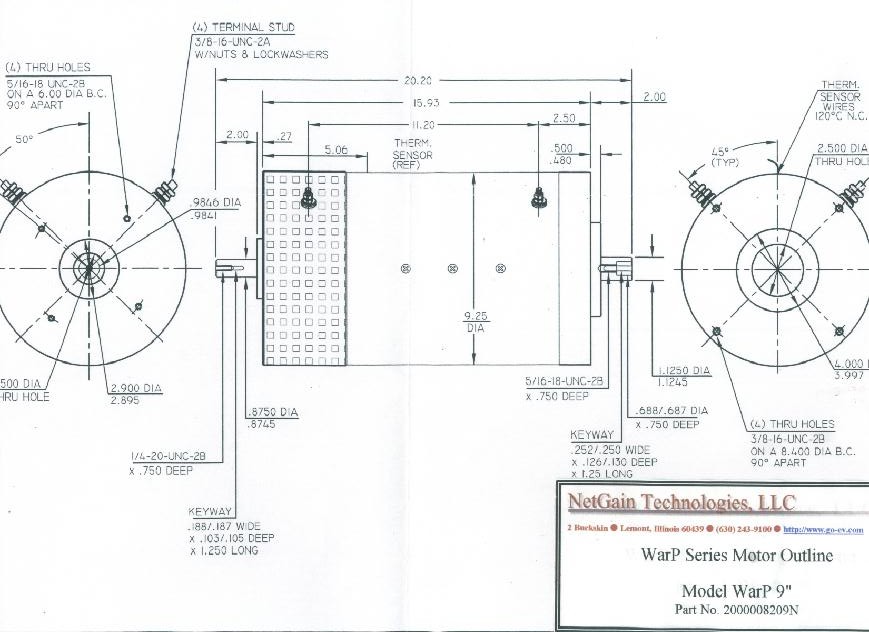
Motor     - Advanced DC 9", barely used for it's age
Pack      - Lot's of NiCads for cold New England winters
The last few pieces I'll have to pick up on the way; a Zilla 1K, maybe a
PFC-20, an Emeter, and of
course, a well made adapter plate. And lot's of little bits and pieces.
Any help on sourcing these
items, new or used, would be appreciated. I have a URL but nothing to show
for it yet. When I get
something up I'll send a link.
Thanks again for all your information and inspiration.
Dave Cover
--- End Message ---
--- Begin Message ---
Seems to me with a small pack electric sports cars are equaling or lowering
the weight of sports cars. LR.........
----- Original Message -----
From: "John Westlund" <[EMAIL PROTECTED]>
To: <[email protected]>
Sent: Thursday, March 24, 2005 12:57 AM
Subject: Re: Zytek Electric Lotus Elise exhibited at Heritage Motor Centre
http://www.sandsmuseum.com/cars/elise/information/press/press/press1996/prelec.html
http://www.econogics.com/ev/evperf.htm
30-70 in 5 seconds, 0-90 in 11.2 seconds, 200 horsepower,
0-60 probably around 5 seconds, 150 lb-ft of torque, 90 MPH
top speed(governed), 1,930 pound curb weight, 100-120 mile
range per charge, charge from 0% in about an hour.
One sweet ass car, but I think they could have done better.
The 90 MPH top end is the turnoff. Everything else seems
just the way it should be. Should have had a two-speed
transmission though, one gear for 0-80, and another for
80-150+ for those times Ponch and John aren't around at a
speed trap.
Those motors are a piece of work as well. 100 horsepower
from each motor, and 75 lb-ft of peak torque, and they only
weigh 29 pounds each! Hell, I can only drool at the thought
of having 3 of them in my Triumph. 300 horsepower and 225
lb-ft of torque would be perfect for the Optima pack I have
planned, and a modest torque number like such wouldn't tear
my tranny a new asshole while the high horsepower would
really allow me to make some evil 1/4 mile passes. I bet
that control system is very pricey...
--- End Message ---
--- Begin Message ---
Caution. Don't add water
Caution. Don't add water
Caution. Don't add water
Caution. Don't add water
That's all. Experiment with a few if you need proof. Add too much water
when you don't know the level and they will
spew..................LR..................
----- Original Message -----
From: "Christopher Robison" <[EMAIL PROTECTED]>
To: <[email protected]>
Sent: Thursday, March 24, 2005 6:23 AM
Subject: BB600 delivery
After all that, they're finally here. :o)
My portion of the Humphrey Haul arrived this morning at 6am, and though it
was pretty early, it turned out not to be as bad as I thought. Mark Farver
stopped by to lend a hand and did a lot of heavy lifting - between him,
myself, and the driver, we got the lot of 600 cells (some of which are
bound for another destination) off the palette and onto the back of the
Hombre, which is still going on its ICE engine.  At just over a ton of
cells, the compact pickup was WAY beyond its weight rating, but amazingly
the suspension still had some travel left. Fortunately it was only about a
200 foot roll to my driveway, where we quickly moved them to my garage
floor.
After everyone had left, I broke open a box and pulled out a cell -- sure
enough, there's a sealed bag around each one, with an expiration date
printed, October 2004.
What seemed kind of odd to me (hopefully this is normal) is that there
wasn't much free liquid electrolyte in the cells. The bottom part of the
cell is dark, containing what looks like a dark grey unmoving gelatinous
mass around the plates. Inverting the cell caused a very tiny amount of
pale yellow liquid to drip to the top.
I know that the sintered plates absorb electrolyte when the cell is
discharged, but does this description sound right?  Also, I noted small
amounts of a grainy white substance around the terminals, which appeared
to be properly shorted with a steel spring. I can't imagine that this
substance is corrosion; the cells were sealed and unused. Could it be some
KOH that has seeped out and dried?  (Should I be worried?)
I'll try to put some pictures on my server when I get a chance, hopefully
tonight.
--chris
--- End Message ---
--- Begin Message ---
If it is the same tranny, YES. LR........
----- Original Message -----
From: "Mark Ward" <[EMAIL PROTECTED]>
To: <[email protected]>
Sent: Thursday, March 24, 2005 6:07 AM
Subject: Adapter kits
Can anyone say if the motor adapter kits currently available for GEOs are
the same for the Metro, Prism, Storm, etc?
--- End Message ---
--- Begin Message ---
  Hi Ryan an' All;

   I have built a thing like that before, a piece of plywood as big as the
front end of the car, with wheel guides and stoping block, to position car
in one spot. Tried and true 3rd rail technology here, spring contacts under
the car to make contact with the contacts mounted on the charging deck, as I
called it. To turn on the juice a micro switch so cars's wheel weight turns
it on. I was running a 24 volt system, in 'Nam, one of my first EV's Now
upscaling it here for 120 volts for my PFC 20 to feed on or 240, plywood
deck would live on my garage floor, just drive in/on, and walk away. Hasn't
been on my top piority, right now, but have started on it, though.Making
sore the contacts aren't hot when car is gone!

   Charging along

   Bob
----- Original Message -----
From: "Ryan Bohm" <[EMAIL PROTECTED]>
To: "EV List" <[email protected]>
Sent: Thursday, March 24, 2005 2:08 AM
Subject: Charging dock idea


> Hi,
>
> I'm thinking of designing and building a sort of docking station for
> EVs.  This would be in the future - I have plenty of things to keep me
> busy right now.  I'd like to know if anything already exists like what
> I'm thinking.
>
> It would be something about the size/weight of a small floor jack.  It
> would plug in.  When you pulled over it, and a sensor-system detected it
> was in line, it would raise up and make the connection to begin
> charging.  Even though it is fun to plug in the fuel-door, sometimes
> you're in a hurry and don't want to think about it.  If you had this
> charging dock, it would all happen automatically. All you'd have to do
> is pull in or back in with even a little accuracy.  You could have a
> charging dock LED somewhere on the dash or in the vehicle that would
> light up when it was docked (of course you'd hear the charger snap on
too).
>
> Anyone seen anything like this?  The only thing that in my mind is fuzzy
> is how you would make a weather-proof connection that would constantly
> be subject to road grime, dust, moisture, and dirt.  The connection
> would have to handle 220 or 120 VAC, at whatever current your charger
> was soaking up.
>
> What do you think?  Do-able?  Already done?  I think this could appeal
> to people that didn't want to think about plugging in.
>
> -Ryan
> --
> - EV Source -
> Zillas, PFC Chargers, and other EV stuff at great prices
> E-mail: mailto:[EMAIL PROTECTED]
> Toll-free: 1-877-215-6781
>
--- End Message ---
--- Begin Message ---
Rush,
good point on the local repair and service. I would make one
suggestion. Once the type of glider is decided on, it might make sense
to train a local mechanic or two for that company, Toyota for instance,
on how to fix the electrical portion of the conversion. Also make sure
that all the EV related parts are mounted such that the normal car type
parts, like brake master cylinder, are still accessible in the manner
that the mechanic is used to. This way, all the repairs can be done at
the glider garage. If they need help with the EV parts, they would call
the local expert, but you wouldn't need to support a separate garage for
the repair of the EVs. In my experience, the EV parts are very
reliable. It is the other mechanical parts that need frequent repair and
maintenance.
One other thing to consider is battery pack leasing. I think that you
could get a local garage very interested in this. I believe that it
solves many of the down sides of owning an EV. The batteries are the
high maintenance and highest failure part of the design. Make sure that
battery pack swapping is easy, like a couple of hours. These days, car
dealers make a significant amount of their incomes on periodic maintenance.
Paul Wallace
'91 Chevy S-10 full of SAFT nicads
--- End Message ---
--- Begin Message ---
One of our members here in Seattle at SEVA is an Auto Writer and got
wind of this meeting. He thought some one might find it useful to pass
it on. ( I think it was already posted... but here it is again )
The full agenda for the 5th International Advanced Automotive Battery
and Ultracapacitor Conference (AABC-05) and Symposia is now available
online. With fourteen sessions, seventy all-invited presentations, three
pre-conference symposia, and three pre-conference tutorials, AABC-05 is
promising to become a landmark event. > >Log onto our website at:
www.advancedautobat.com/AABC/agenda.html and scroll through the
sessions. You are sure to find the material you are seeking in our
presentations discussed by some of the industry’s top experts. They will
be covering the most critical issues facing energy storage for future
automotive military and industrial applications. > >I am indebted to our
distinguished Session Chairs that assisted in assembling this
prestigious agenda and the 70 speakers who accepted our invitations. >
>Other information about AABC-05, including our poster sessions,
exhibits, networking events and registration and lodging information, is
also available on our website. Do not hesitate to call or write to us
for any inquiry you may have. See you in Hawaii. > > >Menahem Anderman,
Chair >Advanced Automotive Battery Conference >Tel: (1) 530 692 0140
>Fax: (1) 530 692 0142 >www.advancedautobat.com >
--
Steven S. Lough, Pres.
Seattle EV Association
6021 32nd Ave. N.E.
Seattle,  WA  98115-7230
Day:  206 850-8535
Eve:  206 524-1351
e-mail: [EMAIL PROTECTED]
web:     http://www.seattleeva.org
--- End Message ---
--- Begin Message ---
The 105 AH @ 12 Volt has a Reserve Capacity of 160 minutes at 25 amps or about
50 minutes at 75 amps.

I have run 130 AH @ 12 Volt which has a Reserve Capacity at 225 minutes or
about 75 minutes at 75 amps.

I can get in 21 each Trojan SCS 225 130 AH @ 12 volt which is 252 volts.  Each
weigh 66 lbs each for a total weight of 1386 lbs.

I also run with 30 each Trojan T 145 260 AH @ 6 volt which is 180 volts.  Each
weigh 72 lbs each for a total weight of 2160 lbs.

The range difference between the 21 each 12 volt @ 130 AH which is 32760 watts
at 1386 lbs as compare to the 30 each 6 volt @ 260 AH is 46800 watts at 2160
lbs is only about 3 to 5 miles for 50 mile run.

The difference is only a 1.09 factor between the two battery packs.

If only 15 each 12 volt @ 130 AH at 180 volts which would be 23400 watts at 990
lbs, the difference is still a 1.09 factor between 260 AH and 130 AH battery
pack.

Or 32,760/((46,800 x 1386)/2160) = 1.09

Or 23,500/((46,800 x 990)/2160) = 1.09

This work out this way when the Amp Hour of one battery is 1/2 of the other
battery AH you are comparing.

Therefore the Kw of the battery pack is proportional to the voltage and amperes
and indirectly proportional to the weight.

Roland


  ----- Original Message -----
  From: Mark Ward<mailto:[EMAIL PROTECTED]>
  To: [email protected]<mailto:[email protected]>
  Sent: Thursday, March 24, 2005 8:17 AM
  Subject: Desirable amp hours


  When considering batteries, obviously looking for the most AH rating is a
  factor.

  What is a good compromise on AH rating vs cost of battery types.

  How would a flooded 12V battery with 105 Ah compare with what is being
  typically used?

  Is anyone using an array of 10 12v for 120 total?

  This would seem a good compromise for size and weight, getting the batteries
  down to about 500 pounds or so.
  (and cost factor too)

  Thanks!
--- End Message ---
--- Begin Message ---
No, they are not the same:
The Geo Metro, Suzuki Swift, and Chevy Sprint (all designed by Suzuki)
share the same tranny design (3cyl and 4cyl models).
The Prism is (I think) a rebadged Toyota.
The Storm is (I think) a rebadged Isuzu.
hth,
Andrew
Mark Ward wrote:
Can anyone say if the motor adapter kits currently available for GEOs
are the same for the Metro, Prism, Storm, etc?
--- End Message ---
--- Begin Message ---
Roland wrote
> The range difference between the 21 each 12 volt @
> 130 AH which is 32760 watts at 1386 lbs as compare
> to the 30 each 6 volt @ 260 AH is 46800 watts at
> 2160 lbs is only about 3 to 5 miles for 50 mile run.
>
> The difference is only a 1.09 factor between the two
> battery packs.
>
> Therefore the Kw of the battery pack is proportional
> to the voltage and amperes and indirectly
> proportional to the weight.
>
> Roland
>
> thank you for this informative post. I assume this
was in the same vehicle--same base weight and motor
and controller(BTW what controller and motor system)
since you have actually tried both what is the
difference in accelleration/stopping performance
because it doesn't seem worth it to carry the extra
weight if you ate only going to get a 10% increase in
range?????
thanks
keith
>
>
>
>
>
>   ----- Original Message -----
>   From: Mark
> Ward<mailto:[EMAIL PROTECTED]>
>   To:
> [email protected]<mailto:[email protected]>
>   Sent: Thursday, March 24, 2005 8:17 AM
>   Subject: Desirable amp hours
>
>
>   When considering batteries, obviously looking for
> the most AH rating is a
>   factor.
>
>   What is a good compromise on AH rating vs cost of
> battery types.
>
>   How would a flooded 12V battery with 105 Ah
> compare with what is being
>   typically used?
>
>   Is anyone using an array of 10 12v for 120 total?
>
>   This would seem a good compromise for size and
> weight, getting the batteries
>   down to about 500 pounds or so.
>   (and cost factor too)
>
>   Thanks!
>
>


__________________________________
Do you Yahoo!?
Yahoo! Mail - Find what you need with new enhanced search.
http://info.mail.yahoo.com/mail_250
--- End Message ---
--- Begin Message ---
Jeff Shanab wrote:
>
> I am reconsidering an adapter design and wanted to get the list's input
>
> The warp 9 or 9" ADC is shorter than most blocks
>
> http://www.go-ev.com/images/warp9_specs.jpg
> and
> http://www.westechperformance.com/pages/Tech_Library/Popular_Engine_Specs/dimensions.html
>
> What if we have an adapter plate at the tranny and a front plate that
> reproduces the bolts on the front of the motor block. A piece of
> aluminum channel welded between the two at the level and angle of the
> motor mounts.
>
> It might be a little heavier than a single plate, but it would allow
> "drop in" replacement and the easy connection of the AC and and other
> accesories and brackets. If that style of connections are required.

An interesting idea! I can imagine a "fake" engine block for some common
car engine, that is really a collection of metal brackets and plates
that provide adapters to mount the traction motor, alternator, power
steering pump, vacuum pump, A/C compressor, controller, contactors,
fuses, etc. So, you could assemble all these items outside the car to
make an electric "engine". Then, the conversion consists of pulling the
old ICE, and dropping this assembly into the car in its place.

This should appeal tremendously to backyard mechanics who are familiar
with normal ICE engines, but fear all that 'lektrik' stuff.
--
"The two most common elements in the universe
are hydrogen and stupidity."    -- Harlan Ellison
--
Lee A. Hart  814 8th Ave N  Sartell MN 56377  leeahart_at_earthlink.net
--- End Message ---
--- Begin Message ---
       Hi John and All,
--- John Wayland <[EMAIL PROTECTED]> wrote:
> Hello to All,
>
> John Westlund wrote:
>
> >
>
http://www.sandsmuseum.com/cars/elise/information/press/press/press1996/prelec.html
> >
> > http://www.econogics.com/ev/evperf.htm
> >
> > 30-70 in 5 seconds, 0-90 in 11.2 seconds, 200
> horsepower,
> > 0-60 probably around 5 seconds, 150 lb-ft of
> torque, 90 MPH
> > top speed(governed), 1,930 pound curb weight,
> 100-120 mile
> > range per charge, charge from 0% in about an hour.
> >
> > One sweet ass car...
>
> I was up close and personal with this car at EVS14
> in Orlando, years ago. The quality of
> construction was stunning, and yes, the twin motors
> were works of art. Lotus knows how to
> make composites look as a good as any factory steel
> or aluminum bodied car....the fit and
> finish of everything on this machine was impeccable!

    I've loved this EV every since it came out as it
shows just what a good composite monocoque chassis
with it's great weight savings along with a well
designed EV drive system can do.
    They didn't mention it but it is faster that the
ICE version of the Elise at least to it's top speed
and probably would be on a tight track as the batts
placement can nicely lower the CG !!!
     We are up to 58 members on the EVProduction list
now at only 36 hrs old and some great ideas flowing
already.
     We could use some suspension, legal and other
knowledgeable people to add to what is an impressive
list of people who really want to get some EV's into
production.
              Thanks,
                  Jerry Dycus


>
> PS:  I've sent an email to the web master of the
> second link you provided, pointing them
> to the NEDRA page so they can get up to speed on the
> Dennis Berube/Current Eliminator
> specs in the 1/4 mile.
>
> See Ya.....John Wayland
>
>


__________________________________
Do you Yahoo!?
Yahoo! Small Business - Try our new resources site!
http://smallbusiness.yahoo.com/resources/
--- End Message ---
--- Begin Message ---
Ivo,

Don't leave, unless for some reason the list admin people asked you to.
If everyone on this list who ever bothered anyone left, we would have very
few list members.  I don't remember being offended by any of your
comments.

Gail

On Thu, 24 Mar 2005, Ivo Jara wrote:

> Well, I'm leaving, sorry if I bothered someone, I was told i don't belong
> here.
>
> Will post my trike in the ev album when finished.
>
>
> Thanks
>
> Bye
>
> Ivo
>
--- End Message ---
--- Begin Message ---
James Massey wrote:
> I have had a link 10 brought to me for repair...
> no lights lit (at all), power supply is running, and whining.
> The biggest chip (the processor) is getting warm, and the unit
> is drawing around 200 to 250mA from 12V.

Sounds like toast, and unfixable. Perhaps they connected the 120vdc
*directly* to it, instead of with a prescaler and DC/DC converter.

If the CPU is running at all, there would be some LEDs lit. There is no
*all off* mode.

The CPU chip normally runs cold. Power consumption at 12vdc is normally
25 ma (LEDs mostly off) to 150ma (all LEDs on in "test" mode"). It is
totally silent in all modes of operation.
--
"The two most common elements in the universe
are hydrogen and stupidity."    -- Harlan Ellison
--
Lee A. Hart  814 8th Ave N  Sartell MN 56377  leeahart_at_earthlink.net
--- End Message ---
--- Begin Message ---
Ryan Bohm wrote:
>
> Hi,
>
> I'm thinking of designing and building a sort of docking station for
> EVs.  This would be in the future - I have plenty of things to keep me
> busy right now.  I'd like to know if anything already exists like what
> I'm thinking.
>
> It would be something about the size/weight of a small floor jack.  It
> would plug in.  When you pulled over it, and a sensor-system detected it
> was in line, it would raise up and make the connection to begin
> charging.  Even though it is fun to plug in the fuel-door, sometimes
> you're in a hurry and don't want to think about it.  If you had this
> charging dock, it would all happen automatically. All you'd have to do
> is pull in or back in with even a little accuracy.  You could have a
> charging dock LED somewhere on the dash or in the vehicle that would
> light up when it was docked (of course you'd hear the charger snap on too).
>
> Anyone seen anything like this?  The only thing that in my mind is fuzzy
> is how you would make a weather-proof connection that would constantly
> be subject to road grime, dust, moisture, and dirt.  The connection
> would have to handle 220 or 120 VAC, at whatever current your charger
> was soaking up.
>
> What do you think?  Do-able?  Already done?  I think this could appeal
> to people that didn't want to think about plugging in.

There has been a system like this for industrial vehicles for many
decades. The trade name "Inductran" comes to mind but I didn't check to
see if that it is.

Basically, it is a conventional 60hz transformer, sawed in half, with
half in the floor and half under the car. You drive onto it, magnetic
force pulls the two together, and it chargers.
--
"The two most common elements in the universe
are hydrogen and stupidity."    -- Harlan Ellison
--
Lee A. Hart  814 8th Ave N  Sartell MN 56377  leeahart_at_earthlink.net
--- End Message ---
--- Begin Message ---
Peter VanDerWal wrote:
> "Electric personal assistive mobility device" means a self-balancing
> two nontandem wheeled device with an electric propulsion system that
> limits the maximum speed of the device to fifteen miles per hour or
> less and that is designed to transport only one person.
>
> Hmm, I wonder what IT could be?  A quick google shows that most
> states now include this, or a similar, definition.

The Segway, of course!

Reading further, our Minnesota law says that such a vehicle requires no
license, no registration, no helmet, no age limit, and can be ridden
anywhere you can legally walk.

When my BEST kids heard about it, they said "Oboy! We can ride in class,
in the mall, even places they don't allow skateboards or bikes! Let's
build one!"

And they did! I described it a couple years ago. In fact, they
discovered perhaps a dozen ways to make a "self-balancing two-wheel
non-tandem" vehicle without any computers or gyroscopes.
--
"The two most common elements in the universe
are hydrogen and stupidity."    -- Harlan Ellison
--
Lee A. Hart  814 8th Ave N  Sartell MN 56377  leeahart_at_earthlink.net
--- End Message ---
--- Begin Message ---
An interesting idea! I can imagine a "fake" engine block for some common
car engine, that is really a collection of metal brackets and plates
that provide adapters to mount the traction motor, alternator, power
steering pump, vacuum pump, A/C compressor, controller, contactors,
fuses, etc. So, you could assemble all these items outside the car to
make an electric "engine". Then, the conversion consists of pulling the
old ICE, and dropping this assembly into the car in its place.
This should appeal tremendously to backyard mechanics who are familiar
with normal ICE engines, but fear all that 'lektrik' stuff.
The "electric engine" concept, consisting of the electric motor, adaptor,
and controller mounted as one unit, was done by Stan Skokan in the late
'80s, using a Prestolite motor and a Skokan transistorized speed controller.
The plate that mounts all of the accessories off the front of the gas
engine was done by Maryann Chapman of Eco Electric in the '90s. One of the
problems with this installation was, in order for the A/C to work, they had
to have the motor idling at stops.
The biggest objection I have to putting all of the components in one place
(in the center of the engine compartment) is that it takes away what I
consider to be prime real estate for batteries. You want to keep your
batteries grouped together as much as possible, so they need the largest
space available. Put the peripherals on the periphery.
Mike Brown
Electro Automotive POB 1113 Felton CA 95018-1113 Telephone 831-429-1989
http://www.electroauto.com [EMAIL PROTECTED]
Electric Car Conversion Kits * Components * Books * Videos * Since 1979
--- End Message ---
--- Begin Message ---
Mike Brown & Shari Prange have on-road experience and
support VoltsRabbit/VoltsPorsche.
And many, many other models as well. Those are just the ones with pre-fab
kits.
  Ken farms out
adapter plates to EVCC; not sure where Mike gets his
done.
EVCC has been out of business for quite some time now. We design all our
own adaptors and have them fabricated by a local machinist. We also supply
adaptors to KTA, now that EVCC is gone.
Mike Brown
Electro Automotive POB 1113 Felton CA 95018-1113 Telephone 831-429-1989
http://www.electroauto.com [EMAIL PROTECTED]
Electric Car Conversion Kits * Components * Books * Videos * Since 1979
--- End Message ---
--- Begin Message ---
Lee Hart [mailto:[EMAIL PROTECTED] wrote:

> It [an E-Meter] is totally silent in all modes of operation.

I would have to disagree.  My serial equipped E-Meter makes an audible
high-pitched sound when operating, and the sound changes as the load on
the E-Meter's internal supply changes (e.g. as the display flashes).
The serial-equipped E-Meter here at work behaves the same.

Both are perfectly functional, and both make an audible sound when
operating.  Admittedly, the sound is not glaringly loud, and it is
high-pitched enough that some people may have difficulty hearing it.

I agree with Lee otherwise; i.e. the processor should not get warm when
operating, and this is usually a sign of a fried IC.

Cheers,

Roger.
--- End Message ---
--- Begin Message ---
I wonder, how it is possible to patent blindly obvious thing
(narrowing rear to improve aero)? This would mean no one
can narrow rear of their new design without paying GM.
That is, as long as GM lawyers think (and they will) that *any*
narrowing (degree of course will depend on
how much money defendant has) is copying GM's idea.
Why GM doesn't sue Volvo - they narrowed rear end:
http://www.canadiandriver.com/news/041014-3.htm
Their concept came out after EV1, and Volvo isn't a
small guy...
--
Victor
'91 ACRX - something different
Lee Hart wrote:
Peter VanDerWal wrote:
my point is that you would need to look at ALL of GMs patents on
the EV-1. It's possible that they patented things like "making the
rear of the vehicle narrower than the front in order to improve
aerodynamics".
I agree. We'd want to read all their EV1 patents in any case, just to
learn from them.
(I wouldn't worry about the narrow rear end, as there are plenty of
examples of prior art -- the 1950's Goggomobile for example :-)
It /might/ be illegal to copy if you are copying an "expression"
of a patented idea.
Again, I agree. But, I cannot imagine GM could have *any* patent
fundamental enough to serve as a serious roadblock. Cars and EVs have
been around so long that almost *everything* has been done at one time
or another. Prior art provides lots of ways to do everything without
patent infringement.
--
Victor
'91 ACRX - something different
--- End Message ---
--- Begin Message ---
I probably will, but the final decision is not up to me.
If I will, I'll be near FEVT booth, and see you there.
--
Victor
'91 ACRX - something different
Mark Hanson wrote:
Howdy,  Is anyone else going to the www.evs21.org ?  If so we can hook up.  I'm
going to do my annual volunteer report and stay April 2 - 9th.
Mark E. Hanson
184 Vista Lane
Fincastle, VA 24090
540-473-1248-H
540-563-2000x290-W (8-4:30est)
www.solectrol.com dc/dc converters, wind, solar
--- End Message ---
--- Begin Message ---
On Thu, 24 Mar 2005, Ryan Bohm wrote:
>
> It would be something about the size/weight of a small floor jack.  It
> would plug in.  When you pulled over it, and a sensor-system detected it
> was in line, it would raise up and make the connection to begin
> charging.  Even though it is fun to plug in the fuel-door, sometimes
> you're in a hurry and don't want to think about it.  If you had this
> charging dock, it would all happen automatically. All you'd have to do
> is pull in or back in with even a little accuracy.  You could have a

Ryan,

Sounds rather interesting but I would never be able to align my car with
something as small as a floor jack.  And, if I switched cars, I would need
36, 48, 72, 96 and 120 volt models, unless you were going to make one that
automatically senses how much voltage should be put out for the vehicle
connected.

Gail
--- End Message ---
--- Begin Message ---
Victor Tikhonov [mailto:[EMAIL PROTECTED] wrote:

> I wonder, how it is possible to patent blindly obvious thing
> (narrowing rear to improve aero)?

Nobody says GM actually did patent such a thing, just that this is the
sort of thing one might have to be wary of.

As to how it is possible to patent blindly obvious things, well, that is
one of the wonders of the US (and probably other) patent offices. ;^>

For instance, Curtis has a patent on the concept of locating the FETs
and diodes in a motor controller as close as possible to one another (I
don't recall the exact patent, but it covers something like locating the
diodes and FETs in pairs or some such).

Cheers,

Roger.
--- End Message ---
--- Begin Message ---
  ----- Original Message -----
  From: keith vansickle<mailto:[EMAIL PROTECTED]>
  To: [email protected]<mailto:[email protected]>
  Sent: Thursday, March 24, 2005 10:04 AM
  Subject: Re: Desirable amp hours


  Roland wrote
  > The range difference between the 21 each 12 volt @
  > 130 AH which is 32760 watts at 1386 lbs as compare
  > to the 30 each 6 volt @ 260 AH is 46800 watts at
  > 2160 lbs is only about 3 to 5 miles for 50 mile run.
  >
  > The difference is only a 1.09 factor between the two
  > battery packs.
  >
  > Therefore the Kw of the battery pack is proportional
  > to the voltage and amperes and indirectly
  > proportional to the weight.
  >
  > Roland
  >
  > thank you for this informative post. I assume this
  was in the same vehicle--same base weight and motor
  and controller(BTW what controller and motor system)
  since you have actually tried both what is the
  difference in accelleration/stopping performance
  because it doesn't seem worth it to carry the extra
  weight if you ate only going to get a 10% increase in
  range?????
  thanks
  keith
  >
  One vehicle was a 1975 Chevelle that had 220 AH and 300 AH batteries that
weigh 7850 lbs with the 300 AH cells.

  The 1977 El Camino had 130 and 260 AH which weighs 5900 lbs with 15 each 130
AH and 6980 lbs with the 260 AH. Could not really tell any difference in
braking, brakes, suspensions, and axle  components are all heavy duty racing
type that can withstand a 4000 lbs thrust and has a 22,000 lb load rating.

  The best performance of all the batteries was the 300 AH cells at 180 volts,
that can propell the car at 60 mph up a steep 2 mile hill with only a voltage
sag to about 170 volts. Could accelerated from 0 to 30 in 10 seconds.

  The worst was the 130 AH at 180 volts which  took forever to accelerated to
about 30 to 35 mph on level grade! The voltage sag was way down to 150 volts on
that one.

  Roland
  >
  >
  >
  >   ----- Original Message -----
  >   From: Mark
  > Ward<mailto:[EMAIL PROTECTED]<mailto:[EMAIL PROTECTED]>>
  >   To:
  >
[email protected]<mailto:[email protected]<mailto:[email protected]<mailto:[email protected]>>

  >   Sent: Thursday, March 24, 2005 8:17 AM
  >   Subject: Desirable amp hours
  >
  >
  >   When considering batteries, obviously looking for
  > the most AH rating is a
  >   factor.
  >
  >   What is a good compromise on AH rating vs cost of
  > battery types.
  >
  >   How would a flooded 12V battery with 105 Ah
  > compare with what is being
  >   typically used?
  >
  >   Is anyone using an array of 10 12v for 120 total?
  >
  >   This would seem a good compromise for size and
  > weight, getting the batteries
  >   down to about 500 pounds or so.
  >   (and cost factor too)
  >
  >   Thanks!
  >
  >


  __________________________________
  Do you Yahoo!?
  Yahoo! Mail - Find what you need with new enhanced search.
  http://info.mail.yahoo.com/mail_250<http://info.mail.yahoo.com/mail_250>
--- End Message ---
--- Begin Message ---
Bill,
Your objective is to replenish sufficient amount of Ah spent since last
charge. The rate is not that relevant, the completeness of the charge
is. More precisely, not in the sense that you *ave* to charge to 100%SOC
every time, you can unplug early and drive, but in general you need to
know your SOC and make sure the cells are equalized at any SOC level.
In short, if you can afford time to wait, slow charge is OK and
simplifies electronics too.
My 90Ah pack is charged at 8.5A max and even that can be reduced because
for every charge the pack is full sometime in the middle of the night,
far before I'm ready to drive. So I don't care how slow it is as long
as it is ready by next morning.
--
Victor
'91 ACRX - something different
Bill Dennis wrote:
The ThunderSky web site says that .3C is the "best" charging rate for their
cells. For 200Ah cells, that would be 60A. I've read on other forums that
some people believe that "best" here really means "maximum"--and that slower
charging would be more beneficial to the longevity of the cells.
For those of you with TS cells, do you have an opinions/experience on this?
Would nightly charging at 40A from a PFC-30 be more harmful than nightly
charging at 12A, doing the 40A only when I absolutely needed it?
Thanks.
Bill Dennis
--- End Message ---
--- Begin Message ---
They mean an electrified wheelchair or self-propelled shoping
carts for disabled people.
Victor
Peter VanDerWal wrote:
While browsing through AZ motor vehicle statues I came across this
definition:
"Electric personal assistive mobility device" means a self-balancing two
nontandem wheeled device with an electric propulsion system that limits
the maximum speed of the device to fifteen miles per hour or less and that
is designed to transport only one person.
Hmm, I wonder what IT could be?  A quick google shows that most states now
include this, or a similar, definition.
--- End Message ---
--- Begin Message ---
Thanks, Victor.  My cells are 200Ah.  8.5A would fill me up overnight as
long as I wasn't below about 50% DOD.  Deeper DOD% than that would take more
than 12 hours at 8.5A.  So I was trying to decide on whether to get a 12A
charger or spring for a PFC-30, for example, which could charge my pack at
over 30A.  I wanted to know if anyone thought charging at 30A or 40A every
night would be harmful to the cells  (yeah, I know I could turn the PFC-30
down to 12A, too, but we also tend to have frequent power outages at my
house, so I thought quicker charging might have that additional advantage).
My planned circuitry would allow max PFC charging amps until first BMS shunt
turned on, then reduce current to 8A or 12A.

Bill Dennis

-----Original Message-----
From: [EMAIL PROTECTED] [mailto:[EMAIL PROTECTED] On
Behalf Of Victor Tikhonov
Sent: Thursday, March 24, 2005 12:34 PM
To: [email protected]
Subject: Re: TS Charging Amps

Bill,

Your objective is to replenish sufficient amount of Ah spent since last
charge. The rate is not that relevant, the completeness of the charge
is. More precisely, not in the sense that you *ave* to charge to 100%SOC
every time, you can unplug early and drive, but in general you need to
know your SOC and make sure the cells are equalized at any SOC level.

In short, if you can afford time to wait, slow charge is OK and
simplifies electronics too.

My 90Ah pack is charged at 8.5A max and even that can be reduced because
for every charge the pack is full sometime in the middle of the night,
far before I'm ready to drive. So I don't care how slow it is as long
as it is ready by next morning.

--
Victor
'91 ACRX - something different


Bill Dennis wrote:

> The ThunderSky web site says that .3C is the "best" charging rate for
their
> cells.  For 200Ah cells, that would be 60A.  I've read on other forums
that
> some people believe that "best" here really means "maximum"--and that
slower
> charging would be more beneficial to the longevity of the cells.
>
> For those of you with TS cells, do you have an opinions/experience on
this?
> Would nightly charging at 40A from a PFC-30 be more harmful than nightly
> charging at 12A, doing the 40A only when I absolutely needed it?
>
> Thanks.
>
> Bill Dennis
--- End Message ---
--- Begin Message ---
Is it really that much trouble to plug and unplug a charger cord
and turn the charger on and off?   Is it worthwhile to give up the
convenience of backing in or heading in to the charging spot?
I'm always against anything that adds significant complexity
for very little gain.
--- End Message ---
--- Begin Message ---
Ivo,
As long as you talk about EVs and only EVs, you ARE belong to this list.
Welcome to stay. Only moderator can ask you to leave. All others
may have opinions, but can't dictate you what to do. If someone
did -  talk to moderator or David Roden off list. I'm sure they
will find acceptable solution.
You are FINE. Again, welcome to stay, learn and contribute.
Victor
> Well, I'm leaving, sorry if I bothered someone, I was told i don't
> belong
> here.
>
> Will post my trike in the ev album when finished.
>
>
> Thanks
>
> Bye
>
> Ivo
--- End Message ---