EV Digest 4608

Topics covered in this issue include:
  1) Re: Ni-cads Re: Valence Lithium-ion
        by Evan Tuer <[EMAIL PROTECTED]>
  2) Re: Valence Lithium-ion
        by Danny Miller <[EMAIL PROTECTED]>
  3) Re: Valence Lithium-ion       Ni-cads in Europe
        by reb <[EMAIL PROTECTED]>
  4) Re: Help me decide!
        by "Paul G." <[EMAIL PROTECTED]>
  5) Re: Valence Lithium-ion       Ni-cads in Europe
        by Sam Harper <[EMAIL PROTECTED]>
  6) Re: Ni-cads Re: Valence Lithium-ion
        by jerry dycus <[EMAIL PROTECTED]>
  7) Re: Best method. 50% / 30 sec CC (was: Correct AGM finish charge)
        by "Paul G." <[EMAIL PROTECTED]>
  8) Re: 100 mile range,   Re: Alternative batteries
        by Victor Tikhonov <[EMAIL PROTECTED]>
  9) Re: Correct AGM finish charge (Was: Re: PFC-30)
        by Victor Tikhonov <[EMAIL PROTECTED]>
 10) Re: Taper Lock Hub help needed
        by Electro Automotive <[EMAIL PROTECTED]>
 11) Re: Correct AGM finish charge (Was: Re: PFC-30)
        by Victor Tikhonov <[EMAIL PROTECTED]>
 12) Plus and Minus Together
        by "Bill Dennis" <[EMAIL PROTECTED]>
 13) Zilla/Warp 9
        by Cwarman <[EMAIL PROTECTED]>
 14) Who's Using Marathon NiCads?
        by [EMAIL PROTECTED]
 15) Touch Screen Controller?
        by [EMAIL PROTECTED]
 16) Re: Alternative batteries
        by Victor Tikhonov <[EMAIL PROTECTED]>
 17) Re: Valence Lithium-ion
        by keith vansickle <[EMAIL PROTECTED]>
 18) RE: Who's Using Marathon NiCads?
        by "Bill Dennis" <[EMAIL PROTECTED]>
 19) Re: Plus and Minus Together
        by Mark Farver <[EMAIL PROTECTED]>
 20) Re: Touch Screen Controller?
        by Mark Farver <[EMAIL PROTECTED]>
 21) Re: Touch Screen Controller?
        by Danny Miller <[EMAIL PROTECTED]>
 22) RE: Who's Using Marathon NiCads?
        by "Christopher Robison" <[EMAIL PROTECTED]>
 23) Re: Correct AGM finish charge
        by Victor Tikhonov <[EMAIL PROTECTED]>
 24) Re: Netgain Warp Dimensions
        by Ryan Stotts <[EMAIL PROTECTED]>
 25) Re: Valence Lithium-ion
        by Victor Tikhonov <[EMAIL PROTECTED]>
 26) Re: Netgain Warp Dimensions
        by Ryan Stotts <[EMAIL PROTECTED]>
 27) RE: Who's Using Marathon NiCads?
        by "Bill Dennis" <[EMAIL PROTECTED]>
 28) Re: Best method. 50% / 30 sec CC (was: Correct AGM finish  charge)
        by Victor Tikhonov <[EMAIL PROTECTED]>
 29) Re: New EVs from Asia
        by Ryan Stotts <[EMAIL PROTECTED]>
 30) Re: 2 golf cart motors?
        by "Lawrence Rhodes" <[EMAIL PROTECTED]>
 31) Re: Plus and Minus Together
        by Victor Tikhonov <[EMAIL PROTECTED]>
--- Begin Message ---
On 8/22/05, jerry dycus <[EMAIL PROTECTED]> wrote:

> I'm not sure where Jerry gets his 20 year life estimate from though :)
>
>
>             From my close to 30 yr old flooded SAFT ni-cads that still put
> out more than
> rated power but also from other sources. Though they did have a bad batch a
> few yrs ago
> but other than that, Ni-cads are known for very long life.

Again I think it depends on the application, and the number of cycles.
 If you're putting 1000 miles a month on your pack in deep cycles, as
I am, I doubt you will get 20 years out of it, perhaps more like 5 in
practice, I would think.

Regards
Evan
--- End Message ---
--- Begin Message ---
Oh wow, I guess that's got a tap for every cell so they can be metered
and charged individually? Complicated, but it would certainly help!
L-ion cells can't take the overcharge needed to finish off the charge in
the last cells.
Danny

Rush wrote:
From: "Ryan Stotts"
Subject: Re: Valence Lithium-ion
http://img371.imageshack.us/img371/5493/lith7in.jpg (what's the "pig tail" for?)
That is the BMS.

Rush
Tucson AZ
www.ironandwood.org
--- End Message ---
--- Begin Message ---
drat must have deleted phillipe's post
if you are reading this phillipe
get in touch and let me know what you have

reb

--- jerry dycus <[EMAIL PROTECTED]> wrote:

>             Hi Reb and All,
>                 Phillipe just posted he has used
> ones for a very good price in France and I believe
> the chargers, motors, ect that you could use
> possibly. I lust after being in Europe just so I
> could get some of those.
>                And even if he didn't, there has to
> be a UK seller of new SAFT's and I believe they are
> made in France.
>
> HTH's,
>
>  Jerry Dycus
>
> reb <[EMAIL PROTECTED]> wrote:
> drat i could do with some posh batteries for my
> motorbike project
>
> reb
>
> --- Evan Tuer wrote:
>
> > OK, you've got me there, probably not in the UK :)
>
> > I'm just saying
> > that these are manufactured products that will
> plug
> > together quite
> > easily (compared to LiIon or even AGM).
> >
> > Regards
> > Evan
> >
> > On 8/22/05, reb
> > wrote:
> > > hi evan
> > > off the shelf from where ? (in the uk)
> > >
> > > reb
> > >
> > >
> > > --- Evan Tuer wrote:
> > >
> > > > On 8/22/05, Michaela Merz
> > wrote:
> > > > >
> > > > > Hey Jerry and all
> > > > >
> > > > > > How about instead, buy
> > Ni-cads
> > > > that while are not as high
> > > > > > cap as Li-ions, do about 2x range vs
> > lead/weight
> > > > in real
> > > > > > life, are very robust and have 20+ yr
> > lives!!
> > > > And they
> > > > > > cost 1/4 or so of Valance Li-ion's. And
> they
> > > > don't need
> > > > > > regs on each batt and can use a much more
> > simple
> > > > batt
> > > > > > charger. They also don't lose cap when
> cold.
> > In
> > > > a custom
> > > > > > built as an EV car done right, they could
> > get
> > > > you a 200
> > > > > > mile range if done correctly.
> > > > >
> > > > > Ok - no problem. Is there anybody on the
> list
> > who
> > > > would be able to design,
> > > > > build and manufacture a set of nicads
> > (including
> > > > thermal management and
> > > > > charging) so that i.e. I would be able to
> use
> > it
> > > > in my new conversion?
> > > >
> > > > I don't think it would take much designing. If
> > you
> > > > bought Saft MRE
> > > > water cooled Nicads, you just need to add a
> pump
> > and
> > > > a temperature
> > > > controlled fan. For the charger, you can use a
> > > > Brusa charger and AH
> > > > counter, it's off the shelf stuff.
> > > >
> > > > I'm not sure where Jerry gets his 20 year life
> > > > estimate from though :)
> > > >
> >
> >
>
>
>
>
>
>
>
___________________________________________________________
>
> Yahoo! Messenger - NEW crystal clear PC to PC
> calling worldwide with voicemail
> http://uk.messenger.yahoo.com
>
>
>
> ---------------------------------
>  Start your day with Yahoo! - make it your home page
>
>
>


___________________________________________________________
Yahoo! Messenger - NEW crystal clear PC to PC calling worldwide with voicemail
http://uk.messenger.yahoo.com
--- End Message ---
--- Begin Message ---
On Aug 22, 2005, at 12:37 AM, Peter VanDerWal wrote:
Hmm, does it strike you as fair to compare PM DC motors to induction AC
motors?
Let's try to compare apples and oranges that are at least somewhat
similar.
If you are going to compare a DC motor to an AC Induction motor, then
(in
fairness) it should be a wound field DC motor.
I wasn't - please reread this:
"But on the AC systems (except BLDC) you have to say "Induction" to
create the magnetic field in the armature. Not much (if any) better
that brushes when you realize that motors need an air gap."
BLDC = brushless DC, a type of non-brushed (AC) motor.
It is not fair to compare PM motors to all wound motors - either AC or
DC.
The idea is simple, either you have brush losses or induction losses
across an air gap. Either way you can't eliminate some power loss to
get power into the armature/rotor.
Paul "neon" G.
--- End Message ---
--- Begin Message ---
And me, too.

reb wrote:
drat must have deleted phillipe's post
if you are reading this phillipe
get in touch and let me know what you have
reb

--- jerry dycus <[EMAIL PROTECTED]> wrote:
           Hi Reb and All,
               Phillipe just posted he has used
ones for a very good price in France and I believe
the chargers, motors, ect that you could use
possibly. I lust after being in Europe just so I
could get some of those.
              And even if he didn't, there has to
be a UK seller of new SAFT's and I believe they are
made in France.
HTH's,
Jerry Dycus
reb <[EMAIL PROTECTED]> wrote:
drat i could do with some posh batteries for my
motorbike project

reb

--- Evan Tuer wrote:
OK, you've got me there, probably not in the UK :)
I'm just saying
that these are manufactured products that will
plug
together quite
easily (compared to LiIon or even AGM).

Regards
Evan
On 8/22/05, reb
wrote:
hi evan
off the shelf from where ? (in the uk)

reb


--- Evan Tuer wrote:
On 8/22/05, Michaela Merz
wrote:
Hey Jerry and all
How about instead, buy
Ni-cads
that while are not as high
cap as Li-ions, do about 2x range vs
lead/weight
in real
life, are very robust and have 20+ yr
lives!!
And they
cost 1/4 or so of Valance Li-ion's. And
they
don't need
regs on each batt and can use a much more
simple
batt
charger. They also don't lose cap when
cold.
In
a custom
built as an EV car done right, they could
get
you a 200
mile range if done correctly.
Ok - no problem. Is there anybody on the
list
who
would be able to design,
build and manufacture a set of nicads
(including
thermal management and
charging) so that i.e. I would be able to
use
it
in my new conversion?

I don't think it would take much designing. If
you
bought Saft MRE
water cooled Nicads, you just need to add a
pump
and
a temperature
controlled fan. For the charger, you can use a
Brusa charger and AH
counter, it's off the shelf stuff.

I'm not sure where Jerry gets his 20 year life
estimate from though :)
___________________________________________________________
Yahoo! Messenger - NEW crystal clear PC to PC
calling worldwide with voicemail
http://uk.messenger.yahoo.com


---------------------------------
Start your day with Yahoo! - make it your home page
___________________________________________________________
Yahoo! Messenger - NEW crystal clear PC to PC calling worldwide with voicemail http://uk.messenger.yahoo.com
--- End Message ---
--- Begin Message ---
                Hi Evan and All,

Evan Tuer <[EMAIL PROTECTED]> wrote:
On 8/22/05, jerry dycus wrote:

> I'm not sure where Jerry gets his 20 year life estimate from though :)
>
>
> From my close to 30 yr old flooded SAFT ni-cads that still put out more than
> rated power but also from other sources. Though they did have a bad batch a
> few yrs ago
> but other than that, Ni-cads are known for very long life.

Again I think it depends on the application, and the number of cycles.
If you're putting 1000 miles a month on your pack in deep cycles, as
I am, I doubt you will get 20 years out of it, perhaps more like 5 in
practice, I would think.


         It will difinately matter on how you use, charge  them but on average
compared to lead GC batts, about 5X's in the same service. I abused mine badly
overcharging them till cells went dry several times  and hitting 10c discharges
all the time and they still stood up well and still do.

        At 35miles per day with a 60 mile range pack, you should get well over
14 yrs, 4,000cycles  with them with reasonable care.


Regards
Evan


---------------------------------
 Start your day with Yahoo! - make it your home page
--- End Message ---
--- Begin Message ---
On Aug 21, 2005, at 11:27 PM, Ryan Stotts wrote:
That's a VERY impressive install who's ever setup that is.  Extremely
nice.  Good job!
Thank you. That is the Rabbit Pickup I built, my face is even in it :-)
It belongs to Don Buckshot now.
Paul "neon" G.
--- End Message ---
--- Begin Message ---
Hi Doug, I'm glad you'r happy with your setups.
Careful planning is the key.

Doug Hartley wrote:
...

The TS cells don't
need regulators as much since they are not being charged anywhere near
4.25 V/cell average pack voltage, so it is unlikely they will get out of
balance before I check them next. Until now, they are staying well in
balance, but I will eventually get regulators built or bought and
installed.
First I did this too. You can run that way checking each cell as often
as every time you charge (And taking care of any problems right then)
but realize this is a gamble. If your cells happen top be uniform enough
from the factory, you'll most likely be just fine. But should any hidden
devect be present or the cells are at way different temps, dangerous
conditions may rise unexpectedly quick.

Each cell is not charged to more than 4.0V is good but does not prevent
one to suddenly go dead (happened before for no appareent reason,
I suspect internal short/leak), and others to take the slack.
If others are uniform, they each may be 4.1V or so, still OK.
But if they are misbalanced of one has higher R_int, it will be
5-6V on that one while still ~4.0V on others.

Just be careful.

--
Victor
'91 ACRX - something different
--- End Message ---
--- Begin Message ---
This strategy might work for a while for Optima, but they'd go
out of business pretty wuick if, say, Excited woulfd last 8 years
and their batteries only one year.

Don't know about you but if my Optima would die in a year, I'd shop
for another brand next time (and Optima will loose a customer...)


Ryan Stotts wrote:
Victor Tikhonov wrote:
why would Optima suggest
charging method which kills their batteries in a few hundred cycles??
Optima would MUCH rather have us buying new batteries every year
instead of every 8 years...
--
Victor
'91 ACRX - something different
--- End Message ---
--- Begin Message ---
The Taperlock Hub looks like a manufactured off the shelf part?
http://www.electroauto.com/catalog/adaptors.shtml
No, it is not off the shelf. We do buy a commercially made bushing, but it
then has to be extensively modified by our machinist. The hub is custom
designed and machined for each application.
Shari Prange
Electro Automotive POB 1113 Felton CA 95018-1113 Telephone 831-429-1989
http://www.electroauto.com [EMAIL PROTECTED]
Electric Car Conversion Kits * Components * Books * Videos * Since 1979
--- End Message ---
--- Begin Message ---
This is not relevant as people must realize - string or not, *each*
battery *must* be treated according to their recommendations.
THe fact that is more difficult in practice if a user chooses to
use many batteries in series, is not Optimas problem. Even if it was,
they only can re-confirm requirement for each battery.
How to achieve it is up to the user.

If users do not realize that and make no distinction between
charging 1 or many optimas, it is NOT Optima's problem for sure.

John G. Lussmyer wrote:
At 01:33 AM 8/21/2005, Nick 'Sharkey' Moore wrote:
If I bought a set of Optimas, and looked after them according to
instructions, and they were dead within a year, I'd be unhappy.
I'd buy my second set from someone else.
Also note that 99.9% of Optima's business is selling single batteries to
people who are NOT using them in series. I doubt they bother with
issues involved with series charging when writing their charging
recommendations.
--
John G. Lussmyer      mailto:[EMAIL PROTECTED]
Dragons soar and Tigers prowl while I dream....
http://www.CasaDelGato.com
--
Victor
'91 ACRX - something different
--- End Message ---
--- Begin Message ---
Are there any problems caused if the traction pack's plus and minus cables
are run right next to each other for a short distance?  Thanks.

Bill Dennis
--- End Message ---
--- Begin Message ---
Hey Guys

Outside of the items below im assuming ill need the follow..

WarP 9
ZillA Controller
PFC Charger
Batterys

I will still need the following correct or no ?

a. Potbox ?
b. DC to DC converter for the aux battery ?
c. Contactor ?
d. Main Fuse
e. A Meter and Shunt ?
f. Sometype of Breaker with manual disconnect cable ?
g. Misc cables, boots, end etc
Im reading everything i can and very nervous im not gonna be able to
pull off the install, im nervous as im not super mech inclined...
CWarman


Ryan Stotts wrote:
Cwarman wrote:
What is better for a s-10 Conversion a Warp DC motor or a Advanced DC
motor ?  Any thoughts and reasons ?
Netgain(WarP) appears to be interested in the EV market(potential
understatement).  Advanced appears to be more interested in the
forklift market and potentially indifferent towards EV's(that's my
impression anyways).

http://www.go-ev.com/ (Netgain/WarP)

http://www.warfieldelectric.com/ (Supposedly builds the WarP motors)

http://www.adcmotors.com/


.
--- End Message ---
--- Begin Message ---
Is anyone here using the Marathon NiCad cells? If so, hows it going?
-Sam
--- End Message ---
--- Begin Message ---
Hey guys. I've been doing my research for my EV, and I am going to use a
home automation controller I've got to run everything (instead of a bunch of
switches). Its a grayscale touchscreen. It'll use RFID to login (vs a
key), and can control the contactors, automatic climate control (or manual,
with temp sensor in the cabin), control direction, open doors, control
windows, show status of various items, talk to you, and whatever else can be
controlled with a relay. Would anyone else have interest in one of these?
It doesnt run an operating system, and won't crash, and it uses very little
power (so it can be on all the time). I'm going to shave the door handles
and put a RFID reader in each of the doors for opening (get rid of the lock
mechanism). Any interest?
-Sam
--- End Message ---
--- Begin Message ---
Lee Hart wrote:
4:1 advantage over AGMs.

The flooded lead-acids only last about 1/3 as long as nicads; but they
6:1 cheaper. This means they beat even nicads in cost per mile.
I believe this statement needs clarification.
When you say "last" do you mean calendar life or miles?

FLooded may last 10 years but cover 50k miles wuth them.
NiCds may last 9 years if "abused", by asking to cover
a million miles during that time and they will deliver that.

Which pack "lasted" longer in your mind (in terms if you *know*
you want your car to cover million miles which pack you'd invest to?)

I think what you describe has little to do with batteries.
It is regular marketing - by 10 of something and the price
of each becomes 1/2 of that if you buy one.

But most people, realizing that, don't have (or not willing to
spend0 money for 10 at once, so buying one [flooded battery pack],
then one more, one more, etc. Same as most of us pay monthly
for homes way overpaying at the end.

--
Victor
'91 ACRX - something different
--- End Message ---
--- Begin Message ---
--- Ryan Stotts <[EMAIL PROTECTED]> wrote:

> Keith wrote:
>
> >  paid $600 ea
>
> Another case of my Lithium pack costing ~$21,600...
>
> Were yours made in China or the US?  How much will
> Chinese made ones be?


I think in the USA but not sure as there is no made in
designation anywhere on them.
>
>
> > then needed the BMU and the recommended charger.
>
> For some reason, I was under the impression the
> batteries would have
> the BMU built into them(hence the price)?

no the BMU is separate and made in 48 volt
incriments-- in other words you need a BMU module for
each 48 volts or part there of.
>
> Do your batteries look like these?
>
> http://img371.imageshack.us/img371/5493/lith7in.jpg
> (what's the "pig tail" for?)

Yes the smallest one--- the pig tail is to plug into
the BMU
>
> >  both of which came to another $800
>
> $800 for 4 BMU's and a charger?

$800 was for the both BMU and charger.  I do not know
what the split was as I got it all as a single
purchase for $3200.   The batts came in a separate
shipment as they are considered "hazardous" and were
labled as costing $600 ea so that is how I determined
their cost leaving $800 for the charger and BMU.

a  the b Or $800 for the
> charger and $800 for the BMU's?
>
> What's the charger and BMU like?

The charger is a delta-q QuiQ 4818.  no adjustments it
is an 18amp 48volt single purpose charger made in
canada see
www.delta-q.com


Any pics? not yet but if I did have pictures where
would i send them?  actually if you go to the Valence
website you can get a pdf file with complete system
setup with drawings that are pretty much to scale so
you can see the bmu and batt relative sizes.. the bmu
and its accompaning cables makes it very difficult to
build battery boxes.   as a result on this trike I
have attached a Kiddie carrier behind the trike and
put all the batts, BMU, charger and motor controller
in the carrier but it is not the solution I would have
perferred and when I get the body/faring for the trike
developed I will have to overcom this constraint.


 What are the specs on the charger?  see above
>
>
I purchased a Blue Sea Systems Amp meter and shunt to
hook up thinking it would give me data logging on amps
out and in but see that it is just an accurate amp
meter and does not have any memory or logging
capability so may take it back and get an "e-meter"
that will remember amps for me if I can find one and
get it set up properly.


keith


__________________________________
Do you Yahoo!?
Yahoo! Mail - You care about security. So do we.
http://promotions.yahoo.com/new_mail
--- End Message ---
--- Begin Message ---
I'm putting together a string of 100 right now.  Currently I'm in the
process of talking them out of their packages and cleaning the terminals,
and am building the battery box.  I should be to the point of charging them
for the first time in a few weeks.  I'll keep you posted.  Also, you might
want to join the BB600 board run by John Lussmyer.

Bill Dennis

-----Original Message-----
From: [EMAIL PROTECTED] [mailto:[EMAIL PROTECTED] On
Behalf Of [EMAIL PROTECTED]
Sent: Monday, August 22, 2005 11:05 AM
To: [email protected]
Subject: Who's Using Marathon NiCads?

Is anyone here using the Marathon NiCad cells?  If so, hows it going?

 -Sam
--- End Message ---
--- Begin Message ---
Bill Dennis wrote:
Are there any problems caused if the traction pack's plus and minus cables
are run right next to each other for a short distance?  Thanks.
Not really, in fact running the cables close together helps reduce
electrical noise and is actually a good idea.
OTOH, having the cables close together increases the possibility of a
short, so make sure your fuse is somewhere inside of the battery pack
and consider using conduit and bushings to protect the cables.
Mark Farver
--- End Message ---
--- Begin Message ---
[EMAIL PROTECTED] wrote:
Hey guys. I've been doing my research for my EV, and I am going to
use a home automation controller I've got to run everything (instead
of a bunch of switches). Its a grayscale touchscreen. It'll use RFID
to login (vs a key), and can control the contactors, automatic climate
control (or manual, with temp sensor in the cabin), control direction,
open doors, control windows, show status of various items, talk to
you, and whatever else can be controlled with a relay.
Touch screens are cool and I've used my fair share of them, but in a car
it is often important to be able to operate controls without looking
away from the road. Consider moving the most needed controls to
physical switches or adding touch and audible cues to the system.
Mark
--- End Message ---
--- Begin Message ---
Another touch screen issue is that these won't work with gloves on.
They don't use force, they require touch.
I agree about looking away from the road, that's a significant issue.

Danny

Mark Farver wrote:
Touch screens are cool and I've used my fair share of them, but in a
car it is often important to be able to operate controls without
looking away from the road. Consider moving the most needed controls
to physical switches or adding touch and audible cues to the system.
Mark
--- End Message ---
--- Begin Message ---
Where did you get 100 Marathon nicads?  Did you buy them from SG Photo?

Are they available in quantity, from anywhere else?

  --chris


Bill Dennis said:
> I'm putting together a string of 100 right now.  Currently I'm in the
> process of talking them out of their packages and cleaning the terminals,
> and am building the battery box.  I should be to the point of charging
> them
> for the first time in a few weeks.  I'll keep you posted.  Also, you might
> want to join the BB600 board run by John Lussmyer.
>
> Bill Dennis
>
> -----Original Message-----
> From: [EMAIL PROTECTED] [mailto:[EMAIL PROTECTED] On
> Behalf Of [EMAIL PROTECTED]
> Sent: Monday, August 22, 2005 11:05 AM
> To: [email protected]
> Subject: Who's Using Marathon NiCads?
>
> Is anyone here using the Marathon NiCad cells?  If so, hows it going?
>
>  -Sam
>
>
>
>
--- End Message ---
--- Begin Message ---
Lee Hart wrote:
Lee Hart wrote:

Correct. So a real-world charger should at least check to see what
voltage the battery is at now. From this, it can decide if it is indeed
a battery, if it is connected with the right polarity, and if its
voltage is somewhere within a range the charger can deal with.

If these conditions aren't met, it should at least do no harm and not be
harmed itself. And most chargers do this. You can't get a charger UL
listed if it is damaged by connecting a battery of the wrong voltage or
reversed polarity.
My goal isn't UL approve my charger. I will reasonably protect it
from harming itself and the battery, whether this comply
with UL's understanding of "reasonable" or not.
There is no protection from user's ignorance (don't want to use
stronger word). A user cahrging Optimas must select "Optimas" from the
menu, not "Hawkers". No charger can force them to, or say in this
case "no, you're wrong, you have Optimas, I'm going to charge it
as Optimas".
Quite a lot of formal data exists on how you should charge various
chemistry batteries at various states of charge, temperatures, ages,
etc. It isn't perfect, but it's pretty good. For flooded lead-acids for
instance, we know that the zero-current voltage varies between
1.95-2.12v/cell from 0-100% SOC, the gassing point is 2.37v/cell, that
it falls to 2.1v/cell as the cell ages, and the charge voltage is
temperature compensated at -0.003v/cell/deg.C.
Yes, thank you, this is well known.
The challenge is that most chargers don't know whether the battery is a
flooded or AGM; don't know its state of charge, temperature, or age.
They have to guess at all these things.
We're discussing my charger, not most the chargers. It has no way
of knowing on its own how old the battery is, but it has a menu
setting where you can input this in, so it will be taken into
consideration. Question is *how* do I change the charge regimen
provided I inputed data "Battery #5 is 4 years old, others are 1
year old".
Compensation for the temp, amount of cycles (age) average DOD during
use ("abuse factor") can all *easily* be implemented using look up
tables.
Yes... if the charger has sensors to provide all this data!
Yes, mine has.
But rarely
is this the case. You would have to configure the charger to exactly
what battery it is to charge, and that charger would have to stay
connected for its entire life. The charger would need to monitor
everything that happens to the battery; charge/discharge currents,
dates, times, temperatures, etc. Quite a challenge!
It does it, and it is not that much of a challenge. My question
was, *assume* you can give each battery what it needs. You have
means. Tell me in formal numbers *what* it needs. Making it happen
is far easier than decide what it is I want to happen.
My view is that even if you did, such a charger that depends exclusively
on calculated theoretical data would fail. Batteries are too
individualistic. Each one is unique. Under identical circumstances, they
will do different things. So, a charger has to adapt to the conditions.
It is not doing teoretical things. It keeps adjusting to what actually
battery is doing. But to program it, *i* need to know what I would do
if I detect something. And I don't know and therefore (and only
therefore) my charger doesn't know either.
This is why I said you should start by assuming YOU are the charger.
Figure out what YOU, as a human being, do to charge a battery when you
have insufficient knowledge of its type and condition.
Precisely. But I can't figure this out, I'm not a battery pro nor
have practical experience. I'm afraid, no one has to the degree
that can suggest actual numbers and what to do for any condition.
Take all this talk about AGM finish charge for example. I maintain that
there *is* no correct way to do it. You have to charge the battery,
watch what it does as it approaches full, and act accordingly.
Please define "Accordingly". Say, uou are the charger, not me.
A "good" AGM's apparent internal resistance rises sharply when it hits
full. If you are charging at a constant 1-2 amps, the voltage will
quickly go over 16v; if you are charging at a constant voltage, the
current rapidly falls to almost nothing. It's full! You can stop
charging.
Yes, this is being discussed. The voltage rises sharply, if clamped,
the current falls near zero quickly, it's full. Yet, Optima says
do it at 2A for 2 hours more, *then* it is *really* full by their
criteria. Other's say don't, it will vent. Bill suggests - yes,
it WILL vent (been done), yet, do it, because it is right way
(no voltage limit) regardless. Roget suggested that 150 mA can vent
them, meaning I'm deliberately setting up myself to a failure
(venting).

That all above is the problem! Not making charger do something!
If the cells are at different states of charge, this threshold is a lot
less abrupt. It needs equalizing, so you have to charge longer. But
there is only so much space inside for gas; you can't put in more than
perhaps 1-2 extra amphours on this charge cycle or it will vent.
So does it vent when extra Ah pit in exceed some percentage, say 2%,
regardless of the rate you put this extra in?
If you see a voltage *drop* at constant current, something is going
wrong. You're overcharging, or the battery is heating up and/or venting,
or it's just plain bad.
The charger will detect that easily, it is up to me to make it
stop charging alltogether and alarm. I need to decide if this
is desirable plan, or I just electrically exclude *that* battery
from the string (And still optionally alarm about it) but
keep charging the rest...
If the battery is old, its end-of-charge voltage is lower,
How much lower per year of age?
For Floodes?
For Optimas?
For Hawkers?

Degree of "lower" depends on the current temp? Average temp
over its life? If depends, then how?

See where the problem is?

 and its
end-of-charge current is higher. How much so depends on the kind of life
it has led -- tender loving care, or regularly abused?
Again, need numbers for either case!
If the internal resistance is high even during bulk charge, the battery
probably has grid corrosion. You'll have to charge it (and discharge it)
a lot slower if you expect to keep using it.
I can't make it discharge slower (e.g. ask the driver not to exceed
15 mph from now on). I can only flag that IF he does it, he kills it.
If it is sulfated (long periods sitting around in a discharged state),
its amphour capacity is low and it will behave like a lower-capacity
battery. If it is also old, its basic charging voltage and currents will
be altered as already mentioned.
No numbers were mentioned Lee. And I suspect they are not going to be.
I'm not asling to do my homework. I'm not sure it really exist
formalized to the degree that everything *I* (as a "charger") can
find in my memory along with recipe for treatment. In numbers,
not just "less or more or increase/decrease as it ages".
This won't do even for fuzzy logic systems unless it learns from
way too many killed packs.
Finally, you could have one or more bad cells. They can range anywhere
from shorted to open to reversed (at -2v!). About all you can say is
that the battery's behaviour will be "abnormal" -- it won't fit any of
the above patterns.

A human "charger" will figure all this out. You can probably do it
yourself -- but it will be hard to capture this "expert knowledge" in an
automated system.
I can easily detect 10V condition on 12V battery.
Knowing its history for all previous cycles, (say, 100 or 500)
I can tell if it is reversed (sudden drop from 12 to 10), especially
if prior high current draws while near 0%SOC are present, or it's
overall just discharged and ill (gradual voltage loss ofer many cycles
ending up with 10V).
Whats' next? Just a message on the screen "Battery #5 has one cell
reversed"? What do I do with other batteries? Disable whole EV
(I can)?
If I had to make the attempt, I think I would permanently "marry" the
charger to the battery. The charger follows the manufacturer's
recommended charge cycle, and records what happens. Then on each
subsequent cycle, it compares the results. If it sees capacity improve
(and it should as the battery gets broken in), all is well.

But the charger needs to experiment. The manufacturer's algorithm will
overcharge -- so the charger should slowly back off the overcharge. See
what happens. At first, nothing. But when it sees a capacity decrease,
charge harder (equalize) on the next cycle.

Likewise, it needs to adapt the voltage and current steps as the battery
temperature changes, and as it ages.
I will take many packs to optimize everything. So initially I need
hard numbers at least as a starting numbers for automation to
learn from. I don't have them but have the hardware to accept them.

Anyone?

--
Victor
'91 ACRX - something different
--- End Message ---
--- Begin Message ---
> Don Cameron wrote:
>
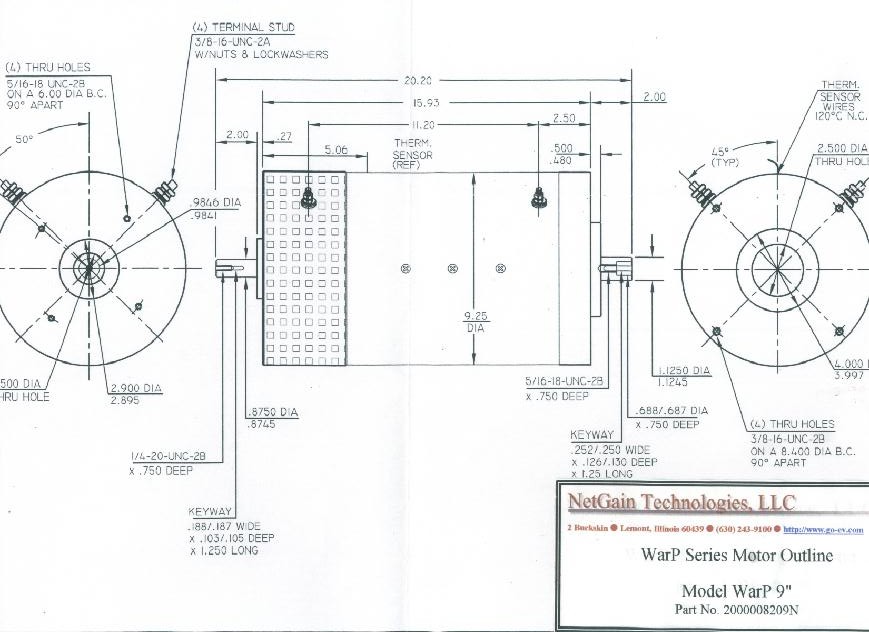
> > I am unable to find on the web any dimensional data for the Warp 9" and 11"
> > motors.


If you email Netgain, they will very likely get back to you with the
specs on the 11".  They seem prompt.
--- End Message ---
--- Begin Message ---
You're right, Wh=V*Ah, but V is changing over the course of delivered
Wh. Valence may have declared Wh at one average V value, and capacity at
slightly another.

Osmo Sarin wrote:
Hello there,
I´m a newbie from Finland, trying to learn the VERY basics... I thought
Wh = V * Ah, but that´s not the case in this Valence datasheet?
U1:
Wh = 550
V*Ah = 512

Osmo Sarin
150A per http://www.valence.com/pdffiles/U-Charge_Datasheet.pdf. Their
--
Victor
'91 ACRX - something different
--- End Message ---
--- Begin Message ---
Don Cameron wrote:

> I am unable to find on the web any dimensional data for the Warp 9" and 11"
> motors.

Some info on the 9" at least:

http://www.go-ev.com/images/warp9_specs.jpg
--- End Message ---
--- Begin Message ---
I bought mine from Lawrence Rhodes.  I don't know if he has more.

Bill Dennis

-----Original Message-----
From: [EMAIL PROTECTED] [mailto:[EMAIL PROTECTED] On
Behalf Of Christopher Robison
Sent: Monday, August 22, 2005 12:51 PM
To: [email protected]
Subject: RE: Who's Using Marathon NiCads?

Where did you get 100 Marathon nicads?  Did you buy them from SG Photo?

Are they available in quantity, from anywhere else?

  --chris


Bill Dennis said:
> I'm putting together a string of 100 right now.  Currently I'm in the
> process of talking them out of their packages and cleaning the terminals,
> and am building the battery box.  I should be to the point of charging
> them
> for the first time in a few weeks.  I'll keep you posted.  Also, you might
> want to join the BB600 board run by John Lussmyer.
>
> Bill Dennis
>
> -----Original Message-----
> From: [EMAIL PROTECTED] [mailto:[EMAIL PROTECTED] On
> Behalf Of [EMAIL PROTECTED]
> Sent: Monday, August 22, 2005 11:05 AM
> To: [email protected]
> Subject: Who's Using Marathon NiCads?
>
> Is anyone here using the Marathon NiCad cells?  If so, hows it going?
>
>  -Sam
>
>
>
>
--- End Message ---
--- Begin Message ---
THe main aircraft purpose (and thus priority) is really to fly well,
not to roll on the runway.

Why bother to design the plain's wheels/suspension very well then?
Charging always seems to be a low priority, even with folks that
know better. (I'm as guilty in this regard as the next guy, by the way.)
I wonder why that is.
Becaused skewed sense of priority.
Lee got it practically right in his earlier post: in an EV design must
start around battery first (decision on the type, not purchase), then
charging, then motor and controller.

Controller type is easiest to replace. Next easiest is the motor.
The battery type total replacement is the most involved (And the charger
should be really viewed as part of the battery).

--
Victor
'91 ACRX - something different
--- End Message ---
--- Begin Message ---
The only thing I don't like about hub motors is the weight of the car
is on those motor shafts..  Also it making the suspension "heavy".

Heavy car... bumpy road...  That motor would be taking a pounding..
The bearing(s) at least.  What about the odd load angles the motor
would experience?  Maybe they have angular roller bearings?

Pic of the motor:

http://media.mitsubishi-motors.com/pressrelease/e/corporate/detail1269.html

Not to mention, the motor is probably always going to be on the small
size due to weight and maybe even size.
--- End Message ---
--- Begin Message ---
They could be mounted on an adapter plate. The outputs could then be
connected to the input via belts. Or as John Wayland has done connect them
end to end and connect directly to the drive shaft. LR..........
----- Original Message -----
From: "Stu or Jan" <[EMAIL PROTECTED]>
To: <[email protected]>
Sent: Monday, August 22, 2005 8:21 AM
Subject: 2 golf cart motors?
Would 2 golf cart motors be viable as an alternative to a single large
motor
to power a 1,500 pound vehicle at 45 mph?

If so, how would you connect them mechanically to drive a chain sprocket?
How would you  control them and electrically connect them?


BoyntonStu
--- End Message ---
--- Begin Message ---
My + and - cables run together almost full length from the rear boxes
to the front. What possible problems can you possibly think of
(other than rubbing insulation in both cables on the same spot
 simultaneously and short the pack, which isn't "electrical" problem)?


Bill Dennis wrote:
Are there any problems caused if the traction pack's plus and minus cables
are run right next to each other for a short distance?  Thanks.

Bill Dennis
--
Victor
'91 ACRX - something different
--- End Message ---