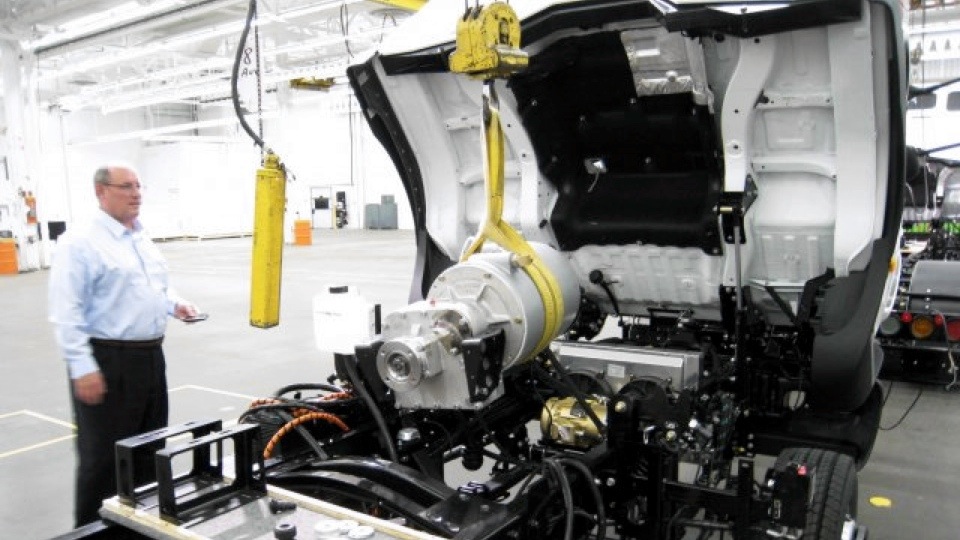
I found trucks and buses on those previous searches, but did not include
them as I was focusing on the controller you asked about. Here are a
couple with images of them in use:
http://www.smithelectric.com/smith-vehicles/models-and-configurations/
[images Smith Electric trucks
http://altmob.com/images/Pictures/2013/Q1/smith_electric_vehicles_newton_03.jpg
http://www.mnn.com/sites/default/files/smith%20kc%20on%20the%20line.JPG
http://graphics8.nytimes.com/images/2012/11/27/automobiles/wheels-smithev/wheels-smithev-blog480.jpg
http://www.csmonitor.com/var/archive/storage/images/media/images/0708-obama-electric-vehicles/8284688-1-eng-US/0708-obama-electric-vehicles_full_600.jpg
http://cdn7.triplepundit.com/wp-content/uploads/trucks-capitol.jpg
http://www.earthtechling.com/wp-content/uploads/2013/06/smithelectric-truck-e1371746799149.jpg
http://www.worktruckonline.com/fc_images/news/dhl-w.jpg
]

http://en.wikipedia.org/wiki/Modec#Technical
[images Modec electric trucks
http://www.electriconwheels.com/modec/modec-facts.jpg
http://news.bbcimg.co.uk/media/images/51542000/jpg/_51542263_modec_050311_oov_1700bm-001.jpg
http://www.blogcdn.com/green.autoblog.com/media/2008/03/ups-modec.jpg
]

Other evdl members much more knowledgeable would know better than I, but
I would think you would want to know:
-the truck's original towing capacity
- what the cargo capacity needed will be after the conversion
-the hp of the original ice
-the weight of said ice
-determine what range you want and at what speed (i.e.: 30 miles @55mph,
or 50 miles @ 35mph)
-how much time are you allowing to charge it (determines what type of
chargers will be needed)

Then you need to know the weight of the truck (by itself) without its
tanks, fuel and exhaust plumping, vs the weight of the truck after
conversion (motor, batteries, all other EV components). From all that
you can get a better idea of what your converted target is, and what its
converted performance and capabilities will be more like.

>From figures off the top of my head, and example might be:

http://www.truckpaper.com/listingsdetail/detail.aspx?dlr=1&etid=1&pcid=2000749611&OHID=4343377&lp=TRK
1987 White 18 wheeler, many details on that page:

Engine Caterpillar       3406B   Horsepower      425
Assuming: after removing ice, and ice components, and installing
batteries, motor, and EV components, truck weight is increased by 20%.
Assume converted target hp of 450 hp and using an AC drive with regen.

Using
http://www.calstart.org/Projects/htuf/ETTFBusinessCaseCalculator_UserGuide_05042012_final.pdf
On page 2 a 6 mpg Class 6 truck uses 1.2 kW/mi.

Assumption: You will need a ~65kW pack.

Charging:
http://www.epa.gov/SmartwayShipper/documents/publications/420r05002.pdf
Truck stop electrification (TSE) only offers one 5-20 and one 14-30 per
space (1kw + 5kW) for charging pack. So plan on using two spaces worth
of power (12kW) to charge the pack. This would mean having four chargers
in parallel: two 5kW level-2 and two level-1.

Assuming the 65kW pack usually only goes as low as still having 5kW
(5mi) left in it, to recharge 60kw off just one 14-30 (5kW) outlet will
take 12-14 hours. But charging at a 12kW rate, the pack will be
recharged in 5-6 hours.

Having two 14-50 to 14-30 adapters would come in handy at an RV park.
Pull-through RV spaces are long and can easily accommodate the truck.
But again you would have to pay for two spaces to get access to two sets
of outlets. A huge truck like that would have to park in two public EVSE
spaces and have two J1772 to 14-50 adapters.

The above numbers are just guesstimates used as just an example.


{brucedp.150m.com}


-
On Tue, Aug 13, 2013, at 04:29 PM, Steve Clunn wrote:
> From: Bruce EVangel Parmenter <
>,, I'd like to see some finished  trucks .
-

--
http://www.fastmail.fm - Accessible with your email software
                          or over the web

_______________________________________________
UNSUBSCRIBE: http://www.evdl.org/help/index.html#usub
http://lists.evdl.org/listinfo.cgi/ev-evdl.org
For EV drag racing discussion, please use NEDRA
(http://groups.yahoo.com/group/NEDRA)