Way too many years ago (1990's), I poured money into upgrades for the S-10
Blazer conversion EV I had (see
https://brucedp.neocities.org/blazer/
). The now retired San Mateo converter installed a small simple circuit that
helped maintain a constant battery current draw. I was lucky to get one as
this was how he won EAA distance rally races.
It basically was a dash mounted: flip switch, push button which engaged a
relay that then used a knob'd potentiometer as the control to the controller
(the relay took the foot accelerator out of the loop/circuit).

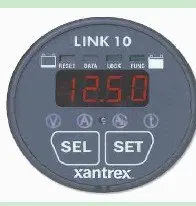
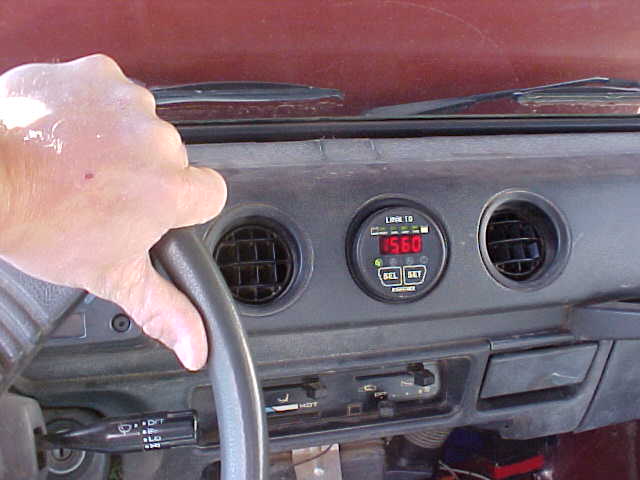
Routinely checking my dash cluster mounted link-10 e-meter (looked like:
https://sc02.alicdn.com/kf/HTB13HUeKFXXXXX4apXXq6xXFXXXe/Xantrex-Link-10-formerly-E-Meter-.jpg

http://www.solarray.com/Images/ImagesEVs/Meter.JPG

-now sold as:
http://www.xantrex.com/power-products/power-accessories/linkpro-battery-monitor.aspx
), I could see the battery current held steady on the flat, would naturally
slow down & draw more battery current on the uphill (e-motor under more
load), and would speed-up & draw less battery current on the down hill
(e-motor under less load).

In a effect, it was the same effort a human makes to keep their foot on the
accelerator steady as a rock (without the human repeatedly re-adjusting the
accelerator position, which wastes power).

Like an ice cruise control, it had the nice effect of letting my foot take a
break from having to depress the accelerator on long trips (one less thing
to do as part of the constant vigil while driving). BTW, there were micro
switches on the brake and clutch levers, that would disengage the circuit,
putting the accelerator potentiometer back in control of the controller if
there was a panic change, etc..

But as Tom inferred, that up/downhill change in speed would be a pain(pita)
for the drivers behind you (ticking them off to do something dumb, etc.).
However, in fact my multiple experiences using this nifty circuit was when I
drove 160 miles from Silicon Valley to Sacramento (to hang out with the
Nedra.com e-racer folk by charging multiple times off the public 6kW Avcon
EVSE), by staying the right lane, I minimized that pita effect.

The right-lane racing fools that thought tailgating would make me speed up,
were educated after reading the ELECTRIC signage and hov/car pool lane
stickers on the rear of my EV, and just passed on the left into the faster
lanes. For most drivers behind me, it wasn't as bad as I had feared (and CA
drivers can be a real obnoxious bunch).

Having said what I really experienced, I agree with Tom, that it would have
been sweeter to have a way to maintain speed on the uphill, and use regen on
the downhill (my Blazer did not have regen like today's AC motor controllers
do).

So, how does one put more energy into the climb, or less energy on the
downhill without varying the current draw on the pack?

The only solution I envisioned was more complex and expensive:
-a buffer pack (perhaps either a prius NiMH, or a small amount of ultracaps)
to draw from and capture the regen when either climbing or on the down hill.
That smart cruise control would truly have to be smart to:
sense the EV's speed, demands on the e-motor, the battery current draw, and
control the power going in and out of the aforementioned buffer pack.

It makes you wonder what we (drivers) will do to maximize range.


For EVLN EV-newswire posts use:
http://evdl.org/evln/


{brucedp.neocities.org}

--
View this message in context:
http://electric-vehicle-discussion-list.413529.n4.nabble.com/Smart-cruise-control-tp4685950p4685979.html
Sent from the Electric Vehicle Discussion List mailing list archive at
Nabble.com.
_______________________________________________
UNSUBSCRIBE: http://www.evdl.org/help/index.html#usub
http://lists.evdl.org/listinfo.cgi/ev-evdl.org
Read EVAngel's EV News at http://evdl.org/evln/
Please discuss EV drag racing at NEDRA (http://groups.yahoo.com/group/NEDRA)