On Sep 28, 2005, at 12:08 AM, A-NO-NE Music wrote:
David W. Fenton / 2005/09/26 / 05:40 PM wrote:
On 26 Sep 2005 at 14:29, Christopher Smith wrote:
. . . All there would be
left to do is to compare them with the original (presumably
sixteen-bit digital.) I would suppose that the maximum of about 3 dB
differences in the mid-range wouldn't be very audible.
I have uploaded the source WAV here:

http://www.dfenton.com/Midi/MozartK581Arr/MozartK581ArrA.zip
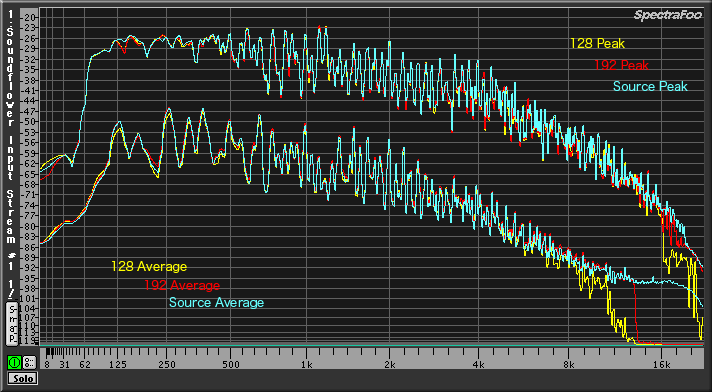
OK, I redone the spectragraph.
<http://a-no-ne.com/temp/mp3Test.gif>
This time, I changed the scale so you can see the differences in high
better.
You might think 8k and above is not necessary to human ear, but this is
where the time impulse lives to reproduce the depth of the image.
Wow, I can really see the difference here. You are right that there is
a lot of detail above 8k that is important to realism, but it is the
parts above 16k that I don't think I am hearing much.
One thing I see that seems to agree with what I have read about mp3
encoding is that frequencies that are much below the general level of
sound get stripped out. This only APPEARS to be the case in the upper
register, but In an average spectrograph like this one won't see the
effects of stripping out low-level details such as transients (the
fast-disappearing frequencies at the start of notes that are important
to timbre perception.)
I listened closely (cranking the volume a bit on my Yamaha NS10M's) and
it is true that there seems to be more blurring, even in the mid-range,
and that it is more pronounced in the lower-quality encoding. The upper
register differences below 16k in the one piece I can hear clearly, and
that is reflected in the spectrograph. Yet the mid-register differences
that I can hear don't seem to be showing in the spectrograph. Nature of
the method, I suppose. Maybe we would see even MORE differences
reflected in a shorter sample of the music.
I have heard talk of (though I haven't done a comparison myself) that
with pop recordings with "big bass", the low register suffers
significantly with lower-rate encoding. I confess that I don't hear
anything of the sort in these recordings, but then they don't have that
kind of energy in the bass!
In any case, both encodings beat the heck out of cassette recordings
(!) and certainly are plenty good for demo purposes.
Thanks for a highly illuminating look at encoding schemes.

Christopher

_______________________________________________
Finale mailing list
[email protected]
http://lists.shsu.edu/mailman/listinfo/finale