On 20 Aug 2006 at 6:26, Cecil Rigby wrote:

> do check the previous measure - aren't the sixth and 13th notes
> thirty-second notes, not sixteenths? It's very hard to see, but so,
> I'm pretty sure.
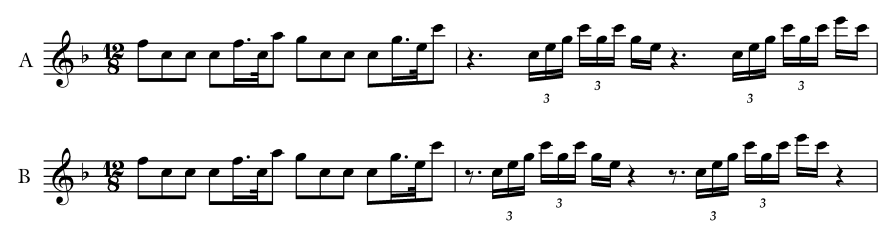
I certainly agree with this. And it's quite clear what the meaning is
-- the dotted 16th/32nd passage should probably be rendered the same
as an 8th/16th under the triplet -- they didn't have any good way to
notate this, and it's very often the case that the dotted notation
was used to indicate this rhythm in triples.

> But the rest (your real question!) is pure speculation for me.... but
> I'm sure performers of the period would have no problem with this.....
>  These old mss many times can't be counted on to render correct
> accumulated number of beats per measure according to the way we read
> rhythms today, of course.

True, but there's a pretty simple way to read this, my example A:

http://www.dfenton.com/images/LaSperanza.gif

Musically it's not very interesting, though.

> Try thinking of and feeling the piece in 2
> rather than 4 (tempo giusto, remember).

Excuse me? This is clearly one of those pieces that isn't in 4 at
all, but is four measures of slow 3/8. The constant subdivision of
the 8ths into triplets makes that quite clear. It would not be fast
at all.

> Perhaps those are not dotted quarter but dotted eighth rests-

That makes no sense whatsoever, as the copyist is quite clear at
notating 8th rests distinct from quarter rests. Now, it could be a
case of copyist misinterpretation (or is this a composing MS?).

> spacing seems to intimate dotted quarter rests would be *wrong*.

Well, a score MS in this time period was not a score as we think of
it, but a guide to a copyist for creating parts. That means that
vertical alignment didn't mean anything, as the copyist creating
parts would not be reading vertically, but horizontally. So the
spacing is simply irrelevant.

The troubling part to me is the partial measure which makes sense for
neither for your interpration, for Kim's nor for mine. I'd like to
see the next system, the completion of the partial measure.

> I would render it as: http://home.earthlink.net/~rigrax/sample.bmp

That doesn't work either, as what you've actually notated contradicts
the beaming, unless you're suggesting a complex rhythmic modulation,
something that makes no sense at all for me in this period.

(BTW, it's a bad idea to post bitmaps, because they are huge and
inefficient and can't be rendered by most browsers without being
downloaded)

--
David W. Fenton                    http://dfenton.com
David Fenton Associates       http://dfenton.com/DFA/

_______________________________________________
Finale mailing list
[email protected]
http://lists.shsu.edu/mailman/listinfo/finale