Nick,

We can help you match the images clouds to the SkewT diagram with an
Augmented Reality overlay. Right now it is a manual process but we hope to
make it automated in the near future.
As I always have to go back and lookup how to read a Skew-T, is it true
that this is from a single location (Norman, OK) and the x-axis is
temperature and Yaxis pressure (proxy for altitude)?

For manual process:
Take some photos while you're looking out the window with your location
services on (GPS). you may need to hold your phone next to the window to
get a good GPS fix. And make sure your camera is "geocoding" your photos.
It should store lat/long and altitude. The GPS is +- 100 ft with GPS and a
little more accurate with barometer but in a pressurized cabin, the
barometric altitude is not helpful. Right down your flight information as
we can also pull up the flight track and match it to the time of your photo.

You can also try our beta of https://reatlime.earth while you're on the
flight for encoding video and photos. On iphone open it in Safari. On
Android, use Chrome. Take photos using the webpage. Android is a little
better right now as we can use the hires image and record video instead of
just images at video resolution.

-Stephen
_______________________________________________________________________
[email protected] <[email protected]>
CEO, Simtable  http://www.simtable.com
1600 Lena St #D1, Santa Fe, NM 87505
office: (505)995-0206 mobile: (505)577-5828
twitter: @simtable


On Sat, Sep 29, 2018 at 1:02 PM Nick Thompson <[email protected]>
wrote:

> To the Weather Nerds among you,
>
>
>
> I’ve been flying down the Ohio Valley for the last hour at 38kft.  Just
> crossed the Mississippi above St. L.  I sprang for the WIFI and so now I
> have a clear view of the bottom of the atmosphere out the window and a skew-t
> diagram <https://www.spc.noaa.gov/exper/soundings/help/index.html> and weather
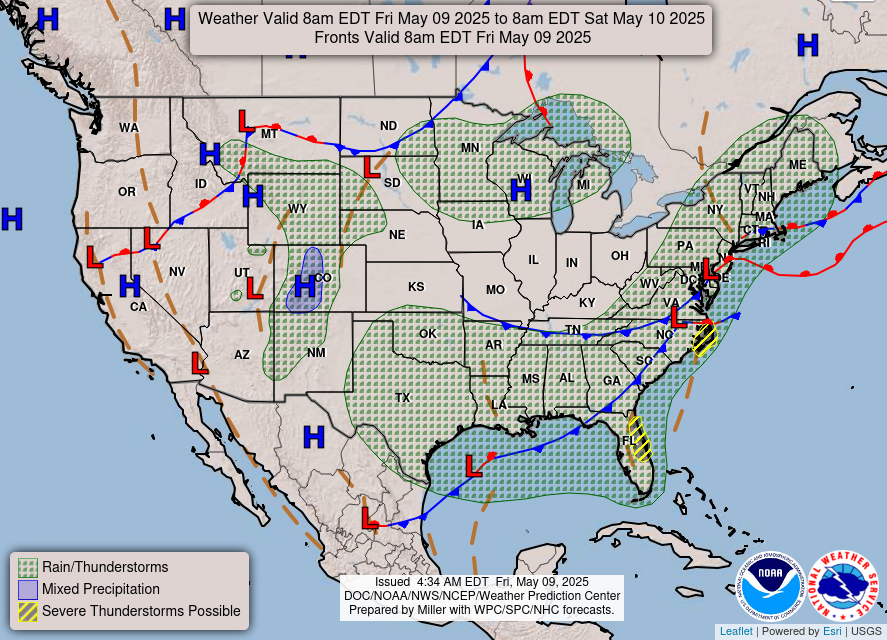
> map <https://www.wpc.ncep.noaa.gov/noaa/noaa.gif> of the same on my
> computer screen.  There ought to be SOME relation between them!
>
>
>
> Flying down to Baltimore from Hartford there were scattered to broken
> clouds arranged in “streets” and quasi streets and proto streets. But the
> interesting thing was that the streets were arranged with respect to each
> other all higgledy=piggeldy, even at what appeared to me the same layer.
> This made me think that the “streeting” of clouds is not, as I had always
> supposed imposed on a layer by forces extrinsic to that layer, but
> something that “self organizes”  within the layer and that the layer I was
> looking at was at some critical state with trying to decide which way to
> street.
>
>
>
> Does anybody have anything to say about any of this?
>
>
>
> Nick
>
>
>
> Nicholas S. Thompson
>
> Emeritus Professor of Psychology and Biology
>
> Clark University
>
> http://home.earthlink.net/~nickthompson/naturaldesigns/
>
>
> ============================================================
> FRIAM Applied Complexity Group listserv
> Meets Fridays 9a-11:30 at cafe at St. John's College
> to unsubscribe http://redfish.com/mailman/listinfo/friam_redfish.com
> FRIAM-COMIC http://friam-comic.blogspot.com/ by Dr. Strangelove
>
============================================================
FRIAM Applied Complexity Group listserv
Meets Fridays 9a-11:30 at cafe at St. John's College
to unsubscribe http://redfish.com/mailman/listinfo/friam_redfish.com
FRIAM-COMIC http://friam-comic.blogspot.com/ by Dr. Strangelove