Intelligence and Vietnam (II): Return of The Top Secret 1969 State
Department Study
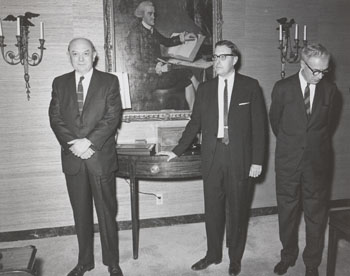
[image: Secretary of State Dean Rusk with Bureau of Intelligence and
Research (INR) Director Thomas L. Hughes, and INR Deputy Director Allan
Evans]
<https://nsarchive.gwu.edu/sites/default/files/thumbnails/image/photo350.jpg>
Left to Right: Secretary of State Dean Rusk with Bureau of Intelligence and
Research (INR) Director Thomas L. Hughes, and INR Deputy Director Allan
Evans (Photo courtesy Thomas L. Hughes)
Published: Dec 2, 2004
Updated: Dec 27, 2020
Briefing Book #121

Edited by Tom Blanton

Updated by John Prados

For more information, contact John Prados:
202-994-7000 or [email protected]

INR study re-released on appeal under FOIA restores redacted text and
hundreds of pages of references

INR was highly attuned to Chinese aid to North Vietnam; first in US
government to recognize significance of the Buddhist crisis in the South
RELATED LINKS

Bangor Daily News
"State Secrets" <https://archive.bdnblogs.com/2004/06/16/state-secrets/>
June 16, 2004

National Security Archive
INR’s Nuclear Watch, 1959-1967 <https://nsarchive.gwu.edu/node/243>
By William Burr
May 18, 2016

Association for Diplomatic Studies and Training
Foreign Affairs Oral History Project
Interview with Thomas L. Hughes
<https://memory.loc.gov/service/mss/mfdip/2011/2011hug02/2011hug02.pdf>
Initial date: July 7, 1999
DNSA COLLECTIONS

(subscription required)

U.S. Policy in the Vietnam War, Part I: 1954-1968
<https://proquest.libguides.com/dnsa/vietnam1>

U.S. Policy in the Vietnam War, Part II: 1969-1975
<https://proquest.libguides.com/dnsa/vietnam2>


SPECIAL EXHIBIT

Complete Pentagon Papers!
<https://nsarchive2.gwu.edu/NSAEBB/NSAEBB359/index.htm>


SUGGESTED READING

by John Prados
*Vietnam: The History of an Unwinnable War, 1945-1975*
<https://www.amazon.com/Vietnam-History-Unwinnable-1945-1975-Studies/dp/0700616349>
Lawrence: University of Kansas Press, 2009
ISBN: 978–0–7006–1634–3


by John Prados and Margaret Pratt Porter, eds.
*Inside the Pentagon Papers
<https://www.amazon.com/Inside-Pentagon-Papers-Studies-Paperback/dp/0700614230>*
Lawrence: University of Kansas Press, 2004
ISBN: 0–7006–1325–0

Washington, DC, December 27, 2020—The National Security Archive is today
posting an update to a 2004 E-book featuring a landmark but still
relatively little-known State Department study of the Vietnam War from
1969.  Commissioned by Thomas L. Hughes, the head of the Bureau of
Intelligence and Research, it was a more modest account of the war than its
more famous cousin, the Pentagon Papers.  Yet in some ways it was more
insightful and is considered essential to understanding the Department’s
role in the conflict.

 The Archive’s original posting presented a sometimes heavily redacted
version of the document – all that was available at the time.  However,
after an Archive appeal under the Freedom of Information Act, the State
Department released a much more complete version – most notably including
an entire 275-page section consisting of specific references to INR's
contributions to various government reporting, including its own papers,
CIA estimates, and other records.

 Today’s posting includes that section (part B), plus related materials by
the document’s authors from that time as well as lengthy prefatory essays
by Hughes and the Archive’s John Prados that also appeared as part of the
original E-book.

* * * * *

Preface to the Updated Posting

By John Prados

The “Pentagon Papers,” a top secret Department of Defense inquiry into the
background and conduct of the Vietnam war, became famous when leaked by
Daniel Ellsberg in July 1971. A landmark Supreme Court case upheld First
Amendment rights, prohibiting then-president Richard M. Nixon from
preventing their publication. For years the Pentagon Papers furnished the
ultimate documentary source for studies of the war. But there was another,
equally secret, review of the Vietnam war, one that did not leak.

*Time *Magazine revealed its existence in August 1971 (see excerpt below)
but that was virtually the only public mention of the State Department's
study, which remained locked away for decades. In the 1990s both the
National Security Archive and Clemson University professor Edwin E. Moise
filed Freedom of Information Act requests for release of the INR study,
much of which was declassified in 2003. The Archive then asked former
Bureau of Intelligence and Research (INR) Director Thomas L. Hughes to
contribute an essay that introduced the Bureau and discussed its work. I
went over the same ground as an historian and supplied a paper that focused
directly on INR's intelligence output. The Archive posted the package as
Electronic Briefing Book no. 121 in May 2004.

At that time an entire section of the INR study, plus many passages
throughout, remained secret and were under appeal. We subsequently got most
of that material released. It is included in this new posting. There are
currently perhaps a dozen short excisions left out of the study for
classification purposes. We have also checked with Dr. Moise, who had also
appealed the secret texts, and found we both held identical copies of the
document. Because the INR study is a seminal resource, and because the
previous electronic briefing book appears in an old format (without
endnotes), we are reposting this package here.

* * * * *


Original PostingIntelligence and Vietnam: The Top Secret 1969 State
Department Study

National Security Archive Electronic Briefing Book No. 121

Retrospective Preface by Thomas L. Hughes
<https://nsarchive2.gwu.edu/NSAEBB/NSAEBB121/index.htm#hughes> (Former
Director, Bureau of Intelligence and Research, U.S. Department of State)

Contextual Introduction by John Prados
<https://nsarchive2.gwu.edu/NSAEBB/NSAEBB121/index.htm#prados> (Senior
Fellow, National Security Archive)

Edited by Thomas S. Blanton (Director, National Security Archive)

Embargoed for release, Sunday, May 2, 2004


Two months after the leak of the Pentagon Papers
<https://nsarchive.gwu.edu/NSAEBB/NSAEBB48/> generated front page headlines
and a landmark Supreme Court case, *TIME* magazine reported:

*"State's Secrets. The Pentagon, it seems, was not the only Government
department to make a top-secret retrospective study of the nation's
decisions in Vietnam. In 1968 Tom Hughes, then director of the State
Department's Bureau of Intelligence and Research, ordered another report,
far less voluminous and ambitious but with considerable potential impact.*

*"Composed by two State Department Asia analysts, the study compared the
Kennedy and Johnson Administrations' key Vietnam decisions with the
bureau's own major judgments during the same period. In almost every case,
the intelligence reports called the shots perfectly about such matters as
the ineffectiveness of the bombing campaign, Vietnamese political upheavals
and North Vietnamese troop buildups. Daniel Ellsberg is said to have read
the study as a consultant for Henry Kissinger in 1969 and reacted: 'My God,
this is astonishing. I thought the CIA stuff was great, but these papers
are even more accurate.'*

*"After publication of the Pentagon papers, the two known copies of the
State study have been locked away. Ray Cline, the intelligence bureau's
current director, has forbidden subordinates to admit their existence."*

-- TIME magazine, August 9, 1971, p. 16

Secrecy and bureaucratic inertia kept this historic study hidden in State
Department vaults for nearly 35 years, until Freedom of Information Act
requests by Clemson University professor Edwin E. Moise and the George
Washington University's National Security Archive forced the release of the
bulk of the study in November 2003. Missing from that initial release
because of a processing mistake was a significant part of the sources for
section A-VI, which the National Security Archive obtained from the State
Department on April 27, 2004. Still missing from the 596-page study are a
number of questionable deletions <https://nsarchive.gwu.edu/node/3032/#1-4> on
national security grounds, which the Archive has appealed
<https://nsarchive.gwu.edu/briefing-book/intelligence-vietnam/2004-12-02/intelligence-vietnam-ii-return-top-secret-1969-state-department-study?eType=EmailBlastContent&eId=a0ca0761-09bb-4a61-89f4-6a9e976eb381#appeal>
.

In late 1968, Thomas L. Hughes, the director of the State Department's
Bureau of Intelligence and Research (INR), commissioned this study,
intended as an in-house classified review and evaluation of INR's
performance on the subject of Vietnam during the eight years of the Kennedy
and Johnson presidencies. As Mr. Hughes explains in the retrospective
preface he generously provided for this posting, he tasked two former INR
analysts who were intimately familiar with INR's product but no longer
serving in the Bureau - W. Dean Howells and Dorothy Avery - to produce the
study. They wrote the chronological review of INR reporting, compiled the
annexes of source material, and wrote the thematic summaries as well.
Recently retired INR staffer Fred Greene then reviewed the material and
wrote the critique section. Mr. Hughes refrained from supervising or
editing the results. All of this material except for the "B" section, the
265-page "Annexes Quoting Sources," is included in this posting.

Then-INR director Hughes comments in his retrospective preface
<https://nsarchive.gwu.edu/briefing-book/intelligence-vietnam/2004-12-02/intelligence-vietnam-ii-return-top-secret-1969-state-department-study?eType=EmailBlastContent&eId=a0ca0761-09bb-4a61-89f4-6a9e976eb381#hughes>
for
this posting: "INR's analysis on Vietnam stood out as tenaciously
pessimistic from 1963 on, whether the question was the viability of the
successive Saigon regimes, the Pentagon's statistical underestimation of
enemy strength, the ultimate ineffectiveness of bombing the North, the
persistence of the North Vietnamese and the Vietcong, or the danger of
Chinese intervention." Mr. Hughes contrasts INR's consistency with that "of
leading actors who were hawks by day and doves by night." Mr. Hughes
laments that "while we [in INR] were heeded, we were unable to persuade,
sway, or prevail when it came to the ultimate decisions."

Archive senior fellow John Prados, who edited the Archive's forthcoming
documentary collection on Vietnam, gives INR more credit in his contextual
introduction
<https://nsarchive.gwu.edu/briefing-book/intelligence-vietnam/2004-12-02/intelligence-vietnam-ii-return-top-secret-1969-state-department-study?eType=EmailBlastContent&eId=a0ca0761-09bb-4a61-89f4-6a9e976eb381#prados>,
calling the Bureau "the mouse that roared." Dr. Prados concludes that INR
"helped hone U.S. intelligence conclusions, called attention to the poor
data and inadequate intelligence collection taking place in Vietnam, saved
the CIA and other agencies from going even farther out on a limb than they
climbed, and … also helped limit the war by contributing to the reluctance
of top officials to escalate too far."

Archive director Thomas Blanton commented that "Lessons from the Vietnam
experience with intelligence run directly counter to today's reform
proposals for the U.S. intelligence community. Instead of a centralized
'czar,' this history suggests we need a multiplicity of competing agencies
and analyses. Instead of policymakers who cherry-pick only the intelligence
they want to hear, we need to encourage dissents and force closer
examination of contrary findings. Instead of covering up with the cloak of
secrecy, we need to open the insider critiques in real time and enrich the
public debate."

Preface: INR'S Vietnam Study in Context
<https://nsarchive.gwu.edu/node/3032>
A Retrospective Preface Thirty-five Years Later
by Thomas L. Hughes, Director of INR 1963-69

Since the completion of this study in 1969, dozens of books and memoirs on
Vietnam have appeared. A striking pattern has emerged from their
disclosures. To a far greater extent than was imagined in the 1960's,
prominent officials in Washington engaged in a combined patriotic,
political, and careerist suppression of their strong personal doubts about
the war. Cumulatively, another tragic dimension has thus been added to the
Vietnam tragedy itself-the unveiling of a dramatis personnae of split
personalities, of leading actors who were hawks by day and doves by night-a
plethora of public hawks who were private doves.

Click here for the full text <https://nsarchive.gwu.edu/node/3032>

Introduction: The Mouse That Roared <https://nsarchive.gwu.edu/node/3033>
State Department Intelligence in the Vietnam War
by John Prados, Senior Fellow, National Security Archive

One of the untold stories of the Vietnam era, a tale that lies at the very
heart of the nexus of Washington's war decisions and its appreciations of
that conflict, is how America's own diplomatic intelligence service
contributed to United States understanding of affairs in Vietnam and their
likely consequences. This is a story of steady efforts to piece together a
wide range of unknowns into a coherent vision of how things appeared to
Hanoi and its allies and what those parties would do about Vietnam
themselves. It is an account of sometimes breathtaking, sometimes
frustrating efforts to speak truth to power in a situation of primary
importance to the United States, its leaders, and its people.

Click here for the full text <https://nsarchive.gwu.edu/node/3033>


THE DOCUMENTS


Note: This version of the INR study was released to the National Security
Archive after the original posting in 2004, in response to a Freedom of
Information Act appeal.

VIETNAM, 1961 – 1968

Interpreted in INR’s Production

By W. Dean Howells, Dorothy Avery, and Fred Greene


A. Review of Judgments in INR Reports

Introductory Note: Note on Sources
<http://nsarchive.gwu.edu/documents/intelligence-and-vietnam-ii-return-of-the-top-secret-1969-state-department-study/Introductory-Note.pdf>

A-I - The Problem Confronted, January 1961-February 1962
<https://nsarchive.gwu.edu/documents/intelligence-and-vietnam-ii-return-of-the-top-secret-1969-state-department-study/A-I.pdf>

A-II - Looking for Progress, February 1962-May 1963
<https://nsarchive.gwu.edu/documents/intelligence-and-vietnam-ii-return-of-the-top-secret-1969-state-department-study/A-II.pdf>

A-III - The Trouble with Diem, May-November 1963
<https://nsarchive.gwu.edu/documents/intelligence-and-vietnam-ii-return-of-the-top-secret-1969-state-department-study/A-III.pdf>

A-IV - Time of Decision, November 1963-March 1965
<https://nsarchive.gwu.edu/documents/intelligence-and-vietnam-ii-return-of-the-top-secret-1969-state-department-study/A-IV.pdf>

A-V - Trial by Force, March 1965-February 1966
<https://nsarchive.gwu.edu/documents/intelligence-and-vietnam-ii-return-of-the-top-secret-1969-state-department-study/A-V.pdf>

A-VI - A Massive Effort to Turn the Tide, February 1966-April 1968
<https://nsarchive.gwu.edu/documents/intelligence-and-vietnam-ii-return-of-the-top-secret-1969-state-department-study/A-VI.pdf>

A-VII - The Search for Peace, April-December 1968
<https://nsarchive.gwu.edu/documents/intelligence-and-vietnam-ii-return-of-the-top-secret-1969-state-department-study/A-VII.pdf>


B. Annexes Quoting Sources (Multiple Vietnam Analyses, annotated)
<https://nsarchive.gwu.edu/documents/intelligence-and-vietnam-ii-return-of-the-top-secret-1969-state-department-study/B.pdf>


C. Thematic Summaries
<https://nsarchive.gwu.edu/documents/intelligence-and-vietnam-ii-return-of-the-top-secret-1969-state-department-study/C.pdf>

C-I - Communist Intentions and Response to U.S. Actions
<http://nsarchive.gwu.edu/documents/intelligence-and-vietnam-ii-return-of-the-top-secret-1969-state-department-study/C-I.pdf>

C-II - Political Stability
<http://nsarchive.gwu.edu/documents/intelligence-and-vietnam-ii-return-of-the-top-secret-1969-state-department-study/C-II.pdf>

C-III - The Course of the War
<http://nsarchive.gwu.edu/documents/intelligence-and-vietnam-ii-return-of-the-top-secret-1969-state-department-study/C-III.pdf>

C-IV – Prospects for Beginning Talks and Negotiating a Settlement
<http://nsarchive.gwu.edu/documents/intelligence-and-vietnam-ii-return-of-the-top-secret-1969-state-department-study/C-iV.pdf>


D. Critique of INR Interpretations in the Light of Contemporary Events

D-I - The Political Situation in South Vietnam
<http://nsarchive.gwu.edu/documents/intelligence-and-vietnam-ii-return-of-the-top-secret-1969-state-department-study/D-I.pdf>

D-II - The Course of the War in the South
<http://nsarchive.gwu.edu/documents/intelligence-and-vietnam-ii-return-of-the-top-secret-1969-state-department-study/D-II.pdf>

D-III - The War Against the North and the Role of China
<http://nsarchive.gwu.edu/documents/intelligence-and-vietnam-ii-return-of-the-top-secret-1969-state-department-study/D-III.pdf>

D-IV - Negotiations
<http://nsarchive.gwu.edu/documents/intelligence-and-vietnam-ii-return-of-the-top-secret-1969-state-department-study/D-IV.pdf>


E. Special Annexes Available as Authorized by the Director

E-I - Infiltration
<http://nsarchive.gwu.edu/documents/intelligence-and-vietnam-ii-return-of-the-top-secret-1969-state-department-study/E-I.pdf>

E-II - The Tonkin Gulf
<http://nsarchive.gwu.edu/documents/intelligence-and-vietnam-ii-return-of-the-top-secret-1969-state-department-study/E-II.pdf>

E-III - Chinese Military Activity, September 1964-January 1965
<http://nsarchive.gwu.edu/documents/intelligence-and-vietnam-ii-return-of-the-top-secret-1969-state-department-study/E-III.pdf>

E-IV - Sino-DRV Air and Ground Action, February 1965-February 1966
<http://nsarchive.gwu.edu/documents/intelligence-and-vietnam-ii-return-of-the-top-secret-1969-state-department-study/E-IV.pdf>

E-V - DRV Planes receive Sanctuary, 1967
<http://nsarchive.gwu.edu/documents/intelligence-and-vietnam-ii-return-of-the-top-secret-1969-state-department-study/E-V.pdf>


Related Contemporaneous Materials

Letter, Fred Greene-Dean Howells, Feb. 2, 1969, Next Stages in the Vietnam
Project
<https://nsarchive.gwu.edu/documents/intelligence-and-vietnam-ii-return-of-the-top-secret-1969-state-department-study/greene-howells-next-stages.pdf>

Note, Fred Greene to file, Feb 2, 1969, Illustrating categories
<https://nsarchive.gwu.edu/documents/intelligence-and-vietnam-ii-return-of-the-top-secret-1969-state-department-study/greene-note.pdf>

Memorandum, Allen S. Whiting-Thomas L. Hughes, Feb. 10, 1969, INR Estimates
and the Vietnam War
<http://nsarchive.gwu.edu/documents/intelligence-and-vietnam-ii-return-of-the-top-secret-1969-state-department-study/whiting-hughes-survey-comments.pdf>

Paper, Fred Greene, Random Observations on INR's Record, March 5, 1969
<http://nsarchive.gwu.edu/documents/intelligence-and-vietnam-ii-return-of-the-top-secret-1969-state-department-study/greene-comments-howells.pdf>


National Security Archive letters appealing questionable deletions in the
INR study:

Department of State
<https://nsarchive.gwu.edu/documents/intelligence-and-vietnam-ii-return-of-the-top-secret-1969-state-department-study/appeal-dos.pdf>
Central Intelligence Agency
<https://nsarchive.gwu.edu/documents/intelligence-and-vietnam-ii-return-of-the-top-secret-1969-state-department-study/appeal-cia.pdf>

--
Anda menerima pesan ini karena Anda berlangganan grup "GELORA45" dari Google
Grup.
Untuk berhenti berlangganan dan berhenti menerima email dari grup ini, kirim
email ke [email protected].
Untuk melihat diskusi ini di web, kunjungi
https://groups.google.com/d/msgid/gelora1945/CAGjSX2CHxkbAdkD_Ro0UjWox1U_RwAhA28JTDjskC3Yw%3DaRhpw%40mail.gmail.com.