Wansolwara student journos report on West Papua human rights struggle

By Wansolwara <https://asiapacificreport.nz/author/wansolwara/> -
June 8, 2017

0
<https://asiapacificreport.nz/2017/06/08/wansolwara-student-journos-report-on-west-papua-human-rights-struggle/#respond>

202

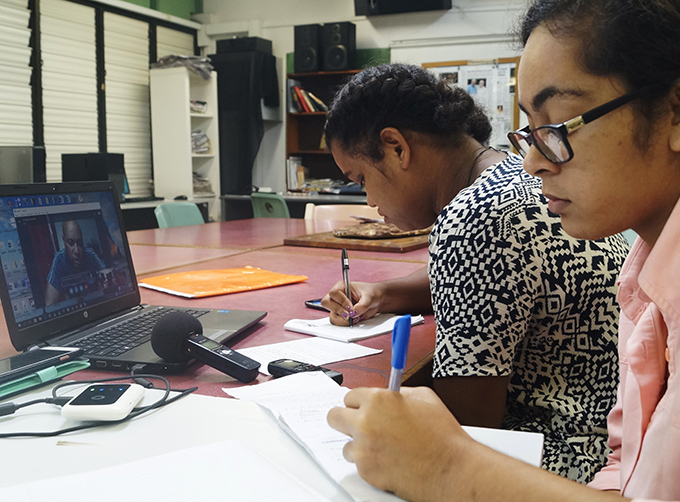
<https://asiapacificreport.nz/wp-content/uploads/2017/06/EditorsInterview-Wansolwara-680wide.jpg>Student
reporter Vilimaina Naqelevuki (left) and Wansolwara chief-of-staff Heather
Traill interview Papua New Guinea journalist Alexander Rheeney about West
Papua via Skype. Image: Wansolwara

*By Vilimaina Naqelevuki in Suva*

Media access to West Papua, where more than half a million of its
indigenous people
<http://thediplomat.com/2014/01/the-human-tragedy-of-west-papua/> have
reportedly been killed over five decades, remains restricted.

Full support … West Papuan Independence leader Benny Wenda (in red shirt)
holds the banned West Papuan Morning Star flag with key supporter Solomon
Islands Prime Minister Manasseh Sogavare during his visit last year. Image:
bennywenda.org

News coverage of the alleged genocide is extremely difficult because of the
restrictions on local and foreign media.

Some West Papuan journalists have also died in their effort to tell the
truth about the deaths that largely occur in remote rural areas.

This makes news coverage of the alleged atrocities in the
Indonesia-occupied land extremely difficult.

West Papuan independence leader Benny Wenda <https://www.bennywenda.org/>,
in an online interview, told *Wansolwara* the restrictions allowed for the
atrocities to remain “silenced”.

And even if access was granted after the labyrinthine effort, “journalists
cannot go freely to report on politics in West Papua,” he said.

-Partners-

“They will get followed and questioned by Indonesian intelligence and West
Papuans will suffer intimidation and threats if they speak to journalists.”

*Recent prominence*
Papua New Guinea Media Council president Alexander Rheeney said West
Papua’s struggle of more than 50 years had only been given prominence in
the region’s mainstream media in recent years.

Papua New Guinean journalist Alexander Rheeney, who is also president of
the PNG Media Council. Image: PNG Media Council

Less than 10 years ago, the mainstream news media – in neighbouring
countries like Fiji, Australia and New Zealand, ignored the situation in
West Papua. It was effectively a media “black hole”.

Rheeney said it was more challenging for Pacific journalists whose
governments recognised the sovereignty Indonesia had over West Papua.

“The media in PNG have reported on West Papua and all the human rights
abuses but not as much as we would want it to despite the fact that PNG and
West Papua share a land order,” he said.

The increasing coverage by Pacific news media should be commended, said
journalism educator Professor David Robie.

Professor David Robie speaking at the Free Media in West Papua seminar in
Jakarta, Indonesia, last month. Image: Alves Fonataba/PMC

Dr Robie, director of the Auckland-based Pacific Media Centre, who has
regularly written and published news on West Papua’s struggle for more than
three decades, said it was a huge relief that the Pacific was “finally
waking up to the issue of West Papua”.

“This an issue of Melanesian solidarity, Pacific solidarity – an issue of
self-determination, and the Pacific countries that got independence on a
plate ought to be telling this story,” he said.

*Jakarta media freedom conference*
Dr Robie was one of the keynote speakers invited last month to the Free
Media in West Papua forum
<https://asiapacificreport.nz/2017/05/07/rave-hospitality-but-indonesia-fails-west-papua-with-media-freedom-hypocrisy/>
at the UNESCO World Press Freedom Day 2017 conference in the Indonesian
capital of Jakarta.

He spoke along with Indonesian and Papuan human rights activists and *Tabloid
Jubi* editor Victor Mambor of Jayapura.

Pacific Freedom Forum editor Jason Brown said it was an utter disgrace that
some in mainstream media published or broadcast stories on wars from other
regions and “not in our own backyard”.

“In recent years, RNZI has done a much better job of covering West Papua.
The recent closure of shortwave services by Radio Australia, however, means
that the region has lost reliable access to news on West Papua from that
source,” said Brown.

Rheeney warned that the region could not afford to fail fellow Pacific
Islanders of West Papua.

He said to do so would be to doom the Pacific region to more instability.

“If a prosperous Pacific region is to be ensured, the issue of West Papua
must be addressed,” he said.

*Timor-Leste lessons*
“As journalists we can no longer continue to turn a blind eye on all the
human rights abuses that is happening.

“The PNG government can no longer turn a blind eye on what is happening on
the other side of the border.”

Dr Robie said that informed political decisions could not be reached if the
news media were not allowed to report freely on West Papua.

He said this lesson could easily be drawn from East-Timor’s road to
independence.

East Timor, which was also occupied by Indonesia in 1975, secured its
independence after a handful of journalists exposed the human rights
violations through video smuggled out of the Indonesian-ruled territory,
especially after the Santa Cruz massacre in the capital Dili in 1991.

Indonesia’s control rapidly fell apart after international pressure.

“In-depth and timely media coverage will save lives as West Papua lurches
towards independence — which will come eventually — no matter how hard
Jakarta tries to block this,” said Dr Robie.

Rheeney is also optimistic. He said Pacific journalists should continue to
report on the issue, to keep the struggle in the news so that lasting
solutions were found sooner and more bloodshed is prevented.

*Vilimaina Naqelevuki is a final year journalism student with the USP
Journalism Programme. Naqelevuki is pursuing a double major in journalism
and politics, and is pictures editor of Wansolwara
<https://issuu.com/wansolwaranius/docs/wansolwara-issue012017>, the student
news publication produced by the Journalism Programme.*