The article you/Ken cited is about methane capture.  It is not a
research paper supporting the statement "we can expect permafrost to
release large quantities of methane, from as early as 2011 onwards"
I don't understand your use of the word arrogant.  The danger of
climate change may exceed the scenario projections (not "predictions")
from the climate scientists.  Likewise, the danger of geoengineering
may exceed the opinion of a few of those in this group.  Either side
may claim arrogance.  But I don't feel arrogance is the big factor --
intelligent, learned people will differ on the relative risks.

I side in favour of aggressively developing an SRM capability while
simultaneously advancing a viable governance framework and advancing
research to better quantify the environmental impact of deployment
(compared to a no-deployment baseline).  I hope we could be ready with
those critical elements in a few years.  That seems to me as the best
case scenario regardless of whether we have that much time to avoid
triggering tipping points.

On Sat, Jul 17, 2010 at 1:13 PM, Stephen Salter <[email protected]> wrote:
> Hi All
>
> Did Glyn miss Boucher and Folberth, Atmospheric Environment 44 (2010)
> 3343–3345  which Ken circulated earlier this week?
> Is the track record of prediction accuracy of climate scientists high enough
> for us to bet the planet on them always being correct?  The best ones that I
> know are not that arrogant.
>
> Stephen
>
> Emeritus Professor of Engineering Design
> School of Engineering and Electronics
> University of Edinburgh
> Mayfield Road
> Edinburgh EH9 3JL
> Scotland
> tel +44 131 650 5704
> fax +44 131 650 5702
> Mobile  07795 203 195
> [email protected]
> http://www.see.ed.ac.uk/~shs
>
>
> Glyn Roberts wrote:
>>
>> You say "The Arctic warming is now accelerating, and we can expect
>> permafrost to release large quantities of methane, from as early as
>> 2011 onwards, which will lead inexorably to runaway greenhouse warming
>> and abrupt climate change."
>>
>> However in a 2007 review of scientific papers [1] it concluded that
>> permafrost methane was not a top priority tipping point issue  "Recent
>> permafrost melt in Siberia has been described in the popular media as
>> a tipping point because it is accompanied by increased fluxes of
>> methane and carbon dioxide that contribute to the greenhouse effect.
>> However, existing future projections of permafrost melt, although
>> substantial, are quasi-linear and do not exhibit threshold behaviour
>> [ref provided in paper]. These projections ignore the positive
>> feedback from methane emissions, but it is estimated to be weak [ref
>> provided in paper] at the global scale and hence cannot promote a
>> strongly non-linear regional response. The inclusion of an estimated
>> ∼400 PgC of methane stored in frozen hydrate reservoirs under the
>> boreal permafrost could strengthen the feedback somewhat. However, no
>> studies to date convincingly demonstrate that it is a tipping element
>> by our definition. "
>>
>> Has their work been discredited in your opinion?
>>
>> [1]  "Tipping elements in the Earth's climate system", Lenton, et al
>> (see supporting information (SI) Appendix 1)
>> http://www.pnas.org/content/105/6/1786.long
>>
>> Glyn
>>
>> On Thu, Jul 15, 2010 at 2:43 PM, John Nissen <[email protected]> wrote:
>>
>>>
>>> Dear all,
>>>
>>> I have tried to summarise the arguments various people have made for not
>>> supporting the letter, listing six main issues below.
>>>
>>> If this letter is successful in drawing the attention of John Holdren,
>>> then
>>> one would expect him to refer to the experts in various areas to check
>>> out
>>> the evidence and the arguments.  The recipients of this email include top
>>> experts on Arctic sea ice, climate modelling and geoengineering.  Other
>>> recipients have access to such experts.  So no doubt Holdren will get
>>> back
>>> to several of you and your colleagues.
>>>
>>> We have had considerable discussion about the issues during the course of
>>> the past few years, particularly since the dramatic retreat of Arctic sea
>>> ice in September 2007.  It was at that time that I became extremely
>>> concerned about the positive feedback building up in the Arctic, and my
>>> concerns were confirmed in a briefing by David Wasdell and Peter Wadhams
>>> entitled “Accelerated Global Warming” at Tomorrow’s Company in February
>>> 2008
>>> [1].  David impressed me by his understanding of the nature of positive
>>> feedback, and how it had been largely neglected by climate scientists,
>>> particularly in the 2007 IPCC report.  Peter added his knowledge and
>>> understanding of the Arctic sea ice, to present a very alarming picture
>>> of
>>> the situation.  David was keen to distinguish being alarmist from being
>>> honest about an alarming situation.  And the more I have looked into the
>>> science, the more alarmed I have become.
>>>
>>> But I have been most puzzled by the reaction from scientists.  There has
>>> been a refusal to accept the danger of the situation and what can be done
>>> about it.  Perhaps I have been fundamentally wrong about some critical
>>> piece
>>> of evidence or crucial part of the argument.   I wish, I wish, that
>>> somebody
>>> could prove me wrong.  But I refuse to be comforted by a cosy consensus
>>> that
>>> seems to propagate the idea that there’s nothing to worry about.  For
>>> example it has been said, by a past government adviser at a House of
>>> Commons
>>> seminar, that we won’t need geoengineering for at least 30 years [2].
>>>  The
>>> Royal Society study on geoengineering didn’t address the Arctic sea ice
>>> problem at all [3].
>>>
>>> So where could I be wrong?  What arguments are there against the letter
>>> to
>>> Holdren?
>>>
>>>
>>> Sea ice retreat could be much slower
>>>
>>>
>>> This is the argument that the sea ice could last till well beyond 2050.
>>>  Certainly this is possible.  But can we bank on it, given the current
>>> evidence of sea ice volume decline?  Isn’t it wiser to take the
>>> precautionary approach and work on the assumption that the sea ice
>>> retreat
>>> will happen quicker than expected, rather than slower?
>>>
>>>
>>> Methane not a menace
>>>
>>>
>>> Tom Wigley was concerned with this passage:
>>>
>>> "... we can expect permafrost to release large quantities of methane,
>>> from
>>> as early as 2011 onwards, which will lead inexorably to runaway
>>> greenhouse
>>> warming and abrupt climate change."
>>>
>>> It is now generally recognised that there is a vast amount of carbon
>>> locked
>>> in frozen structures within the Arctic region, and, as temperatures rise,
>>> it
>>> will emerge in ever increasing quantities.
>>>
>>> I replied to Tom in detail on 12th July, as follows:
>>>
>>> If all carbon trapped in permafrost were released as CO2, it would triple
>>> CO2 in the atmosphere [1].  A significant proportion will be released as
>>> methane, which a much more potent greenhouse gas than CO2.
>>>
>>> Continued heating of the Arctic will inevitably lead to melting of
>>> permafrost.   This heating is accelerating due to positive feedbacks.  A
>>> major feedback is from the albedo change when sea ice is replaced by
>>> water
>>> [2].  As the sea ice retreats, we can expect methane to be released in
>>> ever
>>> larger quantities.  The global warming effect of the methane will lead to
>>> further methane release, and further warming, in what can be described as
>>> thermal runaway.  Abrupt climate change could then be expected.  Massive
>>> methane discharge is thought to have caused abrupt climate change in the
>>> past, "on a timescale less than a human lifetime" [3].
>>>
>>> [1] Copenhagen Diagnosis, p21
>>> http://www.ccrc.unsw.edu.au/Copenhagen/Copenhagen_Diagnosis_LOW.pdf
>>>
>>> [2] Nature Letters
>>>
>>> http://sciences.blogs.liberation.fr/files/arctique-ann%C3%A9es-2000-tures.pdf
>>>
>>> [3] Clathrate gun hypothesis
>>> http://en.wikipedia.org/wiki/Clathrate_gun_hypothesis
>>>
>>>
>>> Best to wait until things get worse
>>>
>>>
>>> When you are fighting a fire, you don’t wait to see if the fire has taken
>>> hold.  If a patient is ill, with a significant chance of cancer, you
>>> don’t
>>> delay treatment.  The longer we wait to apply geoengineering, the less
>>> likely it is to succeed in cooling the Arctic.
>>>
>>>
>>> Geoengineering is too dangerous
>>>
>>>
>>> One has to balance the risks of geoengineering against the risks of not
>>> geoengineering.  The latter are clearly so high that they almost
>>> certainly
>>> dwarf the possible adverse effects of geoengineering.  We’ve had a long
>>> discussion about this on the geoengineering list.  In particular, a few
>>> people have argued that SRM could adversely affect monsoons, but the
>>> modelling seems inconclusive as to the possible size of this effect and
>>> even
>>> its direction.
>>>
>>> Again the fire-fighting analogy comes in: if a building is on fire, your
>>> main concern is putting out the fire, not worrying about the damage to
>>> contents from fire extinguisher fluid.  However you will try to use
>>> effective extinguishing techniques that avoid damage to the furniture.
>>>  And
>>> you will certainly avoid techniques that could fan the flames.
>>>
>>>
>>> Geoengineering can’t be the only option
>>>
>>>
>>> Unfortunately geoengineering does seem to be the only option to cool the
>>> Arctic and save the Arctic sea ice.  In the letter we say that “even if
>>> emissions could be cut to zero, the existing CO2 in the atmosphere would
>>> continue to warm the planet for many decades.”  Therefore there can be no
>>> cooling effect from emissions reduction.  CO2 removal would have to bring
>>> the level down below pre-industrial level to have a negative forcing on
>>> the
>>> climate – and that clearly cannot be done in the necessary time-scale.
>>>  So
>>> we are left with geoengineering as the only option.  Note that
>>> geoengineering can be defined as “deliberate intervention to change
>>> climate”, and this is what we need to do in the Arctic to cool it.
>>>
>>>
>>> We need more research on geoengineering
>>>
>>>
>>> Having a project “of the intensity of the Manhattan project” does not
>>> rule
>>> out further research.  But it does stress that time is of the essence, to
>>> reduce the risk of being too late.  The risk of being too late is growing
>>> with all delay, due to growing effects of positive feedback.  Thus first
>>> task of the project would be work out a plan of attack, to maximise
>>> chances
>>> of success.  Research can continue in parallel with preparations for
>>> deployment.  A mix of different techniques will no doubt be considered –
>>> some more ready for deployment than others.
>>>
>>> ---
>>>
>>> I hope everyone can now accept that the letter is grounded in good
>>> science
>>> and logical argument, as fitting to put to Professor Holdren.
>>>
>>> Put it another way.  Suppose this letter fails for lack of your support.
>>> Can you imagine looking back from the future and thinking: “Wasn’t it a
>>> shame we screwed up the planet, when we knew we could have saved it, if
>>> only
>>> we’d pressed for geoengineering earlier”?
>>>
>>> Best wishes,
>>>
>>> John
>>>
>>> [1] “Accelerated Global Warming”, see near bottom of this page:
>>> http://www.tomorrowscompany.com/events.aspx
>>>
>>> [2] Sir David King reported here:
>>>
>>> http://blogs.nature.com/climatefeedback/2010/01/testing_geoengineering_a_catch_1.html
>>>
>>> [3] Royal Society report ”Geoengineering the Climate”:
>>> http://royalsociety.org/Geoengineering-the-climate/
>>>
>>> ---
>>>
>>> John Nissen wrote:
>>>
>>> Dear Ron,
>>>
>>> The letter argues that geoengineering is now our only hope - our only
>>> option
>>> to avoid sea ice disappearance and the possibility of catastrophic
>>> methane
>>> release - since only geoengineering can act quickly enough to cool the
>>> Arctic.  Procrastination will reduce chances of success, as well as
>>> increase
>>> chances of unmanageable side effects.
>>>
>>> Cheers,
>>>
>>> John
>>>
>>> ---
>>>
>>> Ron Lindsay wrote:
>>>
>>> Please do not add my name to the letter.  I think geoengineering is a
>>> false
>>> hope and highly prone to unintended consequences.
>>>
>>>    -- Ron
>>>
>>>
>>> John Nissen wrote:
>>>
>>> In view of the situation in the Arctic, I would be grateful for support
>>> for
>>> an open letter to John Holdren, along the following lines.  Please let me
>>> know whether you agree with this text and whether you'd be happy for me
>>> to
>>> add your name at the bottom.
>>>
>>> Cheers,
>>>
>>> John
>>>
>>> ---
>>>
>>> To John P Holdren, the Director of the Office of Science and Technology
>>> Policy
>>>
>>> Dear Dr Holdren,
>>>
>>> The Arctic sea ice acts as a giant mirror to reflect sunlight back into
>>> space and cool the Earth. The sea ice has been retreating far faster than
>>> the IPCC predicted only three years ago [1]. But, after the record
>>> retreat
>>> in September 2007, many scientists revised their predictions for the date
>>> of
>>> a seasonally ice free Arctic Ocean from beyond the end of century to
>>> beyond
>>> 2030. Only a few scientists predicted this event for the coming decade,
>>> and
>>> they were ridiculed.
>>>
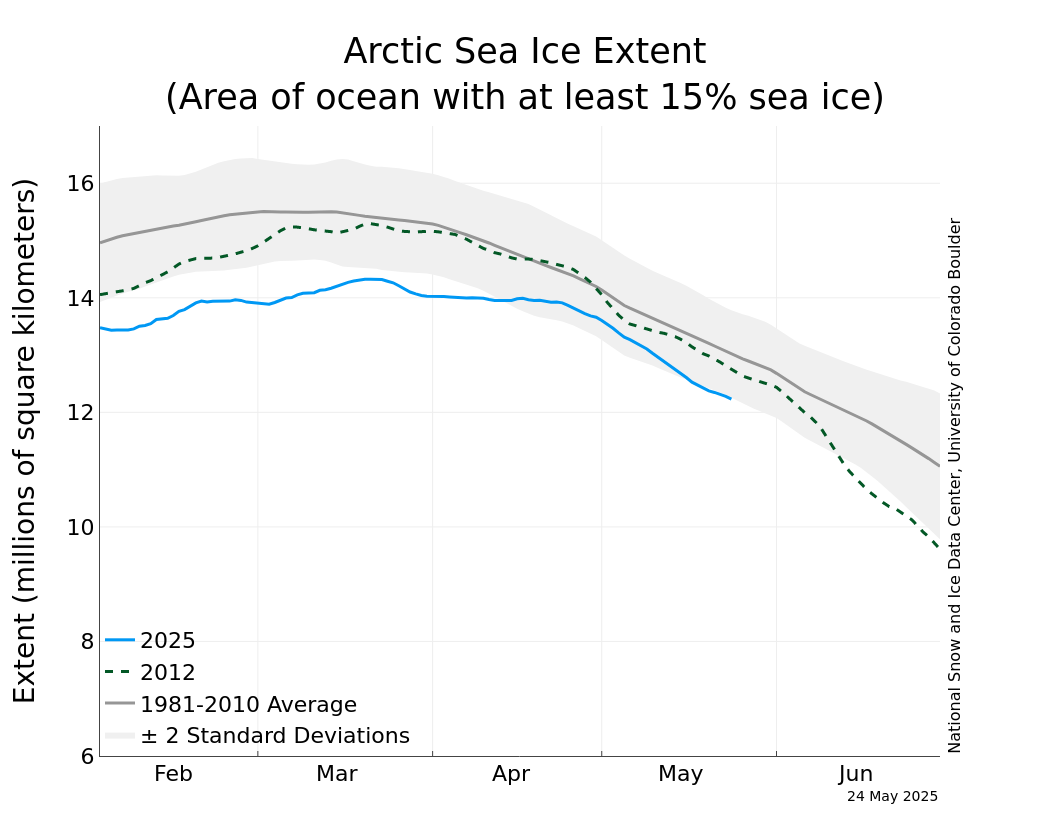
>>> In 2008 and 2009 there was only a slight recovery in end-summer sea ice
>>> extent, and it appears that the minimum 2010 extent will be close to a
>>> new
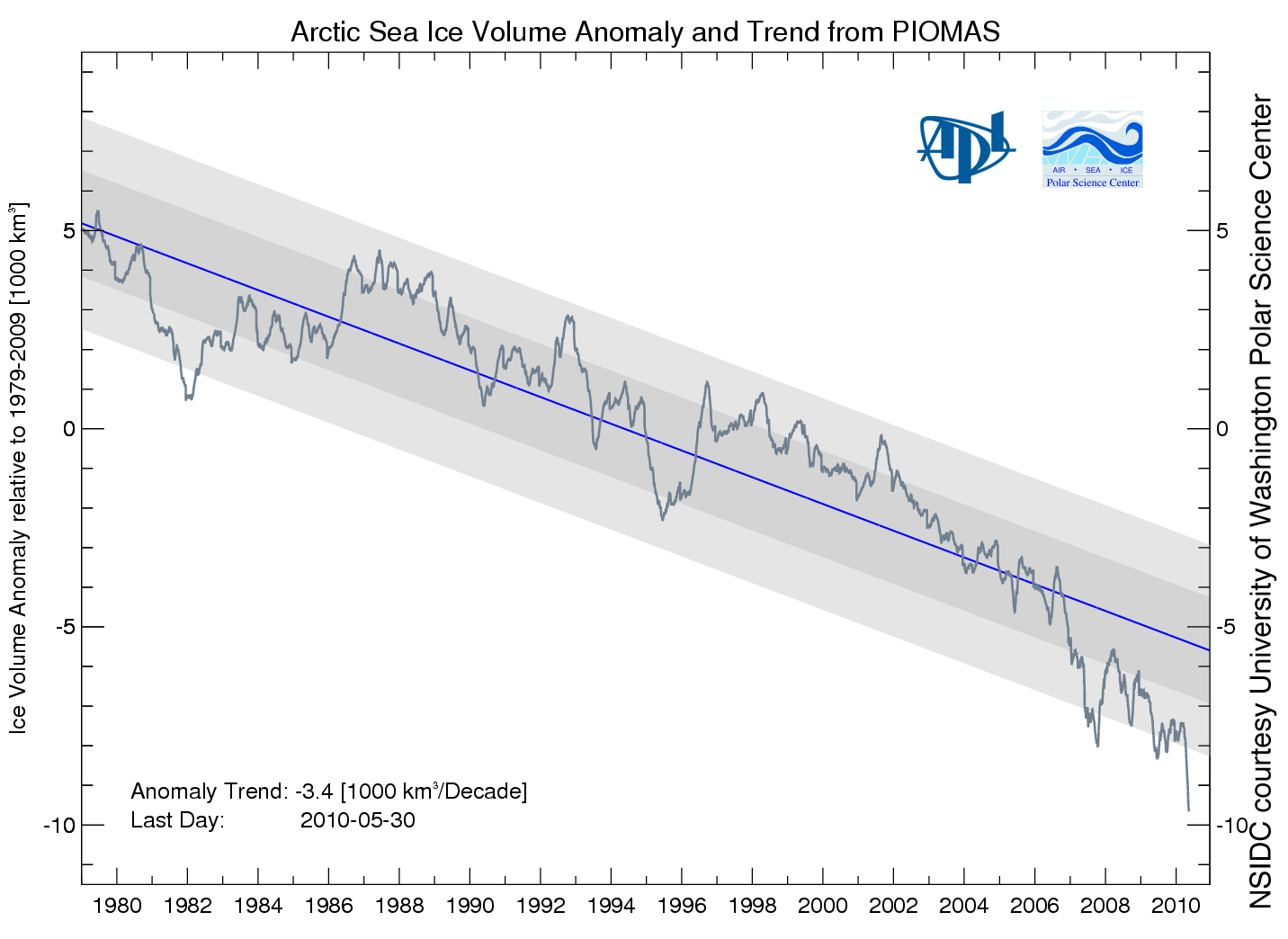
>>> record [2].  However the evidence from PIOMAS is that there has been a
>>> very
>>> sharp decline in volume [3], which is very worrying.
>>>
>>> The Arctic warming is now accelerating, and we can expect permafrost to
>>> release large quantities of methane, from as early as 2011 onwards, which
>>> will lead inexorably to runaway greenhouse warming and abrupt climate
>>> change.  All this could become apparent if the sea ice retreats further
>>> than
>>> ever before this summer.  We could be approaching a point of no return
>>> unless emergency action is taken.
>>>
>>> We suggest that the current situation should be treated as a warning for
>>> us
>>> all. The world community must rethink its attitude to fighting global
>>> warming by cutting greenhouse gas emissions sharply. However, even if
>>> emissions could be cut to zero, the existing CO2 in the atmosphere would
>>> continue to warm the planet for many decades.  Geoengineering now appears
>>> the only means to cool the Arctic quickly enough.  A geoengineering
>>> project
>>> of the intensity of the Manhattan Project is urgently needed to guard
>>> against a global catastrophe.
>>>
>>> Yours sincerely,
>>>
>>> John Nissen
>>>
>>> [Other names to be added here.]
>>>
>>> [1] Stroeve et al, May 2007
>>> http://www.smithpa.demon.co.uk/GRL%20Arctic%20Ice.pdf
>>>
>>> [2]
>>>
>>> http://nsidc.org/data/seaice_index/images/daily_images/N_stddev_timeseries.png
>>>
>>> [3] http://nsidc.org/images/arcticseaicenews/20100608_Figure5.png
>>>
>>> --
>>> You received this message because you are subscribed to the Google Groups
>>> "geoengineering" group.
>>> To post to this group, send email to [email protected].
>>> To unsubscribe from this group, send email to
>>> [email protected].
>>> For more options, visit this group at
>>> http://groups.google.com/group/geoengineering?hl=en.
>>>
>>>
>>
>>
>
> --
> The University of Edinburgh is a charitable body, registered in
> Scotland, with registration number SC005336.
>
>

--
You received this message because you are subscribed to the Google Groups
"geoengineering" group.
To post to this group, send email to [email protected].
To unsubscribe from this group, send email to
[email protected].
For more options, visit this group at
http://groups.google.com/group/geoengineering?hl=en.