Good observation otherwise, but the thinned ice breaks up and scatters more.
If you look at satellite pictures a few years ago the sea ice was not nearly as
fluid as it is today. The North Pole sea ice is predominantly arranged such a
way that some of the regular geometries resulting from the rotation are
constantly almost always visible. In the past the rigid and thick multi year
sea ice caused a lot more ridges and strengt variation within ice impeding a
regular contraflows and centrifugal scattering of sea ice from the pole. In
addition, the same laws of water displacement by floating ice become
applicable. As much of the sea ice has been pushed towards perimetry of the
Arctic Oceans coastal containment margin, the movement of ice towards equator
from the pole requires displacement of the corresponding sea ice volume. So, if
North Pole has 70-80 of sea ice, 20% of the surface water has been uplifted as
the ice has been slinging towards perimeters. This kind of water upswell was
irregularised "dissipated" by the ice ridges of pack ice, variable sea ice
thickenesses randomising the effects. Withnessing patterns like cirles and
ovals and spiralling ice galaxies do not increase my confidence that all is
well as it used to... Some years ago the Arctic sea ice was so rigid that when
Siberian rivers poured warm water into sea these weakened the sea ice from the
estuary and the ice split all across the ocean to Canada. It was solid like the
sement wall, not a fluid ice of today.


I do not remember who called it the "rotten ice" on the Beaufort Sea last
autumn, but that's it. Anyone who has been living in the Arctic knows that
spring ice is thick but weak. The autumn ice is thin and strong. Between the
two is the winter ice which Arctic used to be. Seeing the coriolis forces
arranging highly regular patterns result from ice uniformity.


Kr, Albert


Date: Mon, 12 Jul 2010 13:13:16 -0400
Subject: Re: [geo] SEA ICE LOSS STUNS SCIENTISTS - open letter to John Holdren
From: [email protected]
To: [email protected]
CC: [email protected]; [email protected]; [email protected];
[email protected]; [email protected]; [email protected];
[email protected]; [email protected]; [email protected];
[email protected]

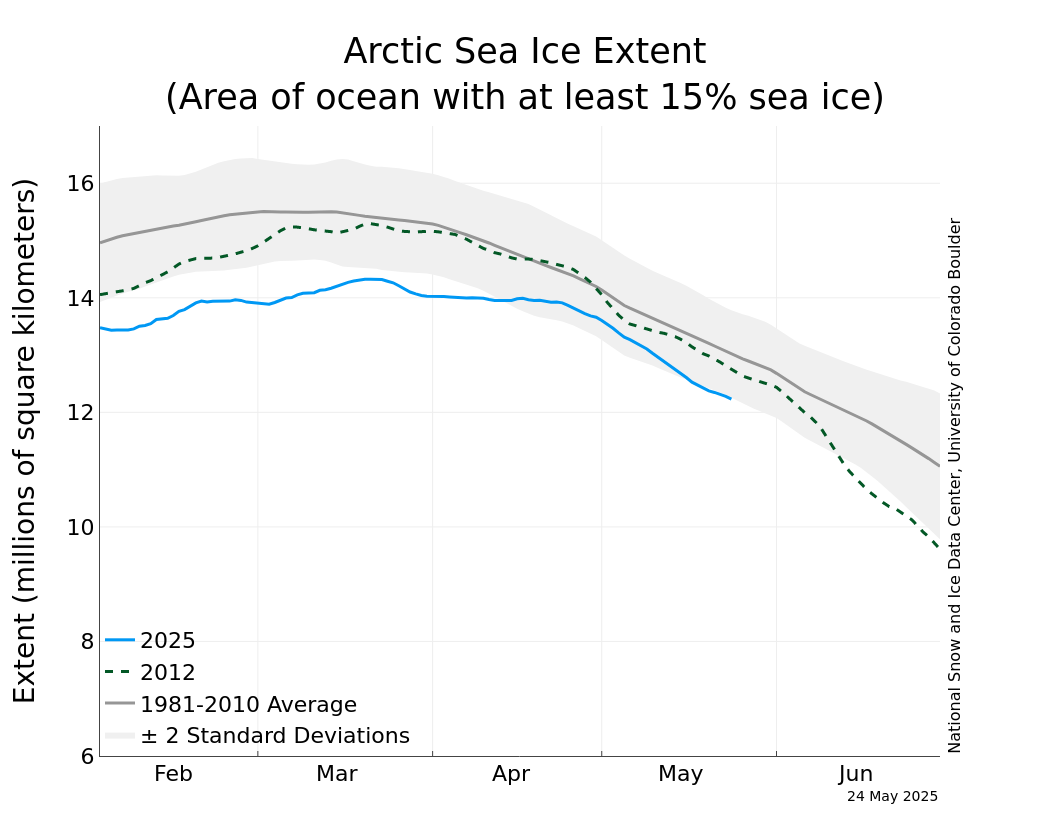
The current extent of ice coverage is no different than it was 20 years ago:


And, it appears to be tracking the 2006 decline, which makes sense as the wind
patterns are about the same, and wind  has far more to do with the extent of
ice coverage than temperatures of the kind we have today.


As I have written repeatedly, wait until the end of September and we will be
able to argue from actual data on ice loss.  These hysterics are getting in the
way of actual observations - what some of us like to think is the baseline for
science.


d.


On Sun, Jul 11, 2010 at 10:57 PM, Tom Wigley <[email protected]> wrote:

John,

You say ...


"we can expect permafrost to release large quantities of methane, from as early
as 2011 onwards, which will lead inexorably to runaway greenhouse warming and
abrupt climate change."

This is guesswork, not science.

I do not want to sign this letter.

Tom.

+++++++++++++


John Nissen wrote:


In view of the situation in the Arctic, I would be grateful for support for an
open letter to John Holdren, along the following lines.  Please let me know
whether you agree with this text and whether you'd be happy for me to add your
name at the bottom.

Cheers,

John

---

To John P Holdren, the Director of the Office of Science and Technology Policy

Dear Dr Holdren,

The Arctic sea ice acts as a giant mirror to reflect sunlight back into space
and cool the Earth. The sea ice has been retreating far faster than the IPCC
predicted only three years ago [1]. But, after the record retreat in September
2007, many scientists revised their predictions for the date of a seasonally
ice free Arctic Ocean from beyond the end of century to beyond 2030. Only a few
scientists predicted this event for the coming decade, and they were ridiculed.

In 2008 and 2009 there was only a slight recovery in end-summer sea ice extent,
and it appears that the minimum 2010 extent will be close to a new record [2].
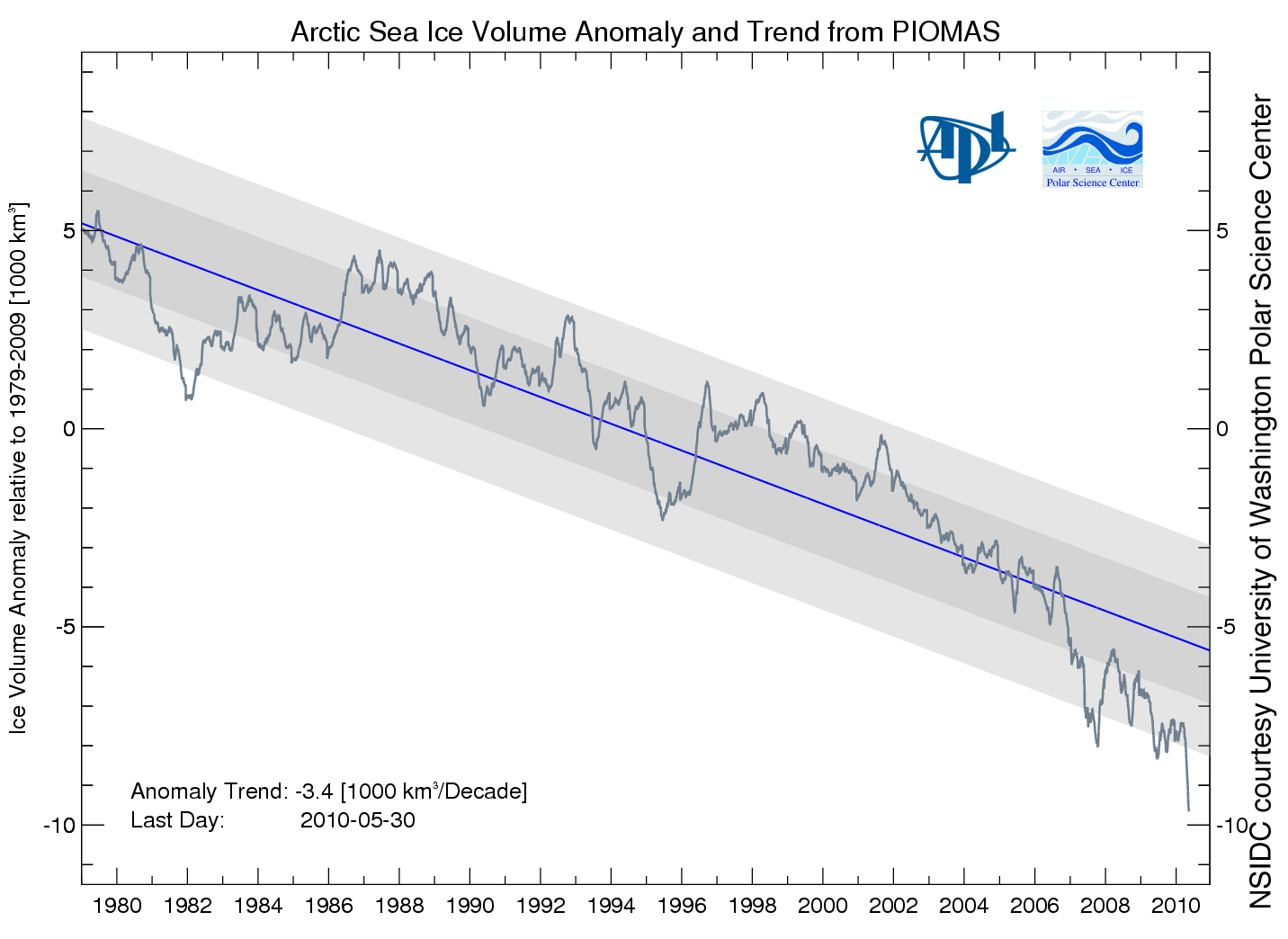
However the evidence from PIOMAS is that there has been a very sharp decline in
volume [3], which is very worrying.

The Arctic warming is now accelerating, and we can expect permafrost to release
large quantities of methane, from as early as 2011 onwards, which will lead
inexorably to runaway greenhouse warming and abrupt climate change.  All this
could become apparent if the sea ice retreats further than ever before this
summer.  We could be approaching a point of no return unless emergency action
is taken.

We suggest that the current situation should be treated as a warning for us
all. The world community must rethink its attitude to fighting global warming
by cutting greenhouse gas emissions sharply. However, even if emissions could
be cut to zero, the existing CO2 in the atmosphere would continue to warm the
planet for many decades.  Geoengineering now appears the only means to cool the
Arctic quickly enough.  A geoengineering project of the intensity of the
Manhattan Project is urgently needed to guard against a global catastrophe.

Yours sincerely,

John Nissen

[Other names to be added here.]

[1] Stroeve et al, May 2007
http://www.smithpa.demon.co.uk/GRL%20Arctic%20Ice.pdf

[2]
http://nsidc.org/data/seaice_index/images/daily_images/N_stddev_timeseries.png

[3] http://nsidc.org/images/arcticseaicenews/20100608_Figure5.png

--
You received this message because you are subscribed to the Google Groups
"geoengineering" group.
To post to this group, send email to [email protected].
To unsubscribe from this group, send email to
[email protected].
For more options, visit this group at
http://groups.google.com/group/geoengineering?hl=en.


--
You received this message because you are subscribed to the Google Groups
"geoengineering" group.
To post to this group, send email to [email protected].
To unsubscribe from this group, send email to
[email protected].
For more options, visit this group at
http://groups.google.com/group/geoengineering?hl=en.


--
David W. Schnare
Center for Environmental Stewardship


--
You received this message because you are subscribed to the Google Groups
"geoengineering" group.
To post to this group, send email to [email protected].
To unsubscribe from this group, send email to
[email protected].
For more options, visit this group at
http://groups.google.com/group/geoengineering?hl=en.

_________________________________________________________________
http://clk.atdmt.com/UKM/go/197222280/direct/01/
Do you have a story that started on Hotmail? Tell us now

--
You received this message because you are subscribed to the Google Groups
"geoengineering" group.
To post to this group, send email to [email protected].
To unsubscribe from this group, send email to
[email protected].
For more options, visit this group at
http://groups.google.com/group/geoengineering?hl=en.