|
Dear all, If this letter is successful in drawing the attention of John Holdren, then one would expect him to refer to the experts in various areas to check out the evidence and the arguments. The recipients of this email include top experts on Arctic sea ice, climate modelling and geoengineering. Other recipients have access to such experts. So no doubt Holdren will get back to several of you and your colleagues. We have had considerable discussion about the issues during the course of the past few years, particularly since the dramatic retreat of Arctic sea ice in September 2007. It was at that time that I became extremely concerned about the positive feedback building up in the But I have been most puzzled by the reaction from scientists. There has been a refusal to accept the danger of the situation and what can be done about it. Perhaps I have been fundamentally wrong about some critical piece of evidence or crucial part of the argument. I wish, I wish, that somebody could prove me wrong. But I refuse to be comforted by a cosy consensus that seems to propagate the idea that there’s nothing to worry about. For example it has been said, by a past government adviser at a House of Commons seminar, that we won’t need geoengineering for at least 30 years [2]. The Royal Society study on geoengineering didn’t address the Arctic sea ice problem at all [3]. So where could I be wrong? What arguments are there against the letter to Holdren?
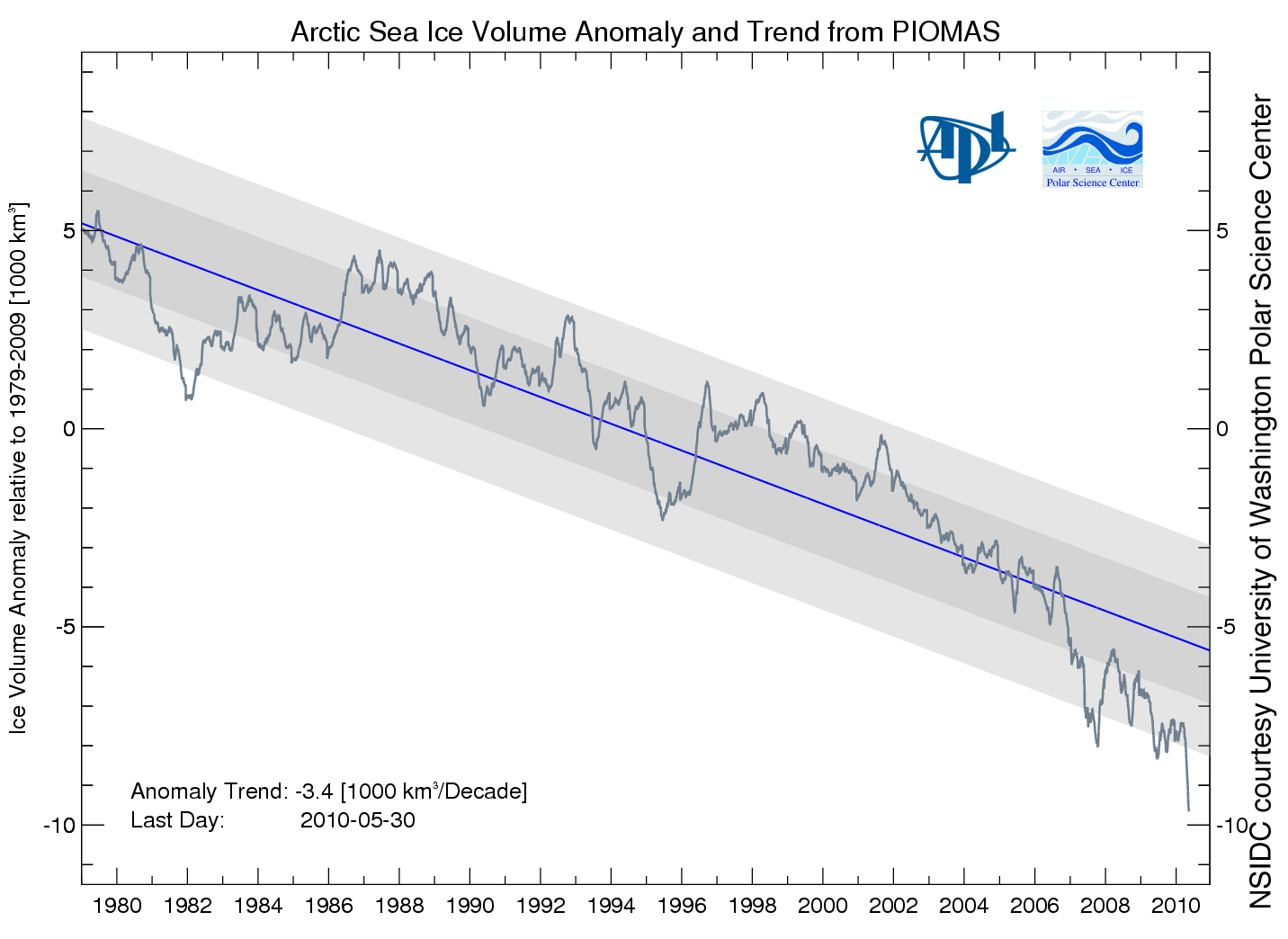
This is the argument that the sea ice could last till well beyond 2050. Certainly this is possible. But can we bank on it, given the current evidence of sea ice volume decline? Isn’t it wiser to take the precautionary approach and work on the assumption that the sea ice retreat will happen quicker than expected, rather than slower?
Tom Wigley was concerned with this passage: "... we can expect permafrost to release large quantities of methane, from as early as 2011 onwards, which will lead inexorably to runaway greenhouse warming and abrupt climate change." It is now generally recognised that there is a vast amount of carbon locked in frozen structures within the Arctic region, and, as temperatures rise, it will emerge in ever increasing quantities. I replied to Tom in detail on 12th July, as follows: If all carbon trapped in permafrost were released as CO2, it would triple CO2 in the atmosphere [1]. A significant proportion will be released as methane, which a much more potent greenhouse gas than CO2. Continued heating of the [1] Copenhagen Diagnosis, p21 http://www.ccrc.unsw.edu.au/Copenhagen/Copenhagen_Diagnosis_LOW.pdf [2] Nature Letters http://sciences.blogs.liberation.fr/files/arctique-ann%C3%A9es-2000-tures.pdf [3] Clathrate gun hypothesis http://en.wikipedia.org/wiki/Clathrate_gun_hypothesis
When you are fighting a fire, you don’t wait to see if the fire has taken hold. If a patient is ill, with a significant chance of cancer, you don’t delay treatment. The longer we wait to apply geoengineering, the less likely it is to succeed in cooling the
One has to balance the risks of geoengineering against the risks of not geoengineering. The latter are clearly so high that they almost certainly dwarf the possible adverse effects of geoengineering. We’ve had a long discussion about this on the geoengineering list. In particular, a few people have argued that SRM could adversely affect monsoons, but the modelling seems inconclusive as to the possible size of this effect and even its direction. Again the fire-fighting analogy comes in: if a building is on fire, your main concern is putting out the fire, not worrying about the damage to contents from fire extinguisher fluid. However you will try to use effective extinguishing techniques that avoid damage to the furniture. And you will certainly avoid techniques that could fan the flames.
Unfortunately geoengineering does seem to be the only option to cool the
Having a project “of the intensity of the --- Put it another way. Suppose this letter fails for lack of your support. Can you imagine looking back from the future and thinking: “Wasn’t it a shame we screwed up the planet, when we knew we could have saved it, if only we’d pressed for geoengineering earlier”? Best wishes, John [1] “Accelerated Global Warming”, see near bottom of this page: http://www.tomorrowscompany.com/events.aspx [2] Sir David King reported here: http://blogs.nature.com/climatefeedback/2010/01/testing_geoengineering_a_catch_1.html [3] Royal Society report ”Geoengineering the Climate”: http://royalsociety.org/Geoengineering-the-climate/ John Nissen wrote: -- You received this message because you are subscribed to the Google Groups "geoengineering" group. To post to this group, send email to [email protected]. To unsubscribe from this group, send email to [email protected]. For more options, visit this group at http://groups.google.com/group/geoengineering?hl=en. |
- Re: [geo] SEA ICE LOSS STUNS SCIENTISTS - open letter t... David Schnare
- [geo] Re: SEA ICE LOSS STUNS SCIENTISTS - open letter t... John Nissen
- Re: [geo] Re: SEA ICE LOSS STUNS SCIENTISTS - open... Yousif Masoud
- Re: [geo] Re: SEA ICE LOSS STUNS SCIENTISTS - ... Glyn Roberts
- Re: [geo] Re: SEA ICE LOSS STUNS SCIENTIST... Yousif Masoud
- Re: [geo] Re: SEA ICE LOSS STUNS SCIEN... Glyn Roberts
- [geo] Re: SEA ICE LOSS STUNS SCIENTISTS - open let... John Nissen
- Re: [geo] Re: SEA ICE LOSS STUNS SCIENTISTS - ... Glyn Roberts
- Re: [geo] Re: SEA ICE LOSS STUNS SCIENTIST... Stephen Salter
- Re: [geo] Re: SEA ICE LOSS STUNS SCIEN... Glyn Roberts
- [geo] Re: SEA ICE LOSS STUNS SCIE... Nathan Currier
- Re: [geo] Re: SEA ICE LOSS STUNS ... David Schnare
- Re: [geo] Re: SEA ICE LOSS STUNS ... Glyn Roberts