Adrian et al.,

Thank you for posting your work on this subject and doing so in such short
time. However, the paper's conclusion clearly states that:
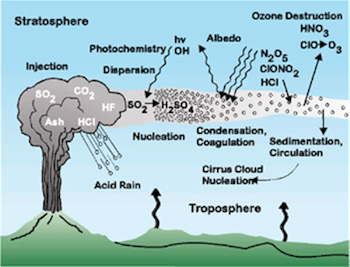
*1)* The work is limited to the "[...]* southern hemisphere*.". Aggressive *Arctic* methane release, due to marine and atmospheric warming, seems to present the most critical concern relative to the long list of polar warming issues. And, methane does seem to effect the "*frequency and the optical thickness of PSCs to increase substantially*" per (Sloan 1998 <http://onlinelibrary.wiley.com/doi/10.1029/98GL02492/pdf>). In simple words, we do need qualitative *and* quantitative investigations of both polar regions, specifically on the PCS/H2SO4 connection (and other sulfur compounds), as the dynamics of each polar region offers distinctly different biogeochemical scenarios. *2)* The conclusion in your paper also states that "*PSCs always increased the short-wave heating *[...]". On that point, it is easy to beg the question of; *If PSCs increase short-wave heating, should not the increase of the number and thickness of PSCs, which can be induced with additional H2SO4 and other sulfur compounds, be avoided in any geoengineering scheme?* Also, your paper seems to suggest that PSCs play a meaningful role in tropospheric cloud formation and I find in Wang et al. 2008 <http://www.atmos.uwyo.edu/~deshler/articles/Wang&_08_GRL.pdf> the following: "[...]* These new findings suggest that Antarctic PSC formation is closely connected to tropospheric meteorology and thus governed by synoptic scale dynamics, local topography, and large-scale circulation. More dedicated studies are still needed to better understand Antarctic PSC formation*." The latitudinal variances which your paper points out, in respect to ground temperature, tropospheric cloud cover and stratospheric temperature, as well as the issues Wang et al. bring to the table, indicates that predictive modeling of the full spectrum of the biogeochemical response(s) (*within the polar regions and specifically in regards to PSCs*) to stratospheric aerosol injection (SAI) of H2SO4 and other sulfur compounds may simply be beyond our current modeling abilities. To conclude, any significant intentional anthropogenic increase in polar warming, from any biogeochemical avenue, such as SAI, should be viewed as being too unpredictable to deploy....at this time. In the most simplistic terms, to our best collective knowledge, SAI can just as easily warm the polar regions as not. Tough gamble! Best, Michael *Michael Hayes* *"How inadequate it is to term this planet "Earth", as it is evident that it should be called "Ocean". Arthur C. Clarke.* *US Plan: Chemosynthetic Management of the Water/Energy/Nutrient Nexus (WENN) <http://climatecolab.org/web/guest/plans/-/plans/contestId/1302001/planId/1318702>* On Wed, Sep 9, 2015 at 4:31 PM, Adrian Tuck < [email protected]> wrote: > I suggest reading the attached paper before hanging too much on the > heating effect of PSCs at the poles. > > Adrian Tuck > > 'ATMOSPHERIC TURBULENCE: A Molecular Dynamics Perspective'. > Oxford University Press, 2008. ISBN 978-0-19-923653-4. > http://www.oup.com/uk/catalogue/?ci=9780199236534 > > *************************************************** > > > > > Adrian Tuck > [email protected] > > > > On 9 Sep 2015, at 22:19, Michael Hayes <[email protected]> wrote: > > Hi Folks, > > Regretfully, the authors have relegated the use of the word Geoengineering > to simply include SRM concepts. However, to their collective credit, they > do explain that they purposefully picked the easiest concept to model. > > With that said, their efforts at viewing the challenge(s) from a > multi-latitudinal perspective is a refreshing break from the belief that > attaining a reduction in the 'Average Global Temperature' is some sort of > gold standard in Geoengineering. > > Creating an* equitable climate > <http://www.seas.harvard.edu/climate/eli/research/equable/climate.html>* > (a.k.a. > an averaged out climate) must be avoided at all costs > <https://www.google.com/webhp?sourceid=chrome-instant&ion=1&espv=2&ie=UTF-8#q=equable%20climate%20problem> > and stratospheric aerosol injection (SAI), using sulfuric acid (H2SO4) or > other sulfur compounds, can lead to the formation of Polar Stratospheric > Clouds (PSC) and thus warming of the polar regions (a > <http://www.ncbi.nlm.nih.gov/pubmed/17745351>)(b > <http://www.atmos-chem-phys.net/3/987/2003/acp-3-987-2003.pdf>)(c > <https://www.nasa.gov/centers/langley/news/factsheets/Aerosols.html>)(d > <http://geotest.tamu.edu/userfiles/231/p19.pdf>)(e > <http://onlinelibrary.wiley.com/doi/10.1029/91JD02740/abstract>)(f > <http://www.seas.harvard.edu/environmental-chemistry/publications/97GL03408.pdf> > )(g <http://wind.sjsu.edu/papers/PhysToday.pdf>)(etc.).....while cooling > of the lower latitudes a.k.a. *an equitable climate*. > > The hazards of warming the polar regions through increasing polar > stratospheric clouds is well covered by *LC Sloan et al.- 1998 "*Polar > stratospheric clouds: A high latitude warming mechanism in an ancient > greenhouse world > <ftp://ftp.tudelft.nl/pub/TUDelft/irctr-rse/Mieke/Papers/SloanPollard98-PSCforHighLatPTMwarmArctic.pdf> > " > > *Abstract:* > > *The presence of water vapor clouds in the stratosphere produces warming > in excess of tropospheric greenhouse warming, via radiative warming in the > lower stratosphere. The stratospheric clouds form only in regions of very > low temperature and so the warming produced by the clouds is concentrated > in polar winter regions. Results from a paleoclimate modeling study that > includes idealized, prescribed polar stratospheric clouds (PSCs) show that > the clouds cause up to 20°C of warming at high latitude surfaces of the > winter hemisphere, with greatest impact in oceanic regions where sea ice is > reduced. The modeled temperature response suggests that PSCs may have been > a significant climate forcing factor for past time intervals associated > with high concentrations of atmospheric methane. The clouds and associated > warming may help to explain long-standing discrepancies between > model-produced paleotemperatures and geologic proxy temperature > interpretations at high latitudes, a persistent problem in studies of > ancient greenhouse climates."*.(My highlight) > > <http://eeclat.ipsl.jussieu.fr/wp-content/uploads/2011/05/t4_PSC.png> > > <https://pubweb.bnl.gov/~xujun/99post/strato_freezing.gif> > > > <http://www.thetruthdenied.com/news/wp-content/uploads/2012/12/stratospheric-chemistry.jpg> > > <http://www.nature.com/ngeo/journal/v3/n12/images/ngeo989-f2.jpg> > > > (*Side note:* To keep things simple, I'm leaving the ozone destruction > potential of the PSC/H2SO4 combination off the table for now and simply ask > the reader to focus upon the *thermal* issues presented by SAI.) > > Hopefully, the *Kravitz et al*. work will give us a detailed way to > predict *simply the thermal hazards of SAI.* With equal hope, once the > hazards of SAI induced polar warming (as well as the hazard to ozone) is > well repeated in both peer reviewed papers and popular press, the highly > productive and appropriate *'Other'* form of Geoengineering, which I > believe is called Carbon Dioxide Removal (CDR), can gain footing in the > debate. > > Regrettably, expanding the Kravitz model to cover more complex concepts, > other than the simplistic SAI concept, will not be easy. The authors > clearly point out in their '*Discussion and Conclusion'* section that* > "Understanding the boundaries of what is achievable, as well as what robust > conclusions can be obtained about any particular strategy, are open > questions that require further research*.". > > In brief, the work of *Kravits et al*. needs to be expanded upon as it > would be interesting to see this same detailed analytical tool applied to > the *other* Geoengineering concepts such as biochar, olivine, advanced > weathering of limestone and vast scale marine biomass production. Deployed > individually and or in concert, such efforts can clearly produce a* "[...] > deliberate large-scale intervention in the Earth’s natural systems to > counteract climate change.**"* ( > http://www.geoengineering.ox.ac.uk/what-is-geoengineering/what-is-geoengineering/ > ). > > Best, > > Michael > > > > On Tuesday, September 8, 2015 at 4:20:57 PM UTC-7, andrewjlockley wrote: >> >> http://www.earth-syst-dynam-discuss.net/6/1635/2015/esdd-6-1635-2015.html >> >> Geoengineering as a design problem >> >> 08 Sep 2015 >> Abstract. Understanding the climate impacts of solar geoengineering is >> essential for evaluating its benefits and risks. Most previous simulations >> have prescribed a particular strategy and evaluated its modeled effects. >> Here we turn this approach around by first choosing example climate >> objectives and then designing a strategy to meet those objectives in >> climate models. >> >> There are four essential criteria for designing a strategy: (i) an >> explicit specification of the objectives, (ii) defining what climate >> forcing agents to modify so the objectives are met, (iii) a method for >> managing uncertainties, and (iv) independent verification of the strategy >> in an evaluation model. >> >> We demonstrate this design perspective through two multi-objective >> examples. First, changes in Arctic temperature and the position of tropical >> precipitation due to CO2 increases are offset by adjusting high latitude >> insolation in each hemisphere independently. Second, three different >> latitude-dependent patterns of insolation are modified to offset >> CO2-induced changes in global mean temperature, interhemispheric >> temperature asymmetry, and the equator-to-pole temperature gradient. In >> both examples, the "design" and "evaluation" models are state-of-the-art >> fully coupled atmosphere–ocean general circulation models. >> >> Citation: Kravitz, B., MacMartin, D. G., Wang, H., and Rasch, P. J.: >> Geoengineering as a design problem, Earth Syst. Dynam. Discuss., 6, >> 1635-1710, doi:10.5194/esdd-6-1635-2015, 2015. >> > > -- > You received this message because you are subscribed to the Google Groups > "geoengineering" group. > To unsubscribe from this group and stop receiving emails from it, send an > email to [email protected]. > To post to this group, send email to [email protected]. > Visit this group at http://groups.google.com/group/geoengineering. > For more options, visit https://groups.google.com/d/optout. > > > > -- You received this message because you are subscribed to the Google Groups "geoengineering" group. To unsubscribe from this group and stop receiving emails from it, send an email to [email protected]. To post to this group, send email to [email protected]. Visit this group at http://groups.google.com/group/geoengineering. For more options, visit https://groups.google.com/d/optout.