The Sun doesn't change much in the visible or infrared spectrum - it
does seem to change considerably more in the UV.  How does that
influence climate? I suggest you look at the Lockwood et al (2010)
reference. Regardless - I have linked to a number of impeccable
sources.  Admittedly - I have linked to Roy Spencer for CERES and
recent tropospheric temperature - neither of which is at all
questionable.
The energy dynamics I have been looking at in an article in
development.  It is energy out that varies most.  For instance - the
planet has warmed in the past decade as seen in data from NASA's
Clouds and Earth's Radiant Energy System (CERES) instrument on the
Terra satellite - but this was most noticeably in the shortwave.  I am
far from being a skeptic - I in fact think that both sides are full of
shit. Both sides need to step up to a higher level.  So instead of
mindless throwaway insults - constructive responses would be much more
welcome.

A new 1st order differential global climate change equation that
provides objective resolution of that vexed question – has the planet
warmed or cooled in the past decade?

Planetary warming or cooling in any period occurs because there is a
difference, an energy imbalance, between incoming and outgoing
energy.  The energy imbalance causes changes in the amount of energy
stored, mostly as heat in the atmosphere and oceans, in Earth’s
climate system.  If more energy enters the atmosphere from the Sun
than is reradiated back out into space – the planet warms.
Conversely, if less energy enters the atmosphere than leaves – the
planet cools.  Thus Earth’s energy budget can be completely defined in
three terms.  Energy in is equal to energy out plus the change in
energy stored as planetary heat.

This can be expressed as:

EIN/S = EOUT/S + d(GES)/dt.

By the law of conservation of energy - the average unit energy in at
the top of atmosphere (TOA) in a period is equal to the average unit
energy out plus the rate of change in global energy storage (GES).
The most commonly used unit of energy is Joules.  Energy in and energy
out is most commonly reported in Watts (or Watts/m2) – and is more
properly understood to be a radiative flux or a flow of energy.  A
flux of one Watt for one second is one Joule – which is known as unit
energy.  Most of the stored energy is stored as heat in the oceans
which is measured in Joules (or Joules/ m2).

The equation is in a 1st order differential form – but I can give an
analogy that might make more sense to the non mathematical.  The
equation has an equivalent in the equation of water storage.  In that
case – the flow in is equal to the flow out plus the change in the
volume of water stored in any period.  Because there is a differential
(the change in the volume of water stored) it can be expressed in a
differential form that is simply a mathematical procedure that allows
useful calculations to be made – such as the rate at which the volume
of water stored is increasing or decreasing.

Energy in as visible (shortwave) and infrared (longwave) radiation
varies marginally over the 11 year Schwabe solar cycle, perhaps a
little more over the longer term due to solar variation and, due to
orbital changes, over an Ice Age.  On a decadal timescale – energy in
(at TOA) is more or less constant.

Most change in the global energy balance occurs in energy out.  Energy
out is measured by satellite in the visible and infrared spectrum.
The absolute value of radiative fluxes are not known with any
precision but the relative change is known with far greater accuracy
and it is just these changes that we are interested in.  This data is
commonly reported as radiative flux anomalies with a nominal zero
point.

Neglecting small changes in energy in - the sign of the rate of change
(negative or positive values of d(GES)/dt – cooling or warming
respectively) in global energy storage can be determined from the
trend in energy out.

For example, increasing greenhouse gases in a period absorb more
outgoing longwave radiation and energy out decreases thus creating an
energy imbalance which results in an increase in energy stored (mostly
as heat) in the climate system.  Reflected shortwave radiative flux is
influenced by land clearing, ice, volcanos, dust and, importantly for
short term changes, changes in cloud cover.   Again, these changes
cause an energy imbalance that result in changes to the heat content
of the atmosphere and oceans.

It may be easier to see how this works by applying it to radiative
flux data.  Graphed data from NASA’s Clouds and Earths Radiant Energy
System (CERES) instrument on the Terra satellite are shown below in
Figures 1, 2 and 3.  The graphs are sourced with thanks from the
website of Dr. Roy Spencer.

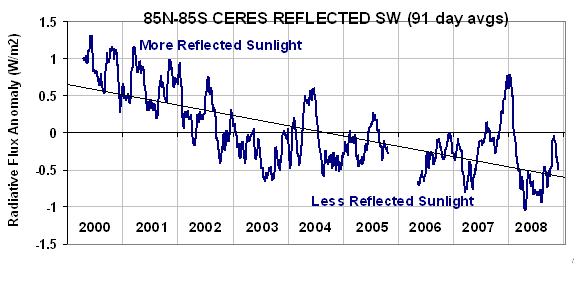
The trend is to quite substantially less reflected shortwave radiative
flux over the period 2000 to 2008.  The trend was to less energy
leaving the climate system and this must result in more energy being
stored in the atmosphere and oceans.  Thus the planet warmed in the
period as a result of less cloud reflecting less of the Suns’ energy
back into space.

http://www.drroyspencer.com/wp-content/uploads/Terra-CERES-ES4-Ed2-global-SW.gif

    Figure 1: CERES Reflected Shortwave Anomaly (Source: Dr Roy
Spencer)

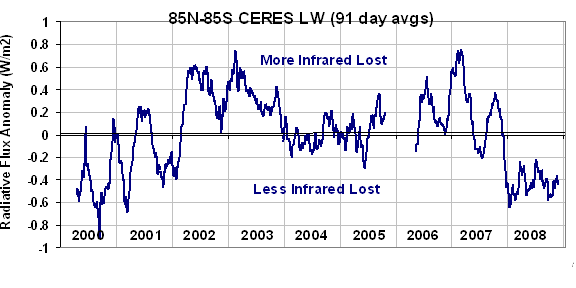
The infrared radiative flux fluctuated in ways that were influenced by
the El Niño Southern Oscillation (as broadly indicated) but without
notably increasing or decreasing in the period.  So there was no
warming or cooling as a result of longwave out changes in the
period.

http://www.drroyspencer.com/wp-content/uploads/Terra-CERES-ES4-Ed2-global-LW.gif

        Figure 2: CERES Longwave Anomaly (Source: Dr Roy Spencer)

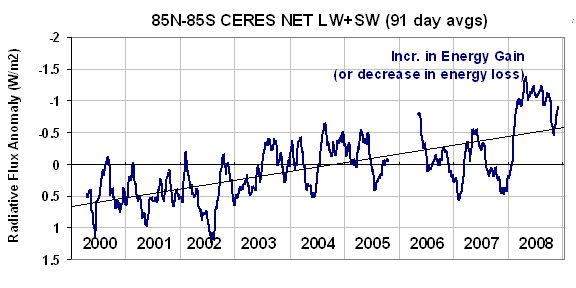
The trend of net radiative flux (shortwave plus longwave) is, by
convention, shown as energy gained or lost by the planet.  A trend
upward is energy gained and, conversely, a trend down shows energy
lost.  So the upward trend in net radiative flux anomalies in Figure 3
shows that less energy was leaving the Earth’s climate system at the
end of the record than at the beginning.

http://www.drroyspencer.com/wp-content/uploads/Terra-CERES-ES4-Ed2-global-SWLW.gif

        Figure 3: CERES Net (SW + LW) Anomaly (Source: Dr Roy Spencer)

The net trend in radiative flux anomalies is to an increasing
planetary energy gain thus the planet has warmed over the last decade
- although not notably as a result of greenhouse gases.  Net (oceans
and atmosphere) energy storage must increase by an equal (relatively)
and opposite amount to the decrease in energy out – remembering that
energy in from the Sun is relatively constant.  As the heat is not
found in the atmosphere, it must be found in the oceans.

ARGO is a program involving 3000 odd probes measuring temperature and
salinity in the oceans since 2003.  Most analyses of ARGO results
integrate the data to 700m and show no change to slight cooling.  The
remaining analysis integrates the data to 2000m and shows warming of
the oceans in the period.  The results of this analysis are shown
below in Figure 4.


        Figure 4:  Ocean Heat Content (after von Schuckmann et al 2009)

Given that the planet did warm in the period - although not notably as
a result of greenhouse gases - the global climate change equation
provides an objective confirmation of at least the trend in the von
Schuckmann result.  Inter alia, this suggests that a radical rethink
of heat distribution mechanisms in the oceans is required.


Reference

von Schuckmann, K., F. Gaillard, and P.-Y. Le Traon (2009), Global
hydrographic variability patterns during 2003–2008, J. Geophys. Res.,
114, C09007, doi:10.1029/2008JC005237


On Jan 17, 5:05 am, Per Edman <[email protected]> wrote:
> Robert,
>
> And how and when do you believe the sun has changed?
>
> Data or GTFO.
>
> Thanks for the demonstration.
>
> On Sun, Jan 16, 2011 at 2:10 AM, Robert I Ellison <
>
>
>
>
>
>
>
>
>
> [email protected]> wrote:
> > Greetings from the flood zone.  I am fine - thank you - but
> > traumatised by the deaths and angered and saddened by idiots who seek
> > to make a political point out of tragedy.  Both sides of this argument
> > are full of shit - intellectual featherweights who are instant
> > internet experts on everything and are utterly convinced of their own
> > logical infallibility.  Both sides angling to blame the deaths and
> > destruction on the other.  I wish they would pull their f....... heads
> > in.
>
> > Rant over - I thought I would see if I could put a ruler under 20
> > years of work.  Neither the floods or the current La Nina are notably
> > unusual over the longer term - it is part of a Pacific decadal pattern
> > that is likely to lead to decades more intense and frequent La Nina.
>
> > see -http://www.earthandocean.robertellison.com.au/index.html
>
> > As an Australian hydrologist, I was introduced to the concept of
> > drought dominated and flood dominated regimes (DDR and FDR) in the
> > late 1980’s. These are 20 to 40 year periods dominated by droughts
> > followed by  a 20 to 40 year period dominated by floods.  The original
> > result was replicated dozens of times across Australia in the
> > following decade.  In 1997 the Pacific Decadal Oscillation was
> > described defining a link between sea surface temperatures and
> > fisheries biology.  The periods of the PDO modes were exactly the same
> > as the periods of DDR and FDR.  An apparent but astonishingly odd link
> > between North American fisheries and Australian rainfall.  Over the
> > following decade it emerged that the PDO is part of a pattern of
> > decadal and longer changes in sea surface temperature in the Pacific
> > Basin with teleconnections to Asian, Australian, African and American
> > rainfall - and seemingly to the formation of cyclones in the
> > Atlantic.
>
> > In 2003 I made the mistake of looking closely at the Climatic Research
> > Unit surface temperature record - and saw that the inflection points
> > are at exactly the same periods as the transitions between DDR and FDR
> > and between PDO modes.  Still looking for the causes of DDR and FDR I
> > read nearly everything that emerged on the PDO and the El Niño
> > Southern Oscillation (ENSO).  However, without much of an idea
> > anywhere of causative mechanisms, there was not much more than an
> > intriguing similarity in the timing of changes.
>
> > More recent work has identified the Pacific Ocean climate system as
> > chaotic.  As I eventually realised, chaos is not just a word but a
> > property of complex and dynamic systems in chaos theory.  It explains
> > abruptness in the changes observed in ocean states and therefore in
> > global temperature and in the transitions of Australian rainfall
> > regimes.  It changes the way in which climate risk is viewed.  Where
> > before, climate evolved slowly with cycles of minor warming and
> > cooling in a system that is far from driven solely by greenhouse gas
> > forcing.  After chaos theory, climate change is abrupt and predictable
> > only as a probability density function.  There is objectively a small
> > risk of catastrophic climate change (warming or cooling) that could
> > happen within months as a result of anthropogenic greenhouse gas
> > emissions.
>
> > Currently, revisions to existing satellite records, new data sources
> > for radiative flux and ocean heat content, new theoretical work and
> > computer modeling and new compilations of surface cloud observations
> > are providing new ways of confirming a Pacific Ocean influence on
> > global climate.  The picture that emerges is of the Pacific Ocean as
> > far and away the major driver of global climate.  It does this
> > primarily by changing cloud formation dynamics.  More cloud forms
> > above cold water - and the biggest change to sea surface temperature
> > on interannual, decadal and millennial scales occurs as a result of
> > upwelling of  cold and nutrient rich (and also acidic) sub-surface
> > water in the eastern Pacific.  These changes in cloud cover are seen
> > in surface observations of cloud over the Pacific, in satellite
> > measurements of reflected shortwave and outgoing long wave radiation
> > and in modeling studies.  Most recent climate change has been as a
> > result of changing cloud cover.
>
> > And the cause of these changes? A small change in the initial
> > conditions of a complex and dynamic system that most probably involves
> > top down forcing by solar UV heating of ozone in the upper
> > atmosphere.  As Judith Lean says - ‘ongoing studies are beginning to
> > decipher the empirical Sun-climate connections as a combination of
> > responses to direct solar heating of the surface and lower atmosphere,
> > and indirect heating via solar UV irradiance impacts on the ozone
> > layer and middle atmospheric, with subsequent communication to the
> > surface and climate. The associated physical pathways appear to
> > involve the modulation of existing dynamical and circulation
> > atmosphere-ocean couplings, including the ENSO and the Quasi-Biennial
> > Oscillation.'
>
> > Cheers
> > Robert
>
> > --
> > You received this message because you are subscribed to the Google Groups
> > Global Change ("globalchange") newsgroup. Global Change is a public,
> > moderated venue for discussion of science, technology, economics and policy
> > dimensions of global environmental change.
>
> > Posts will be admitted to the list if and only if any moderator finds the
> > submission to be constructive and/or interesting, on topic, and not
> > gratuitously rude.
>
> > To post to this group, send email to [email protected]
>
> > To unsubscribe from this group, send email to
> > [email protected]
>
> > For more options, visit this group at
> >http://groups.google.com/group/globalchange
>
> --
>  / Per

--
You received this message because you are subscribed to the Google Groups
Global Change ("globalchange") newsgroup. Global Change is a public, moderated
venue for discussion of science, technology, economics and policy dimensions of
global environmental change.

Posts will be admitted to the list if and only if any moderator finds the
submission to be constructive and/or interesting, on topic, and not
gratuitously rude.

To post to this group, send email to [email protected]

To unsubscribe from this group, send email to
[email protected]

For more options, visit this group at
http://groups.google.com/group/globalchange