Thanks for the help, but still no luck.

I ran as you suggested:
GRASS 6.4> g.region res=1 res3=1 t=75 b=0 tbres=1
GRASS 6.4> r.mapcalc "one = 1"
GRASS 6.4> r.mapcalc "two = 2"
GRASS 6.4> r.to.rast3elev -l input=one,two elevation=contours,bottom_2
output=volumemap
Creating 3D raster map
 100%
 100%
GRASS 6.4> r3.out.vtk input=volumemap output=/tmp/volumemap.vtk
 100%
GRASS 6.4>

Note, I used just the 1-foot grid (it is a US State Plane coordinate
system) which perhaps is too fine, but I have a relatively small area
(800 x 900 ft) and only need to evaluate 75 feet in thickness and it
still works (just slow).  It gave me a 3D raster:

GRASS 6.4> r3.univar input=volumemap
total null and non-null cells: 54000000
total null cells: 40596983

Of the non-null cells:
----------------------
n: 13403017
minimum: 1
maximum: 2
range: 1
mean: 1.51073
mean of absolute values: 1.51073
standard deviation: 0.499885
variance: 0.249885
variation coefficient: 33.089 %
sum: 20248304
 100%
----------------------

The overall volume (which would be the number of non-null cells, in
cubic feet) looks a bit high, but may be correct.

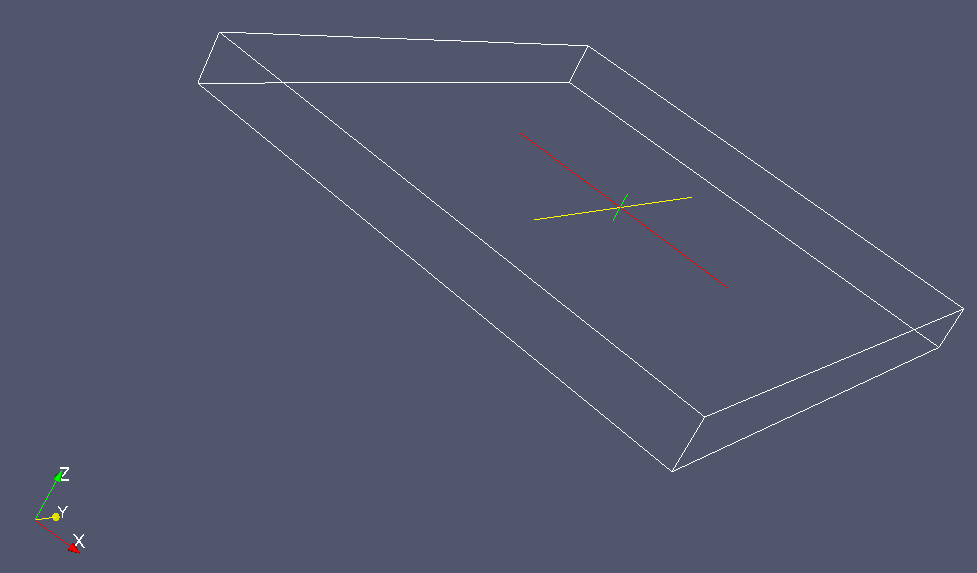
However, nothing shows up in paraview or nviz.

Screenshot: http://public.sundquist.imapmail.org/paraview-1.png

It's a pretty by vtk file (~1 GB), but that shouldn't matter.

In paraview, the "Filter" menu is greyed out.  I went to tools>create
custom filter but there were no "objects" or "properties" to select.  I
am not too familiar with paraview.

Thanks again for the help.

J.S.


On Mon, 21 Feb 2011 15:57:59 +0100, "Soeren Gebbert"
<[email protected]> said:
> Hi,
> make sure your 3d region is set correctly, like:
>
> g.region res=200 res3=200 t=2000 b=0 tbres=20
>
> This will set a region with a 2d/3d resolution of 200m, the top at
> 2000m, the bottom at 0m and a top-bottom-resolution of 20m.
>
> In this case you will have 100 layer.
>
> Now fill the voxel cells below your surface and bottom with different
> values, first we
> create two helper maps which represent the values below the elevation
> maps.
>
> r.mapcalc "one = 1"
> r.mapcalc "two = 2"
>
> Now start the module and set the elevation maps from top to bottom,
> the flag -l will fill the cells below the elevation maps with the
> assigned values.
>
> r.to.rast3elev -l input=one,two elevation=surface,bottom output=volumemap
>
> Your region of interest in the output volume map should have value 1.
>
> You can use paraview to visualize the voxel map. Use r3.out.vtk to
> export the voxel map.
> Use the threshold filter in paraview to extract all cells with value 1.
>
> Example:
> r3.out.vtk input=volumemap output=/tmp/volumemap.vtk
> paraview --data=/tmp/volumemap.vtk
>
> Here are two (a bit old) presentations about 3d data handling with
> grass and paraview:
> http://www-pool.math.tu-berlin.de/~soeren/grass/files/LausanneConferencePresent_soeren_handouts.pdf
> http://www-pool.math.tu-berlin.de/~soeren/grass/files/3DWorkshop_soeren_handouts.pdf
>
> Best regards
> Soeren
>
> 2011/2/21  <[email protected]>:
> > I admit I am not a pro (but I have devoured both the 2nd and 3rd
> > editions of "the book", and have been using GRASS on and of for about 5
> > years now), but I am lost on this command.
> >
> > Here is part of what I am trying to do:  Let's try showing just a 3D
> > raster of the space between the ground surface and the bottom (I have a
> > few otehr more intersting applications, too, but this is the simplest).
> >
> > I put GTiff exports of these files here:
> > http://public.sundquist.imapmail.org/bottom_2.tif and
> > http://public.sundquist.imapmail.org/ground_surface.tif
> >
> > I want to generate a 3D raster showing the space between these two
> > surfaces.
> >
> > I tried running this command:
> >
> >  r.to.rast3elev input=ground_surface,AREA_DSM
> >  elevation=ground_surface,AREA_DSM output=3d1
> >
> > and got no errors but got essentially nothing:
> >
> > r3.univar input=3d1@PERMANENT
> > total null and non-null cells: 546
> > total null cells: 469
> > Of the non-null cells:
> > ----------------------
> > n: 77
> > minimum: 1
> > maximum: 1
> > range: 0
> > mean: 1
> > mean of absolute values: 1
> > standard deviation: 0
> > variance: 0
> > variation coefficient: 0 %
> > sum: 77
> >
> > I added to input files because when I tried just one, it said the number
> > of input and elevation files must match.  Note, I do not care about the
> > actual values in the 3D raster, just whether they are null or not.
> >
> > Sorry if this is a basic question, but if I can get this generated, it
> > would be very helpful for explaining something to a client.
> >
> > Thanks.
> >
> > J.S.
> >
> > On Mon, 21 Feb 2011 06:06:37 +0100, "Soeren Gebbert"
> > <[email protected]> said:
> >> Hi,
> >> You can try r.to.rast3elev which will do exactly what you need.
> >>
> >> Best
> >> Soeren
> >>
> >> Am 21.02.2011 02:38 schrieb <[email protected]>:
> >> > Hamish:
> >> >
> >> > I looked at that before and the only thing I could think of was to use
> >> > r.to.rast3 by first generating a whole series of horizontal surfaces
> >> > with r.mapcalc, one for each foot of elevation, with each cell getting a
> >> > value of "1" if the "elevation" for that particular new surface lied
> >> > between the corresponding cell values of the top and bottom surfaces.
> >> > Then taking those whole bunch of surfaces and feeding them to
> >> > r.to.rast3. But that seemed pretty inelegant. But it may be only way
> >> > to do it. I would only be about 25 rasters to generate and then merge.
> >> >
> >> > J.S.
> >> >
> >> > On Sun, 20 Feb 2011 17:14:39 -0800 (PST), "Hamish" <[email protected]>
> >> > said:
> >> >> J.S. wrote:
> >> >> > I want to generate a 3D raster (and display in nviz) that is
> >> >> > the volume between two 2D elevation rasters.  The application
> >> >> > is to visualize the subsuraface area that will be subject to
> >> >> > environmental remediation.
> >> >>
> >> >> maybe this summary helps,
> >> >> http://grass.osgeo.org/wiki/Help_with_3D
> >> >>
> >> >>
> >> >> Hamish
> >> >>
> >> >>
> >> >>
> >> >>
> >> > _______________________________________________
> >> > grass-user mailing list
> >> > [email protected]
> >> > http://lists.osgeo.org/mailman/listinfo/grass-user
> > _______________________________________________
> > grass-user mailing list
> > [email protected]
> > http://lists.osgeo.org/mailman/listinfo/grass-user
> >
> _______________________________________________
> grass-user mailing list
> [email protected]
> http://lists.osgeo.org/mailman/listinfo/grass-user
_______________________________________________
grass-user mailing list
[email protected]
http://lists.osgeo.org/mailman/listinfo/grass-user