Elinor Salter wrote:

> I want to make a Tudor outfit for a 12th Night event in January, which
> will be set in 1530's England.
Ah! A woman after my own heart!

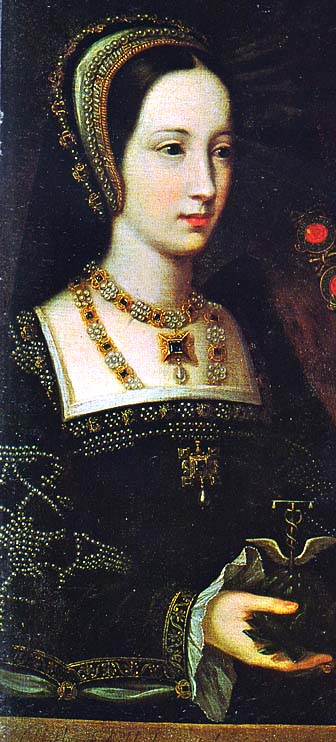
> Mary Tudor by unknown (wedding portrait to Charles Brandon), 1515 -
> http://www.uvm.edu/~hag/sca/tudor/marytudor.jpg
> - What I want to take from this is the french hood,

E House supplied a wonderful link: http://www.photo.rmn.fr/
(thank-you--hadn't seen this one before)
Search on Jean Clouet and you'll find tons of drawings of French hoods.
They seem to wear them further back on the head than the English do, but
that might just be the way these two artists, Clouet and Holbein, chose
to deal with the tricky problems related to perspective.
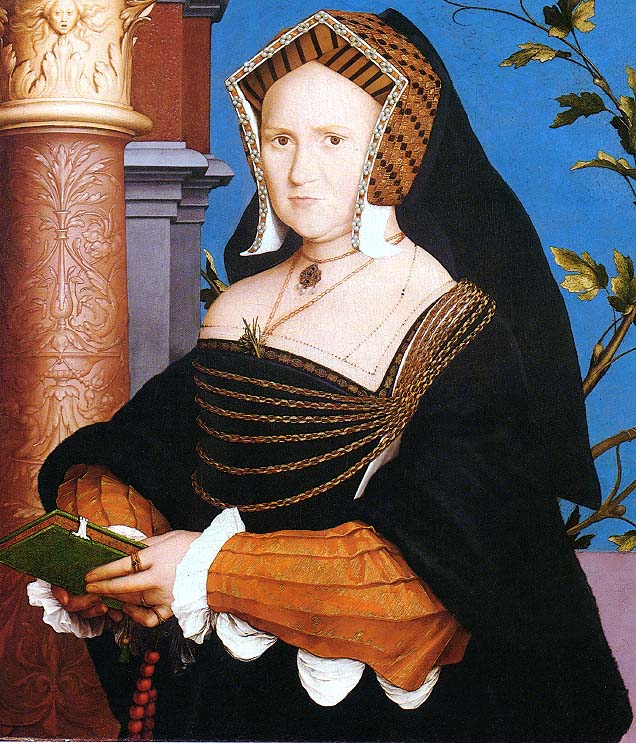
> Lady Guildford by Holbein, 1527 -
> http://www.uvm.edu/~hag/sca/tudor/guildford.jpg
> - I like the fact that she's not a wisp of a woman.  I like the look of
> the foldback sleeves matching the rest of the gown, even though it is
> plain, and I might end up using the idea of using a brocade trim around
> the dress in case my time or budget won't accommodate the jewels.
I'm not sure if what we are seeing is embroidery or metal ornaments.
Personally (strictly personal) I would go without any trim at all if it
was a choice between that and brocade trim. The woven trims always seem
later period to me.
 I
> also like the pleated false sleeves in that iridescent fabric
> (especially in that it isn't tapestry).  Is that cloth of gold?  It
> doesn't appear that her gown has a split skirt.
I'd say plain silk taffeta. Holbein does tend to go overboard sometimes
on sheen--one of his tricks for emphasizing virtu or status, perhaps
(take for example the famous portrait of More with his impossible
velvet!). For pleating ideas, check out the other portrait of Jane
Seymour done by one of Holbein's studio painters. Her false sleeves are
plain white silk, and her jewels are much simpler. There's also the
full-length/back view portrait that looks awfully like Lady Guildford.
(BTW she, or at least husband Henry, had an interesting history. I
believe she was 27 when the portrait was painted.)
>
> Undergarments:
> My first dilemma is whether or not I need a set of bodies and a
> farthingale.
A fairly stiff petticoat, or maybe two, should be plenty. The "More
girls" don't seem to have farthingales, nor does the "back view" sketch.
Some kind of stiffening built into the undergown, beyond canvas, is
probably necessary if you want to get the smooth line. The main thing
here, though, is to make the waist high enough. It takes a dive in the
40s, at least in the front, but in the 30s it seems pretty high. If you
consider where the bend of Jane Seymour's elbow is it gives a good idea.
If and when I get a chance to make another gown of this era I'd like to
try cutting the front as a single neck to hem piece but make the back
have a waist seam, then organ pleat the back skirt into it to get the
rolls and fullness. I keep trying to think in non-modern draping terms
instead of modern symetrical paper pattern terms. A smooth line in the
front and fullness in the back could be achieved this way.
For fitting, if you use the center front opening/stomacher construction
you'll be able to draw it in, but make sure you leave yourself a way to
take in the center back. You'll need to do that to keep the upper
arm/shoulder section from getting droopy. (I learned this the hard way
when I made my Tudor then lost 20 pounds.)
> Overdress:
> I plan on using red cotton velvet or velveteen - I know velveteen would
> be more within my budget, but I'm not sure of the overall look of it
> yet.  Would it work well?  I would like for the foldback sleeves to be
> the same color of the dress, as seen with Lady Guildford, but I don't
> see many other examples like this until later.  Could this also be an
> acceptable compromise for someone not of royalty?  The front of the
> skirt will be split to show off the "good" fabric of the kirtle.  If I
> have a train, it will only be a slight one.
Velveteen is kind of flimsy. Cotton velvet is nice but how about a nice
wool? More authentic fiber even if getting the exact weave is a bit
harder, and it was certainly the most common fabric. Some of the
gabardine's work well (the worsted simple ones, not the tricotine ones).
Several of the Holbein portraits show wool with either a very fine fur
or maybe even velvet underside turned back for a cuff. In a good quality
print that I've seen of the Lady Guildford portrait there appers to be a
nap to the turnback sleeve.
Re: the poofs on the false sleeves/chemise question: though the jury is
still out, using a fake undersleeve for the poofs seems logical,
practical, and even authentic. There are places where the fabric of the
poofs looks different from the fabric of the shift at the neckline. They
would have had the same problems we have making the poofs stay poofed!
Also, the tightness of the upper arm of the gown and the rectangular
construction of shirts, mitigates against having a sufficient width to
the lower shift sleeve to poof as it does in the portraits.
Anyway, sounds like it's going to be a wonderful gown! Can't wait to see
the pics (hint, hint!)
- Hope
_______________________________________________
h-costume mailing list
[email protected]
http://mail.indra.com/mailman/listinfo/h-costume