Tim Holt wrote:
I coded up a new version of shot_manipulator.h this morning which some people
might be intersted in using.  What it does is replace the calculation method
for random shot point generation with a biased calculation that statistically
puts more bullets in the middle of the circle than on the edges.  It's probably
closer to what a real gun does in terms of bullet spread, plus gives players
more accuracy while at the same time allowing for "off" bullets at times.
"Nerfing" a gun by just increasing the shot spread using a pure random shot
pattern is too... shall we say random in the eyes of some :^)
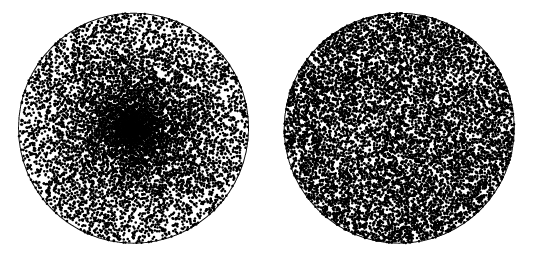
The calculation is done by generating a random polar coordinate and converting
it to X, Y - which introduces an interesting bias in the shots.  Links to two
articles that describe why at the end of email.  Check out
http://mathworld.wolfram.com/images/eps-gif/CircularDistribution_1000.gif for a
picture that's representative of what it can do.  The pattern on left is like
what this code does, the pattern on right what Valve's default code does.

The source code is available at
http://www.orst.edu/~holtt/shot_manipulator.h

You'll see that it has two versions of ApplySpread - one named ApplySpreadBIAS
and the other ApplySpreadVALVE.  ApplySpreadBIAS returns the biased shot
pattern and ApplySpreadVALVE is the default purely random distribution one.
ApplySpread is also defined, and just in turn calls either ApplySpreadBIAS or
ApplySpreadVALVE.

Check out
http://home.wlu.edu/~mcraea/GeometricProbabilityFolder/ApplicationsConvexSets/Problem16/Problem16.html
for an article describing methods of calculating random points in/on a circle
which goes over how the bias can be introduced.  Also see
http://mathworld.wolfram.com/DiskPointPicking.html as well.

_______________________________________________
To unsubscribe, edit your list preferences, or view the list archives, please
visit:
http://list.valvesoftware.com/mailman/listinfo/hlcoders
What about a version that replaces Valve's version with a x = sqrt(r) *
cos(t); y = sqrt(r) * sin(t); etc version? Valve's code has
approximately 1/4 chance of falling outside the circle, and if this
happens, Valve code loops until it falls inside. Doing a sqrt and a cos
may be slower then Valve's way if the the 3/4 chance occurs, but this
could theoretically take an infinite amount of time if the player is
unlucky enough to have all his shots fall within the 1/4 chance. I would
prefer the sqrt/cos way.

--
Jorge "Vino" Rodriguez


_______________________________________________
To unsubscribe, edit your list preferences, or view the list archives, please
visit:
http://list.valvesoftware.com/mailman/listinfo/hlcoders